The text presented here is the unabridged translation of the volume "150 … e passa: La nostra storia, raccontata da noi" ("150 … and counting: Our history, told by us"), published by the Società Filarmonica di Turriaco on the occasion of its 150th anniversary of foundation.
The text is made available here to give the widest possible audience the opportunity to discover the story of one of the most tradition-rich wind bands in Friuli Venezia Giulia.
Through the direct voices of those who lived it, the reader can trace a musical life that has spanned three centuries of history — rooted in the local territory and driven by a shared passion that has made the Filarmonica di Turriaco a point of reference in the regional wind-band scene.
When men make plans, the gods laugh.
We wish to open the book you are about to read with this aphorism, which some believe to be a Greek saying, others a Hebrew proverb (with the second part of the sentence in the singular), and which, in any case, everyone can find quoted in the opening titles of Amnesia by G. Salvatores. No sentence could have proved more prophetic and apt. And now we will explain why.
Quite some time ago, someone noticed that the 150th anniversary of the founding of what everyone here calls la banda de Turiàc — but which, in official documents and reports, is referred to as the Società Filarmonica di Turriaco — was approaching. Band or society as it may be, 150 years of activity undoubtedly represented an important milestone that deserved to be properly celebrated. Plaques, awards, speeches and concerts are all well and good, but these are things we have seen time and again; for this occasion, something special was called for.
The project began rather cautiously with the idea of a photo book. In previous years there had already been exhibitions of images from the past, but a book would represent something more concrete and lasting: photographs and illustrations would always be available and would make an interesting keepsake for friends, guests and visitors.
The idea did not, however, fully convince everyone. Books of that kind already existed in abundance, and a collection of photographs did not seem sufficient to celebrate such an important anniversary. Someone raised the stakes: Why don’t we write a book about the history of the band and include the photographs? The immediate objection was: And who is going to write it? The counter-objection was that, all things considered, writing a book is not an impossible undertaking, and that some of us already had some experience in the matter.
It did not take long for the book project to start taking shape. The Board of Directors gave its approval. A working group was set up, tasked with collecting photographic documentation and drafting the text. A group coordinator was appointed, meetings began, first drafts were circulated — in short, everything seemed to be going smoothly when… Covid arrived! The world we knew, the one we were accustomed to, with its certainties and its routines, suddenly vanished.
The last “normal” event in which the band took part was the traditional Christmas Concert in December 2019. Then everyone learned the meaning of the word lockdown. Rehearsals were suspended, as were lessons at the School of Music and already-scheduled concerts. On Easter Sunday, instead of the usual procession, the band’s greetings to the town were broadcast through the loudspeakers mounted on the Civil Protection vehicles.
In summer, a concert was held in the square, but it felt unnatural. Spectators (few and monitored) seated at a safe distance, each wearing their mask. Band members forced to take the stage also masked, and to play with unusual gaps between them. To allow a wider audience to participate, the event was streamed on Facebook (and this, it must be said, was very much appreciated). In autumn, thanks to the generosity of a couple of friends who made available a much larger venue than usual, rehearsals could resume in preparation for the Christmas Concert — but then the second wave of the pandemic arrived, right on cue.
Despite all these difficulties and setbacks, work on the book managed to press on. 2020 passed, and with it the 150th anniversary. There were no celebrations, of course, but no matter. If the 150th could not be celebrated, we would celebrate the 151st; if that too proved impossible, we would celebrate the 152nd. What matters is knowing that we are still together, that the instruments are always there, even if playing them alone does not have the same flavour as playing them in a group. The band and the Society are still very much alive, and this publication is direct proof of that.
This is a book about our history — a history told by us, as it was passed down to us, as we remember it, and as we wish to pass it on to those who will come after us. It may be a book with a few flaws, and in some respects it may even seem a little naïve, but it is something entirely ours, conceived, written and produced without recourse to intermediaries.
We undertook this work fundamentally for ourselves, to remind us of what we have been and to help us be, as best we can, what we are. But the book was also written with those close to us in mind: for the friends and relatives of the old band members who are no longer with us, for the inhabitants of this town who have known us all their lives and who have followed us, showing their warmth and affection on every occasion, for the colleagues from other bands with whom we have played, for the maestros, singers and choirs we have come into contact with over all these years.
Finally, the book was written also with those in mind who have never heard of us, who do not yet know us and know nothing of the small and great things that have happened here — and who, from reading these pages, will be helped to discover similarities and differences with their own realities.
What we recount we have drawn from the Society’s archive (still largely unexplored), from personal memories, and from what we have read in larger books. Not being historians — either by profession or by inclination — and having no claim to scholarly rigour, we will avoid making painstaking bibliographical references; but we cannot fail to cite, for general background information, two fundamental works about our town: the Storia di Turriaco by Mario Furioso and the Note storiche nella ricorrenza dei 150 anni del Comune di Turriaco by Vittorio Alberto Spanghero, from which we have freely drawn.
In particular, we wish to thank Vittorio for the generosity with which he made available his time, his archive and his knowledge. Alongside these works we wish to mention the manuscript Nel buio del tempo by Silvio Gualtiero Cosolo, which we were generously permitted to read and use, and to express our gratitude to Rinaldo Baldo who, with his meticulous photographic archive, made it easier to document the last decade of the band’s life.
We also wish to thank the Circolo Culturale e Ricreativo don Eugenio Brandl, which allowed us to use some splendid images from its annual calendars, and our friend Fabio Bergamasco, who gave us invaluable help in designing the cover of this volume.
A heartfelt thank-you, finally, to Maestro Maurizio Zaccaria, who sent us the long and affectionate letter which — though trimmed of mention of some events already covered in the text — we have published in the preceding pages.
It may, however, come as a surprise not to find an author’s name on the title page. From the very beginning we decided there would be no I, but that the work would be done by us. Every single word, regardless of who may have written it, was read, discussed and commented upon within the working group, and every single decision — on topics to cover, how to present them, which photographs to include, which quotations to insert, and so on — was taken by common agreement.
In the hope that what follows may reawaken your memories, rekindle your interest, or simply arouse your curiosity, we wish you happy reading.
The working group:
Andrea Baldo
Massimiliano Brumat
Marina Canciani
Marco Cerni
Danilo Fum
Sergio Passon
NOTE. When this work was already complete, Silvio Gualtiero Cosolo passed away suddenly — former president of the Filarmonica and its living historical memory. His loss leaves in each of us a void that is hard to fill. With his three-quarters of a century of service to the band, Silvio played a fundamental role in the history we are about to tell — a history we chose to leave unchanged, even where Silvio is spoken of in the present tense. It is the way we have chosen to remember him and to make him feel still among us.
Turriaco is not a famous place. There is no Battle of Turriaco, no Treaty of Turriaco, and no Armistice of Turriaco. No culinary specialty bears a Protected Designation of Origin tied to the town. There are no prestigious monuments or notable buildings. Nothing of the sort. At the time of writing, there is a Turriaco sofa, produced by a firm that once styled itself “artisans of quality” but has lately—one does not, after all, argue with artisans—preferred to update its motto (or payoff, as aficionados of management-speak would have it). Since Travesio, Venzone, and a few dozen other Italian municipalities have also lent their names to sofas, this hardly qualifies as a distinguishing feature.
If you ask someone where Turriaco is, the answer may not be far removed from the exchange between Nino Manfredi (M) and Stefania Sandrelli (S) in Ettore Scola’s C’eravamo tanto amati (We All Loved Each Other So Much):
M: And where are you from?
S: From Trasaghis
M: Ah, lovely—and where’s that?
S: Trasaghis, right? Near Peonis.
M: Ah, in Sardinia!
If this doesn’t register and isn’t making you laugh—perfectly understandable if you are not from Friuli—knowing that Turriaco lies between Pieris and Cassegliano would not help much either. Perhaps it is better to start from the beginning.
If you look up Turriaco in the Italian version of Wikipedia (we did), you will find:
Turriaco is an Italian municipality of 2,857 inhabitants in Friuli-Venezia Giulia. It is part of the Bisiacaria.
The population figure may vary—the last time we visited the page, it was 2,860—which means that someone (or, more likely, something) is meticulously keeping it up to date. Everything else remains unchanged, including an aerial photograph of the town that reveals very little, and which we have chosen to replace with the splendid drawing by Aldo Bressanutti shown below. The first thing we learn is that we are not looking at a metropolis. It is a small town, like thousands of others, in the far northeast of Italy, in Friuli-Venezia Giulia.
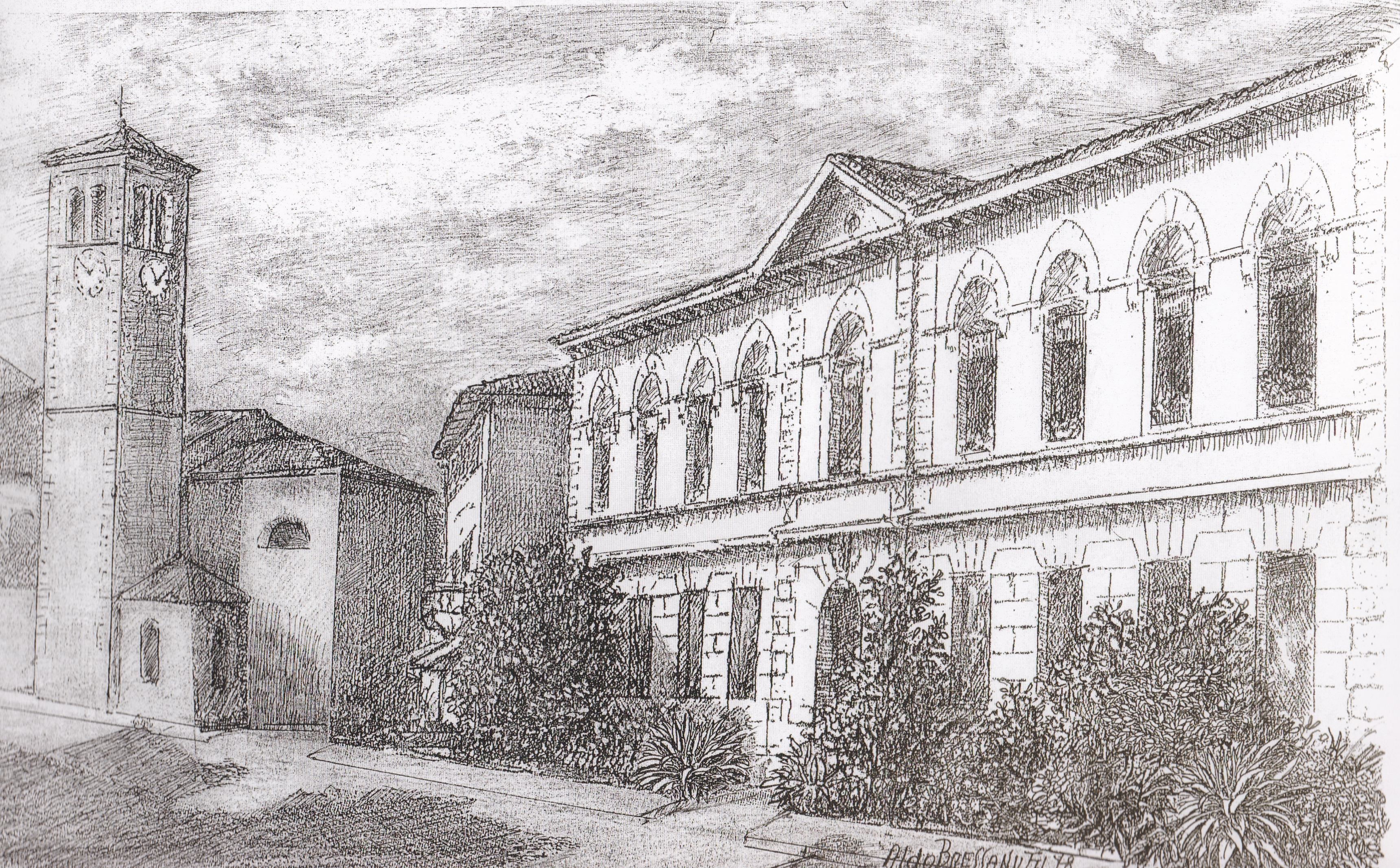 Turriaco: Church and School, now Town Hall (drawing by A. Bressanutti)
And this is where the problems begin. First problem: pronunciation. If you want to antagonize the people of this region, all you have to do is call it Frìuli (stress on the i) rather than the correct Friùli (stress on the u). Nobody here has ever said—or will ever say—Frìuli; the pronunciation is considered almost offensive. The rest of Italy discovered these lands at the time of the 1976 earthquake. On television, Frìuli was heard everywhere. Canepari’s DiPI (Dictionary of Italian Pronunciation) duly took note: after giving the modern, correct, and recommended pronunciation Friùli, it also listed Frìuli as an acceptable alternative, fairly widespread in Central Italy (Tuscany, Umbria, Marche, Lazio) and used by a sizable number of broadcasting professionals.
Evidently Central Italian speakers and broadcasting professionals alike began visiting the region more frequently and soon learned, firsthand, how their pronunciation was received. The DiPI took note. In the current online edition, the Frìuli option has been downgraded to tolerated. A little more patience and we may yet see it relegated to neglected—and therefore to be avoided. (As we know, dictionaries never forbid; they simply record.)
Second problem: the hyphen. To include it or not? The question has become a bone of contention, and where you stand on it says a good deal about your broader sympathies.
In the Constitution of the Italian Republic—as promulgated on January 1st, 1948—Friuli-Venezia Giulia (with a hyphen) is mentioned in Article 116 and Article 131. After the constitutional amendments of 2001, the hyphen disappears from Article 116 while remaining in Article 131. In Article 1 of the Regional Statute, the hyphen is present; yet after 2000 it no longer appears in the Regional Bulletin or in any of the Region’s official documents and letterheads. In acts of the Parliament, as well as those of the Constitutional Court, the hyphen is found almost invariably, though some ministries omit it. Mere typographical variants? Not exactly.
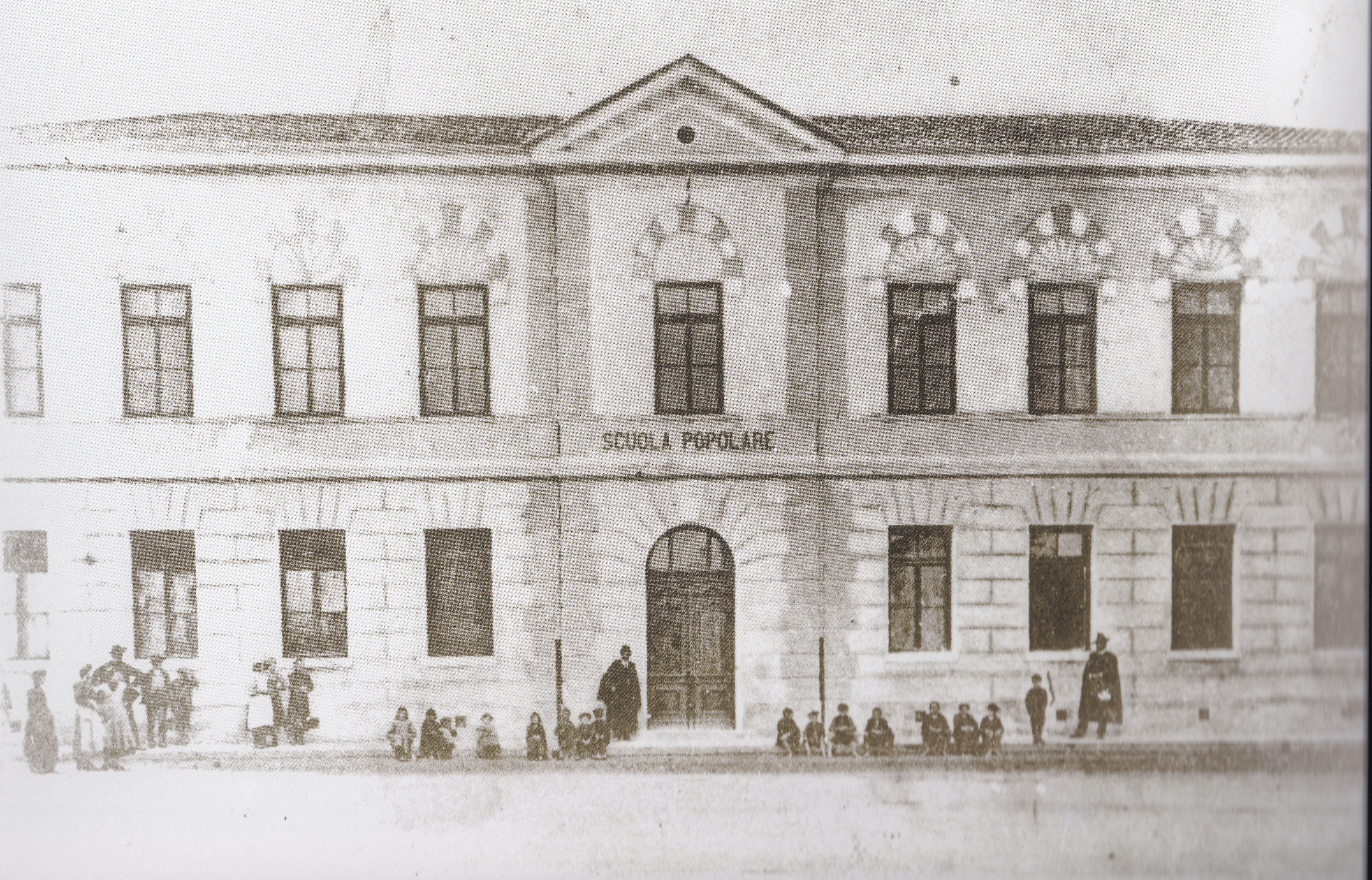 Turriaco: the Scuola Popolare
The point is that, according to the Enciclopedia Italiana (aka: the Treccani), the hyphen is a punctuation mark placed between two distinct graphic units, serving multiple functions—among them conjunction, whether to indicate union or alternation. In plain terms, writing Friuli-Venezia Giulia implies an administrative unit composed of two distinct parts—Friuli and Venezia Giulia (just as Trentino-Alto Adige is universally understood, without anyone taking issue with it). Writing Friuli Venezia Giulia, on the other hand, implies a single unified entity, inhabited by people whom—in a neologism of truly appalling ugliness—someone once attempted to call friulangiuliani.
As you can see, a question of punctuation can easily become a political one. Are Friuli and Venezia Giulia a single entity (without a hyphen, as the Region prefers), or is it simply an administrative union of two realities that—divided by language, history, and tradition—were artificially merged and could just as easily be pulled apart again, giving autonomists on both sides the opportunity to fight over who gets what?
Assuming everyone knows what Friuli refers to, the term Venezia Giulia is rather less self-evident. It was literally invented—along with Venezia Euganea and Venezia Tridentina, designations long since fallen into disuse and now surviving only in the weather-forecast expressions Triveneto or le tre Venezie—by the eminent philologist Graziadio Isaia Ascoli, a native of Gorizia. Ascoli coined the name to designate the region comprising the city and territory of Trieste, the Princely County of Gorizia and Gradisca, and the Margraviate of Istria. Through this name, he sought to assert the Italian character of these lands even at the toponymic level, in deliberate opposition to the designation Austrian Littoral (Österreichisches Küstenland) used in official documents.
In an article titled Le Venezie (The Venices), published in 1863 in the Milanese periodical Museo di famiglia, Ascoli wrote (translated from his 19th-century Italian):
In certain circumstances, names are more than words. They are raised banners—powerful symbols through which ideas gain strength and events are shaped. […]
We shall call Venezia Propria the territory enclosed within the current administrative boundaries of the Venetian provinces: we shall call Venezia Tridentina or Retica —better Tridentina —that which descends from the Tridentine Alps and may have Trento as its capital; and Venezia Giulia shall be for us the province that, between Venezia Propria and the Julian Alps and the sea, encompasses Gorizia, Trieste and Istria. In the collective designation le Venezie we shall then have a name that, by a felicitous ambiguity, classically refers to Venezia Propria alone, and could therefore stand, from now on—cautiously bold—on the lips and in the dispatches of our diplomats.
We are confident that this designation will be well received by the populations—Tridentine and Julian—to whom we mean to offer it, and who will feel its full truth. Trieste, Rovereto, Trento, Monfalcone, Pola, Capodistria speak the tongue of Vicenza, of Verona, of Treviso; Gorizia, Gradisca, Cormons speak that of Udine and Palmanova. We have, in particular, every reason to be confident that the splendid and most hospitable Trieste will bear with pride the name of Capital of Venezia Giulia.
The name Venezia Giulia fell out of official use after the Second World War, by which time Italy retained of Ascoli’s original Venezia Giulia nothing but fragments of the old provinces of Gorizia and Trieste. The name Friuli-Venezia Giulia (with a hyphen), as enshrined in the Constitution, was proposed by the Friulian deputy Tiziano Tessitori and chosen over the designation Regione giulio-friulana e Zara championed by the Triestine Fausto Pecorari. In reality, much of what was intended to be Venezia Giulia lay outside Italy’s national borders. Until 1954, Trieste was part of the Free Territory of Trieste, whose Zone A—the portion later returned to Italy—was administered by the Allied Military Government.
The autonomous region of Friuli-Venezia Giulia, though provided for in the Constitution of 1948, was officially established only in 1963. At that time it comprised the vast province of Udine and the two small provinces of Trieste and Gorizia. In 1968, the province of Pordenone was carved out of the province of Udine.
And the hyphen?
The hyphen, of course, continues to fuel debate, and will do so for a long time to come—in this prediction we feel we are on safe ground. The discussion has attained levels of refinement that would put Byzantine theologians to shame. Consider this (a news report from 2014):
The provincial council spends an hour and a half discussing the hyphen to be restored to the official designation “Regione Friuli-Venezia Giulia.” That hyphen, according to Federico Simeoni (Front Furlan), who tabled a motion subsequently shared and approved by other councillors during the debate, carries a far deeper significance, for what is at stake is the identity of Friuli—an identity already erased by the 2001 reform, when the hyphen was removed from the regional designation, while the autonomous regions of Trentino-Alto Adige and Valle d’Aosta were given the addition of the name in the most widely spoken minority language (Südtirol and Vallée d’Aoste).
And this one:
The Regione Friuli-Venezia Giulia is a kind of Tanzania—that is, a geographical invention, composed of a reality that is Friuli and a memory that is Venezia Giulia.
To be brief about it: whether to hyphenate or not is a matter of vincoli o sparpagliati—“tied together or scattered”—as the Italian comedian Pappagone used to put it (younger readers are invited to consult their elders). Being, among other things, rather lazy, we come down on the side of vincoli and omit the hyphen; readers may do as they please. This does not change the fact that within the regional territory two genuinely distinct areas can be identified. Udine is unquestionably Friuli; Trieste is unquestionably Venezia Giulia; Pordenone is Friuli, even if some areas along the region’s western border might, by language, history, and tradition, reasonably be claimed for Veneto; on Gorizia, the debate may be opened.
According to some, the former province of Gorizia should be assigned, tout court, to Venezia Giulia, while history and geography testify to a completely different reality. This area has always been part of Friuli, whose borders are defined by the Alpine watershed to the north and east, the Adriatic Sea to the south, the River Livenza to the west, and the mouth of the River Timavo to the southeast.
It will come as no surprise that the passage above is drawn from the periodical Il Friuli and reflects, accordingly, what might be termed an annexationist position. Readers may form their own judgment on the historical argument by reading what follows; as for the geographical one, a measure of skepticism seems warranted.
The territory of the former province of Gorizia (we use “province” as a matter of convenience: in 2017 the Regional Council, drawing on its status as an autonomous region and seeking to pre-empt a constitutional reform that was subsequently rejected, abolished the province as an administrative entity) is traversed from north to south by the River Isonzo, which, in its final stretch before emptying into the Gulf of Panzano, also marks the boundary with the province of Udine. It is no coincidence that the term Isontino —used as a noun, l’Isontino—is the one locals prefer when naming their own territory.
The Isonzo creates a division between two well-defined linguistic areas. Since television finally made Italian a spoken rather than merely written language, everyone has been able to communicate with everyone else without excessive difficulty. When at home, among friends, in the square, and in the taverns, however, on the right bank of the Isonzo the language spoken is Friulian (which the Friulians are proud to call a proper language, not a dialect—and on that point we close the discussion at once, fratricidal wars being easy to start and hard to stop). On the left bank the situation is more complex and depends on … altitude. On the heights of the Collio and the Karst, variants of Slovenian dialects are spoken, while in the plain the language is Bisiac. For we are in the Bisiacaria.
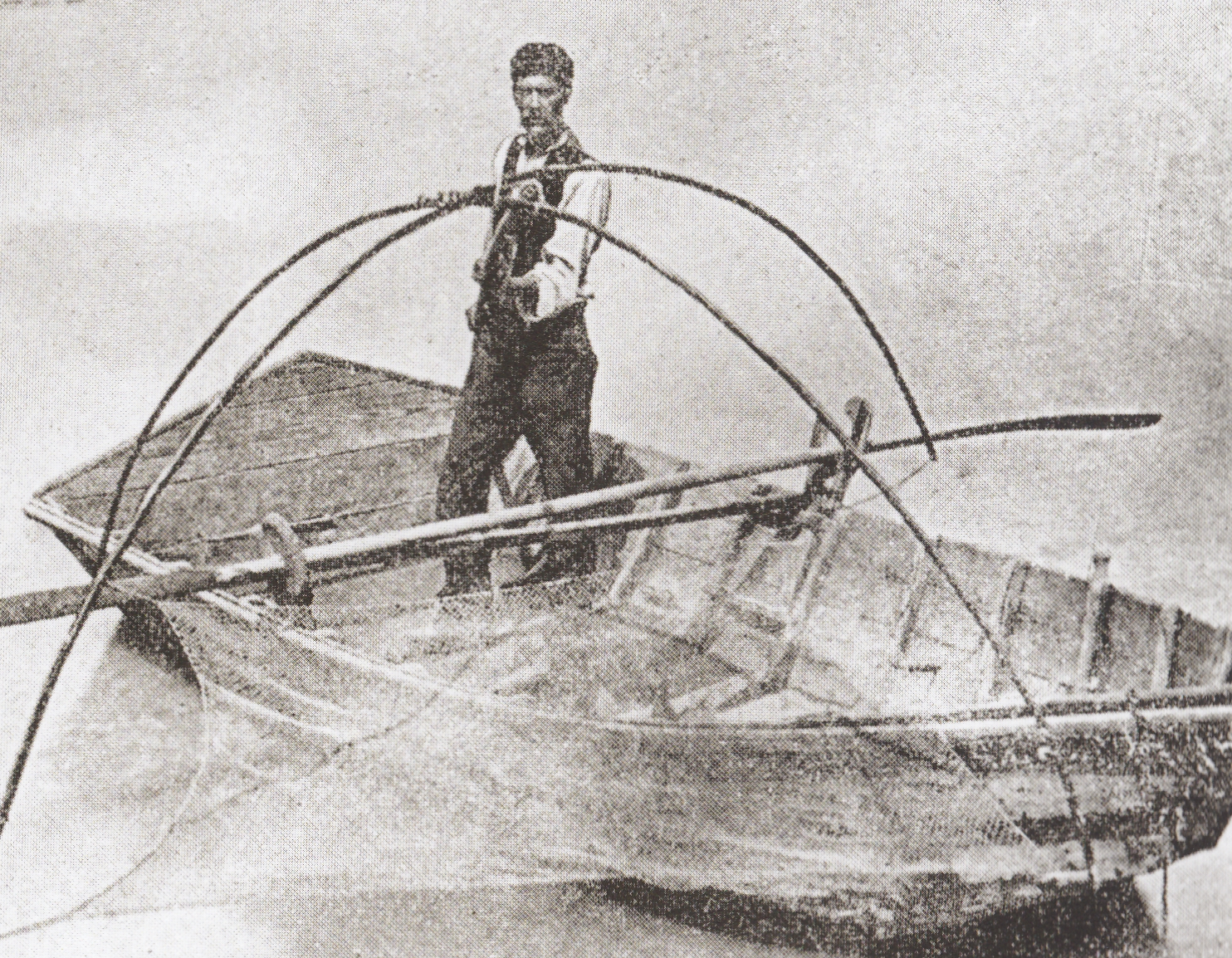 Fishing in the Isonzo at the end of the 19th century
By Bisiacaria (stress on the last i) we mean the triangular territory—oriented vertically, balanced on one of its vertices—that makes up the southern portion of the province of Gorizia, bounded by the course of the Isonzo, the Adriatic Sea, and the heights of the Karst Plateau.
It covers roughly 130 square kilometers, is almost entirely flat, and comprises—in addition to Turriaco, our primary concern—the municipalities of Monfalcone, Ronchi dei Legionari, Staranzano, San Canzian d’Isonzo, San Pier d’Isonzo, Fogliano Redipuglia, and Sagrado.
Whether Sagrado properly belongs to the Bisiacaria has been debated on more than one occasion—presumably when nothing more pressing demanded attention. Geographically there is no doubt: we are on the left bank of the Isonzo. Historically, under an agreement between Empress Maria Theresia and the Republic of Venice, Sagrado was assigned to Austria in 1752, and to travel from Sagrado to Fogliano—or the other way around—one had to reconcile oneself to crossing a border. If, walking along Regional Road 305 (taking care not to be run over by passing cars) you look carefully at the roadside verge, you can still make out the boundary marker (known locally as el cunfìn) that once divided the two states.
The principal center of the Bisiacaria is Monfalcone. As is easy to guess, the town takes its name from Monte Falcone, on whose summit stands the Rocca, its most celebrated monument. To call a rise of less than 150 meters a mountain may seem excessive, but that is the name and there is no point in making easy jokes about it. The city overlooks the Gulf of Panzano, where the Adriatic—and with it the entire Mediterranean—reaches its northernmost point. Through the Valentinis canal, the sea penetrates to the very heart of the town, reaching as far as the intersection of Viale Cosulich and State Road 14.
Monfalcone is known as the city of the shipyards, and owes everything—for better and for worse—to its cantièr: the shipyard around which, for many decades, its life and the life of much of the Bisiacaria revolved.
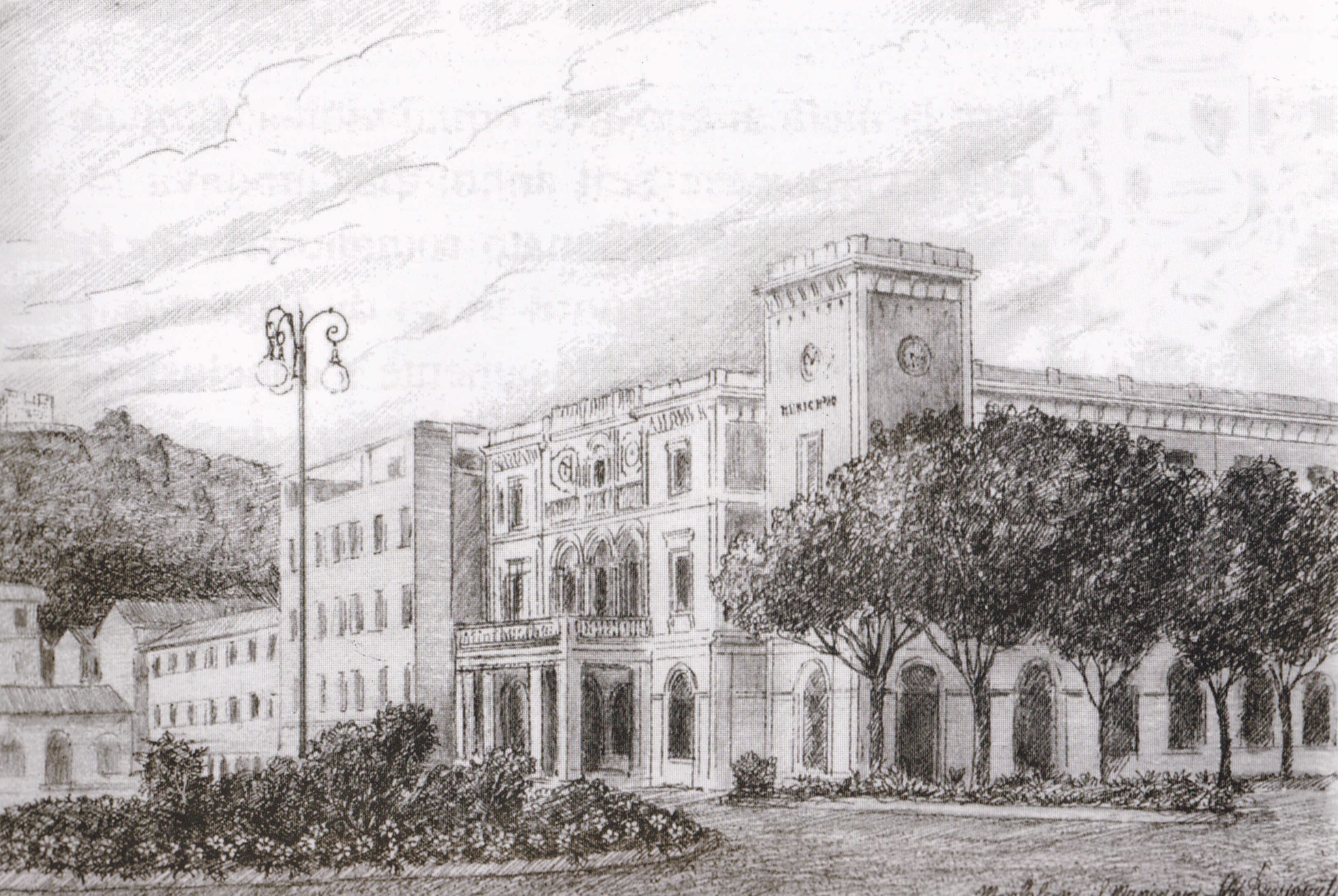 Monfalcone: the Town Hall (drawing by A. Bressanutti)
A little over a century ago, Monfalcone was a small town of some 4,000 inhabitants, set in an area plagued by mosquitoes and malaria. In 1908, the brothers Callisto and Alberto Cosulich—shipowners from the island of Lussino and co-proprietors of the Austrian Navigation Union comprising the Austro Americana and Fratelli Cosulich lines—chose those marshlands as the site for the Cantiere Navale Triestino. The yard has since passed through several changes of name and ownership, arriving at its current designation of Fincantieri—Cantiere navale di Monfalcone, and has become one of the most celebrated and important shipbuilding facilities in the world.
From its slipways and dry docks have emerged vessels that made maritime history. We mention only a few names: the steamship Kaiser Franz Joseph (in the Habsburg era) and the sister ships Saturnia and Vulcania (before the Second World War), the ocean liners Giulio Cesare, Galilei, and Marconi (after the war), the submarines Toti, Sauro, and Dandolo, the aircraft carrier Garibaldi, and, passing over various tankers and supertankers, the cruise giants of the Princess and Carnival lines.
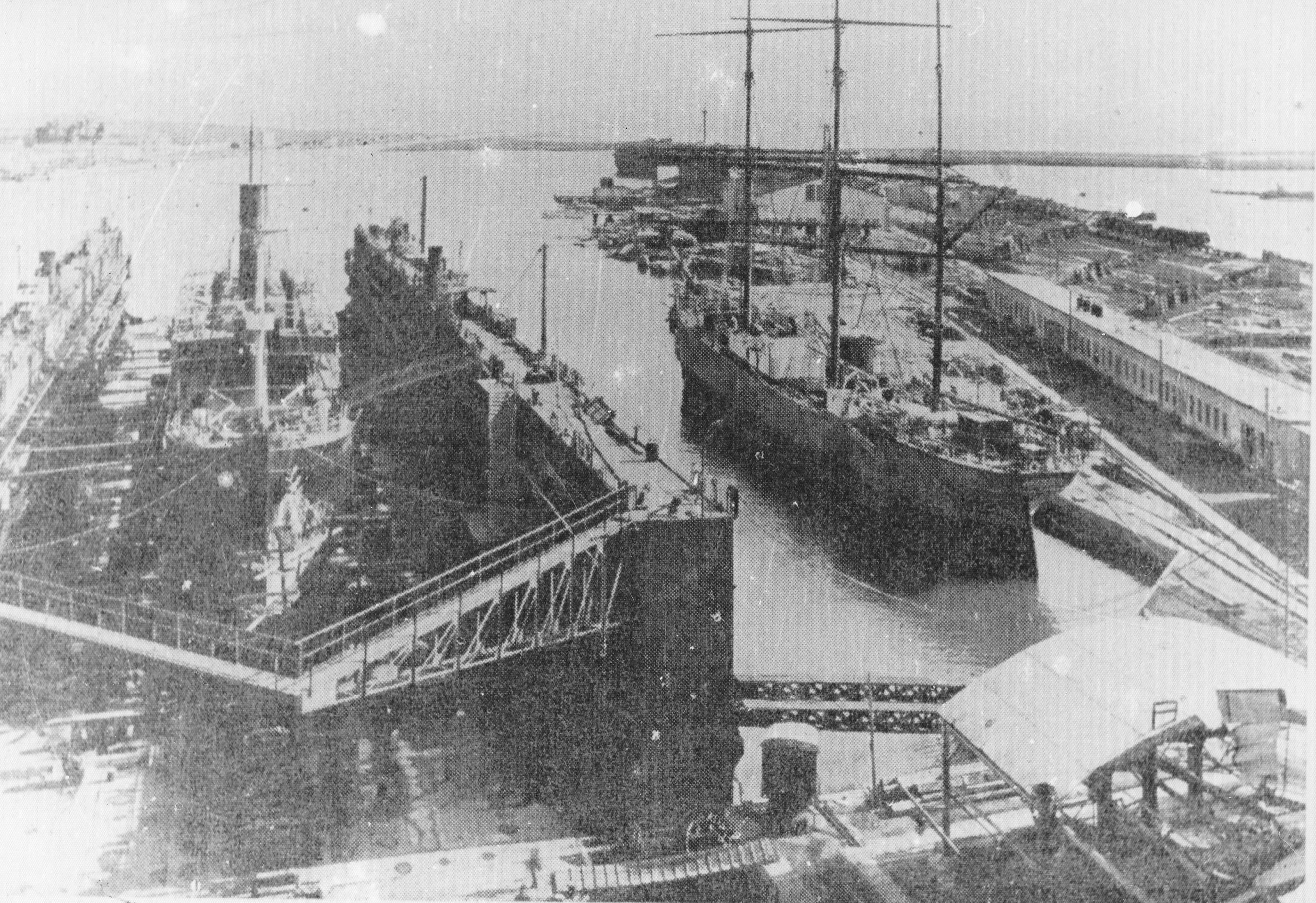 Monfalcone: the shipyard in 1909
The opening and expansion of the yard triggered, from the very outset, large-scale immigration. Among the first to arrive were the British. The Cosulichs, accustomed to having their ships built in British yards, planned from the start to employ those same skilled workers at home. Then came workers from Istria, Dalmazia, and the Slovenian karst hinterland. After the war it was the turn of southerners—largely from Puglia and Campania—whom the Monfalconese, without troubling themselves too much over geography, lumped together under the generic term cabibi, a label which, though hardly politically correct, carried no specifically racist connotation. Now it is the turn of yet another wave of immigration, which has brought over 2,000 people from the Bay of Bengal to the Gulf of Panzano—prompting some local wits to describe Monfalcone as the most beautiful city in Bangladesh.
With foreign residents now accounting for 22% of the population, coexistence is not without its complications. The Monfalconese grumble, naturally, that the city is no longer what it once was, but have by and large learned to live alongside the newcomers. There are no particularly visible frictions or open tensions, but neither is there much integration. The new Monfalconese have introduced cricket and a range of spices whose very existence was previously unknown in these parts. The older residents hold on to their local glories: Gino Paoli, Elisa, and Paolo Rossi—not the lamented striker who scored three goals against Brazil, but the comedian who could not resist making a celebrated quip about his hometown: Whoever sings “Com’è triste Venezia” (How sad is Venice) has clearly never been to Monfalcone.
Monfalcone borders Staranzano and Ronchi dei Legionari.
On Staranzano, Wikipedia has this to say:
Although heavily influenced by the neighboring municipality of Monfalcone, Staranzano, compared to the towns further south in Friuli-Venezia Giulia, is far less busy and more tranquil. It has many open areas including cultivated fields…
Right, we take the point. Let us say that Staranzano is the place where many Monfalconese, or would-be Monfalconese, have chosen to live in order not to breathe lead all day. The municipality has always been regarded as something of an annex to its larger neighbor. Never particularly ambitious—Ronchi has ambitions enough for both—it has coexisted tolerably well with a mildly condescending neighbor that has always looked down on it a little, though, all things considered, relations have remained perfectly agreeable.
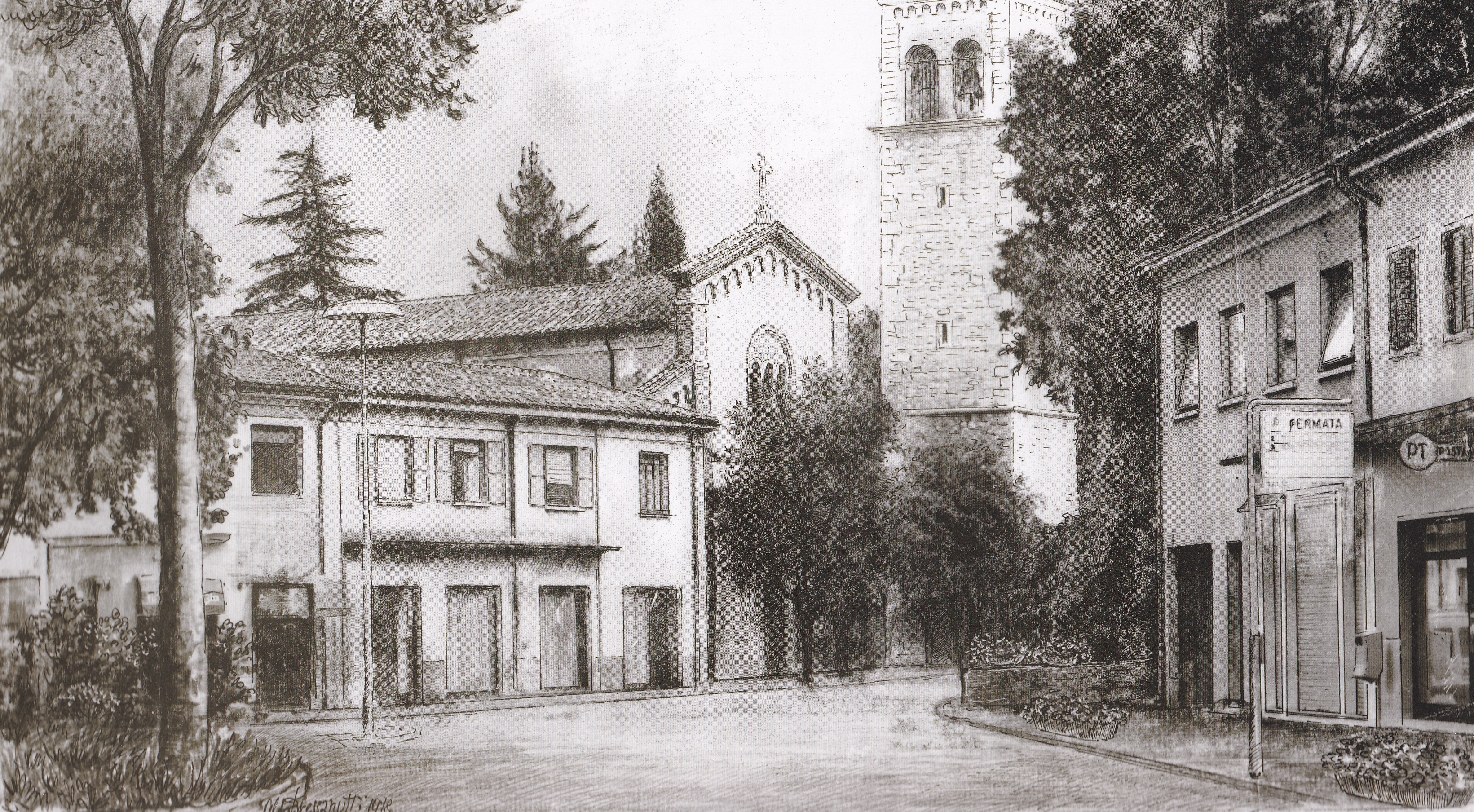 Staranzano: Church of Saints Peter and Paul ( disegno di A. Bressanutti)
For a start, the boundary between the two municipalities is effectively invisible. If from the Anconetta intersection you take Via Terenziana and continue for about half a kilometer to the southwest, you reach Via Trieste. Keeping to the right side of the road you are in Monfalcone; stay on the left and you are in Staranzano, more precisely in the hamlet of Villaraspa.
In the old days, moving from the main village to the outlying hamlets meant reaching almost exotic destinations. You would cycle to Bistrigna and already smell the sea. To Dobbia you went at most once a year—on November 4, for the feast of St. Charles. Dobbia was home to a handful of families, but it had—and still has—a seventeenth-century chapel, scarcely larger than a studio apartment, built by the Susanna counts. When violent storms approached or devastating hailstorms threatened, the population would hurry to the church and ring the little bell. The therapeutic effect, they say, was guaranteed.
Some years ago, a zealous clergyman conceived the idea of moving the statue of St. Charles from the center of the chapel—where it had always stood—to the side of the altar. All hell broke loose. There was a popular uprising: petitions, letters, appeals to conciliar rulings interpreted in whatever manner was most convenient (on the basis that such rules, naturally, applied only to newer churches), and so on. In the end, St. Charles remained in his place, and there he still stands.
What soul Staranzano possesses resides in its hamlets. The center has paid its dues to modernity by acquiring new facilities and services, but at the cost of a creeping anonymity. When the bobolàr—the legendary, magnificent hackberry tree that stands at the heart of the village and is its symbol—finally succumbs entirely to fungi and various diseases, the transformation will be complete.
Ronchi dei Legionari is famous for two things—or rather, three.
First: the legionaries. It was from Ronchi that Gabriele d’Annunzio set out on September 12, 1919 to occupy the city of Fiume. The event left the townspeople relatively unmoved; they did not so much as erect a monument to mark the enterprise. Rather than appear entirely ungracious, they were eventually persuaded to place a plaque on the house where the poet burning with fever and heroic resolve had awaited the radiant dawn, and so on and so forth. The event, in short, did not move them unduly. They have grown accustomed to the dei Legionari appended to the town’s name and are not inclined to part with it, since the alternative—Ronchi di Monfalcone—holds little appeal.
A few years ago someone proposed changing it to dei Partigiani (of the Partisans, the Italian Resistance fighters). The usual debate ensued, the usual intellectuals weighed in, the usual conference was held, the usual book was duly published. Once the liturgies were concluded, the mayor (of the leftist Partito Democratico), after duly recalling the gold medal pinned to the municipal standard in memory of the struggle against Nazi-fascism, concluded: One cannot tug history by the lapels—and the proposal died there.
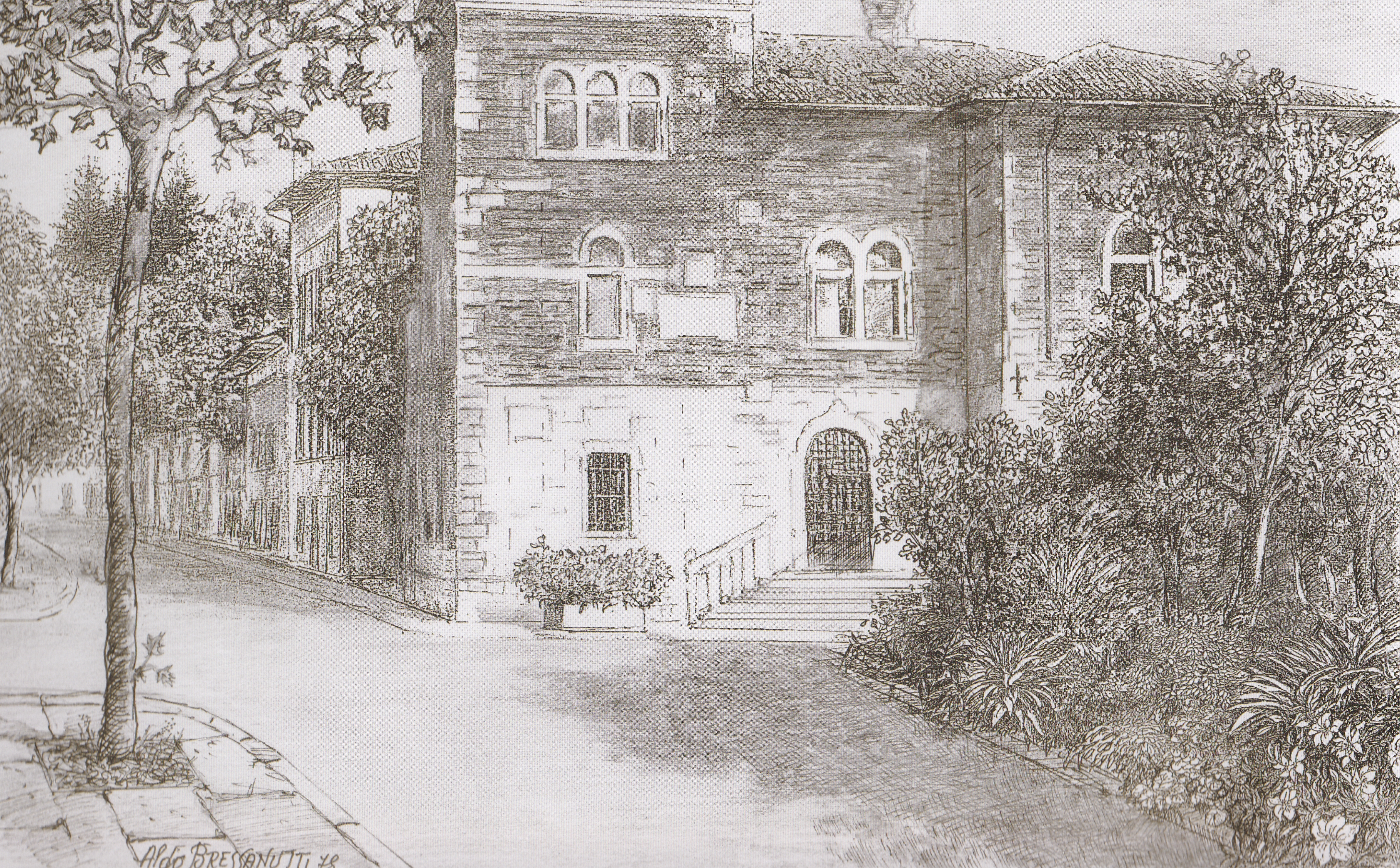 Ronchi: the Town Hall (drawing by A. Bressanutti)
It is remarkable that, on matters of place names, the people of Ronchi are anything but conservative. From the local daily, in 2015:
In the coming weeks, the Municipality will name after Francis Joseph I, Emperor of Habsburg-Lorraine, the small square behind Villa Vicentini Miniussi, which will be adorned with a mosaic recalling the bond between the town of the Left Isonzo and the Kaiser.
A second historical note on Ronchi. It was at an inn in the village that Guglielmo Oberdan was arrested while attempting to smuggle from Rome to Trieste two bombs with which he planned to make an attempt on the life of Francis Joseph, who was then visiting the fidelissima—the title bestowed on Trieste by the Habsburg monarchy in recognition of its abstention from the revolutions of 1848.
And that is enough history. Let us turn to the present. In recent years, Ronchi has become the home of Bisiac curling. Curling—an Olympic winter sport—is the game that resembles bocce: large granite stones are slid along an ice rink toward a target while players sweep frantically with brooms to guide their progress.
In 2013, with an ice rink set up for Christmas skating, someone had the idea of organizing a curling tournament. There was one small problem: each stone costs around a thousand euros—well beyond the budget of such an initiative. Hence the inspired solution: replace the stones with pressure cookers. The shape is broadly similar, the dimensions comparable, and there is even a handle that recalls the original. Before dismissing this as a prank, consider that La Gazzetta dello Sport daily sports newspaper and three RAI television channels covered it, and that the most recent tournament attracted 64 teams.
Monfalcone, Staranzano, and Ronchi dei Legionari form a single conurbation of roughly 50,000 inhabitants. The remaining municipalities share the other 15,000 who populate this territory. Turriaco will naturally be given a section of its own. It remains to say something about the two other municipalities of the Bisiacaria that border Turriaco—San Canzian d’Isonzo and San Pier d’Isonzo—and about the remaining municipality: Fogliano Redipuglia.
San Canzian d’Isonzo—Sa(n)cansiàn in Bisiac, the n being optional, pronounced by some and dropped by others—is the largest municipality in the Bisiacaria and the only one in which, alongside Bisiac, Friulian is also spoken. The hamlet of Isola Morosini, lying on the far side of the Isonzo, is indeed Friulian-speaking. (In theory a variant of Friulian, the sdraussenàr, is also supposed to be spoken in Poggio Terza Armata, in the municipality of Sagrado, but virtually no one seems to have noticed.)
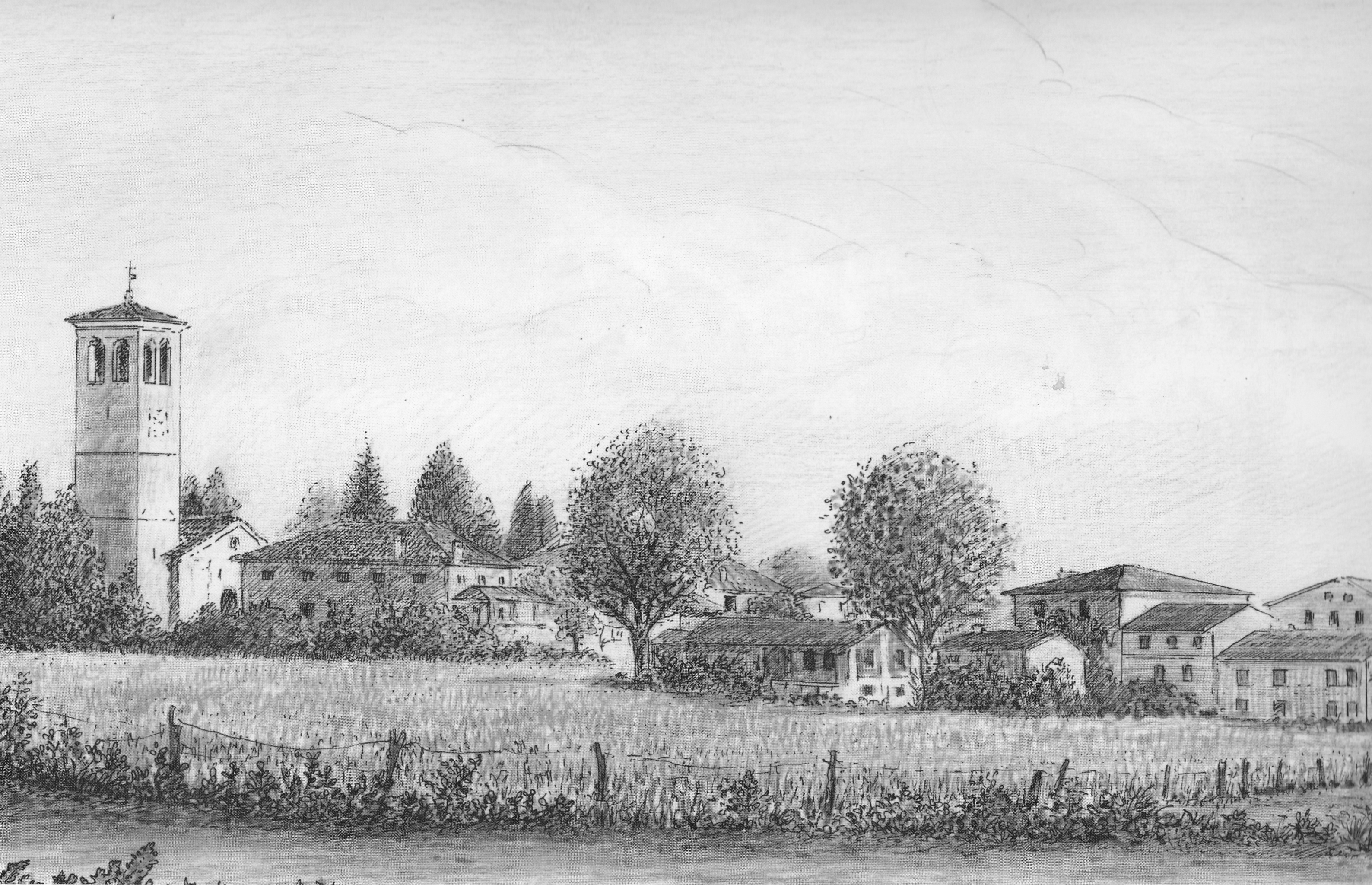 San Canzian d’Isonzo (drawing by A. Bressanutti)
Another distinctive feature of San Canzian d’Isonzo is that, although the municipality takes its name from the principal locality, the town hall is located in the hamlet of Pieris—a circumstance that allows the people of Pieris to look down on the others, if only slightly.
Another hamlet is Begliano, which we mention for a very simple reason. Until a few years ago, the municipality had three soccer clubs—Pieris, Begliano, and S. Canzian—and all three found themselves in the same group of the same division. When Begliano played Pieris—the two villages being separated by a distance coverable in ten minutes by bicycle, without breaking a sweat—the visiting side chartered a bus for the road game, so that a winning result could be celebrated without incident on the ride home. Things have since changed, and though many regarded this as a sin against nature, since 2014 the U.S.D. San Canzian Begliano has been a single club.
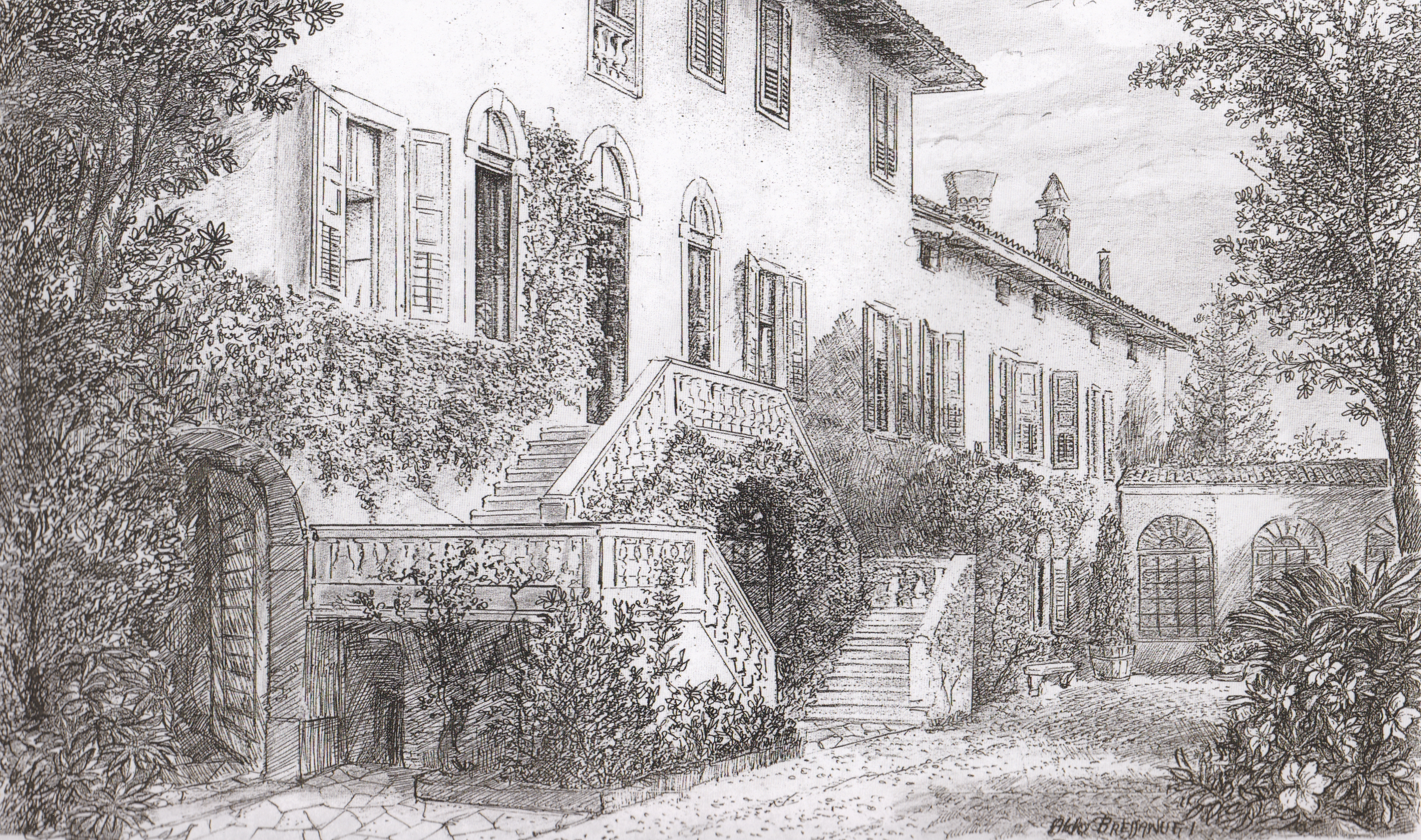 Begliano: Villa Fabris (drawing by A. Bressanutti)
San Canzian also has the greatest historical pedigree in the area. In Roman times, the Via Gemina, linking Aquileia with Istria, passed through this area—more precisely through Aquae Gradatae, whose ancient name survives today in the locality of Grodate. Here, according to tradition, the holy martyrs Cantius, Cantianus, and Cantianilla were put to death by order of Diocletian. The remains of an early Christian basilica have been discovered nearby, along with a tomb containing skeletal remains identified as those of three related individuals. It is also held, by tradition, that one of the nine purple dye-works that operated in Italy was located here—though the ground here is somewhat slippery: the claim rests on a locally discovered inscription mentioning purpurarii, which more than a few scholars interpret as sellers, rather than producers, of purple dye.
And now for San Pier d’Isonzo. The village is dominated by a majestic bell tower—the pride of its residents—which houses the largest bell in the Bisiacaria. Fitting enough: the Pieve of San Pier has been the most important church in the area for centuries. In the 13th century, S. Petri Ultra Soncium (beyond the Isonzo, the locality being seen from the perspective of the Patriarchate of Aquileia) encompassed the villae of Sagrat, Fogliani, Polaz, Rodopoglia, Casegliano, Buselj, Turjach, Sachozana, mezo Pieris, and mezo S. Joanuto.
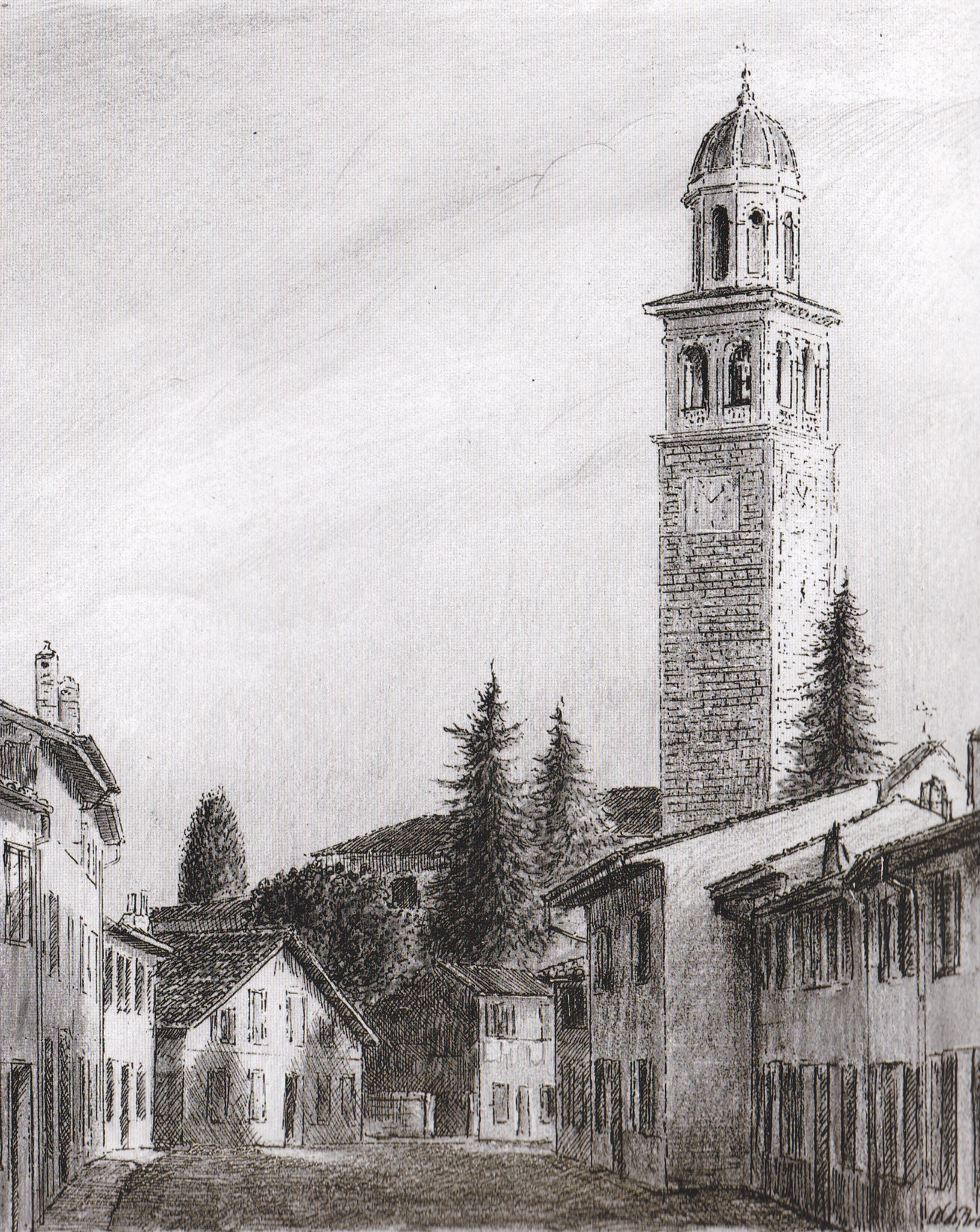 San Pier d’Isonzo (drawing by A. Bressanutti)
Locals will have little trouble identifying most of these place names, though Sachozana is a genuine puzzle. Even Puntin—author of a weighty Dictionary of Historical Toponymy of the territory of Monfalcone and the municipality of Sagrado—can offer no definitive answer. After listing all the documents in which this name appears (the earliest dating to the 13th century, the last to 1666), he writes:
The ancient place name seems to evoke the Slovenian hagionym Skocjan (San Canziano), but its precise meaning eludes us: perhaps a Slovenian “ethnic” Skocjani, “those of St. Canzian”, alluding to a small settlement of farmers originating from that nearby locality. In any case it is the name of a village (though more probably a hamlet) situated in a location that cannot be determined precisely within the territory of Turriaco or Pieris. Devastated by one of the many Isonzo floods (perhaps that of 1490), it gradually vanished from the documents, leaving a trace only in those dealing with old questions of ecclesiastical jurisdiction and rights. […]
Among the hamlets of San Pier d’Isonzo we find Cassegliano. Popular etymology traces the name back to the gens Cassia, some of whose members had presumably made their way to these parts. Discoveries of mosaic fragments, coins, bricks, and amphorae testify to a Roman presence in the territory.
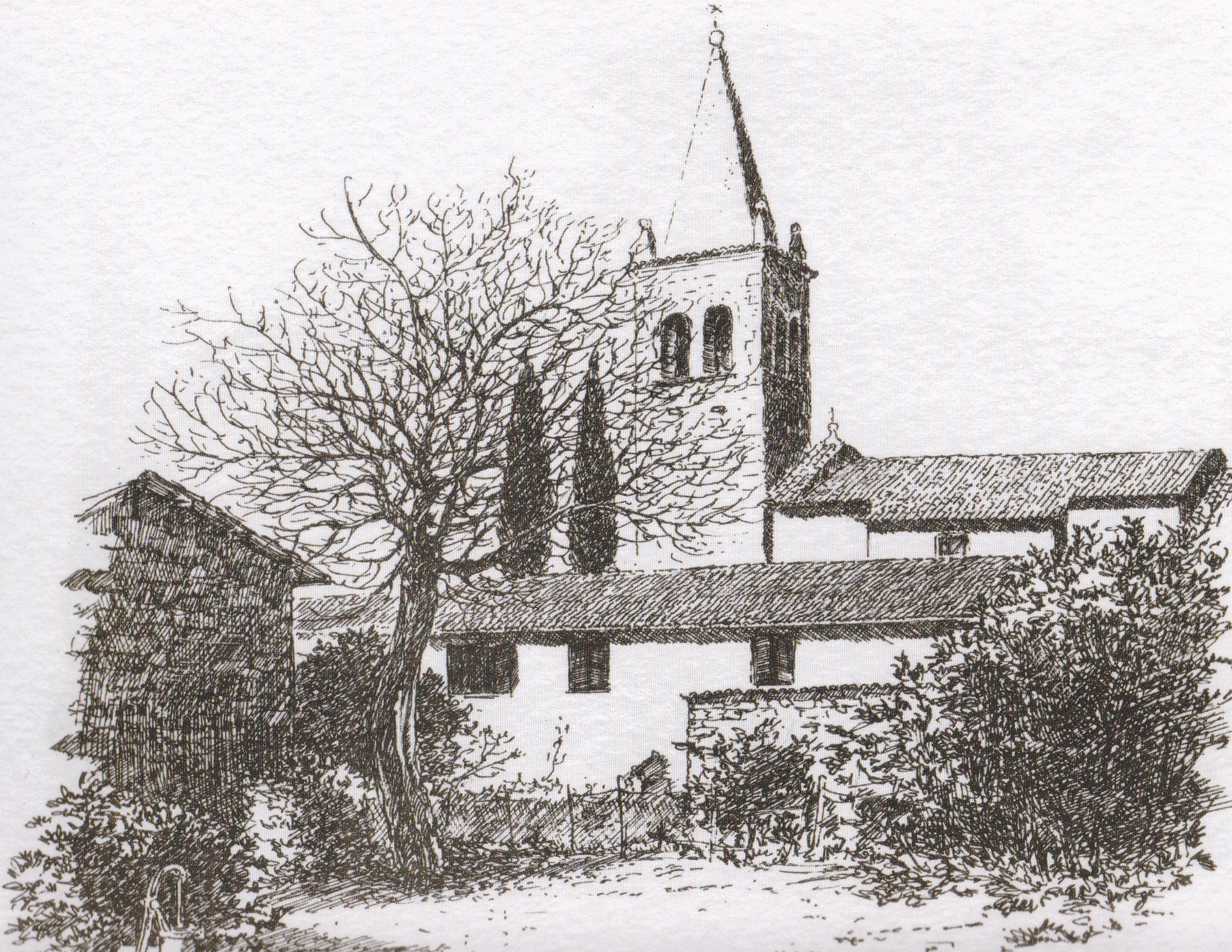 Cassegliano (drawing by A. Bressanutti)
Worth noting in passing is a tendency common to this part of the world. Many villages derive their names from supposed Roman legionaries or families who settled in the area. Besides Cassegliano, which claims descent from the gens Cassia, there is some Terentius at the root of the name Staranzano (whose soccer club is called Terenziana), a Furius for Fogliano, and, as we shall see, a Turius for Turriaco. These attempts to ennoble one’s origins recall those of people who, for a few dozen euros, commission a family coat of arms. Harmless enough, as long as they are not taken too seriously. Rigorous etymological inquiry, such as that conducted by Puntin, demolishes most of these hypotheses—with the one possible exception of Fogliano, which may derive from a praedium Folianum, and thus from a cognomen Folius.
Cassegliano was a crossing point on the Isonzo. Rafts ferried travelers between the banks, and the right to collect the toll had been granted to the Sbruglio counts of Udine, who also held the monopoly on navigation over the river’s final stretch. The crossing attained its greatest importance in the 18th and 19th centuries, as the only link between Central Friuli and Trieste, which, following the creation of the Porto Franco (Free Port), was steadily growing in significance. The construction of the Sagrado bridge in the mid-19th century greatly reduced traffic at the crossing, though the ferry service remained in operation until the early years of the last century.
Among the municipalities of the Bisiacaria, the best known nationally is certainly Fogliano Redipuglia (no one here has ever dreamed of inserting a hyphen). Fogliano is the home of zuf, where the z is not a z at all, but is pronounced like the voiced s in English rose. El zuf (not Arabic—it’s Bisiac!) is a soup that could not be more frugal, and every family jealously guards its own recipe. Not knowing the family, one risks a surprise. Dozens of versions of the dish exist. The simplest, eaten as breakfast on winter mornings, has just two ingredients: milk and polenta flour, with the optional addition of a sprinkle of sugar (very little, as it was expensive). The polenta flour may be replaced with semolina that everyone here calls grìes, from the German—the i and the e forming a hiatus and pronounced quite separately. Think porridge? Well, zuf is better.
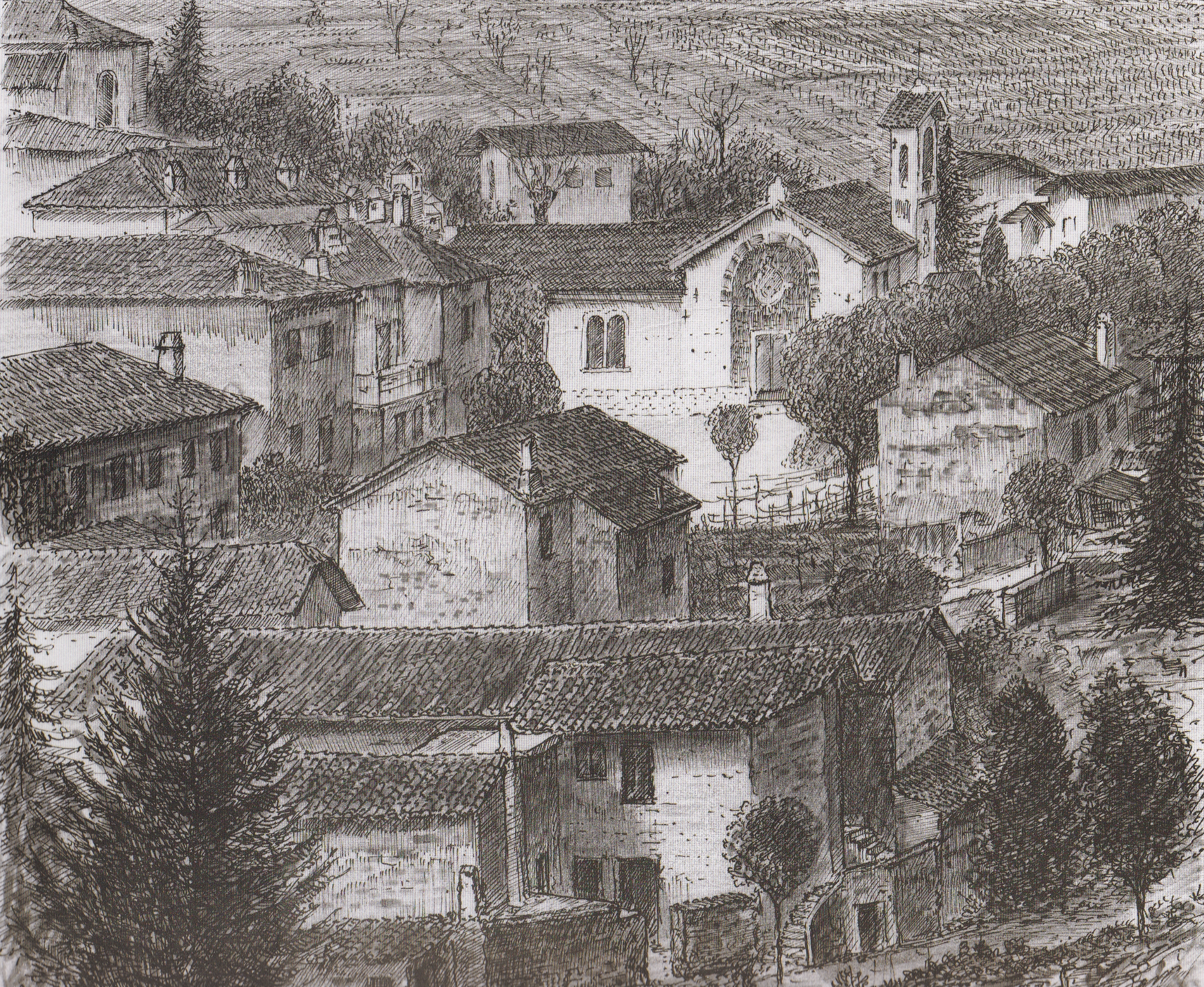 Fogliano Redipuglia (drawing by A. Bressanutti)
Richer—or perhaps less poor—versions also exist. We shamelessly borrow one of the many possible recipes:
A humble dish, a sort of minestrone made with whatever vegetables were left in the fields—cabbage stumps, a few beans, a carrot, an onion, perhaps a thread of seed oil but certainly some lard beaten near the rind, and to flavor it a toasted handful of buckwheat polenta flour and salt. Boiled for a few hours, it was served in a wooden or earthenware bowl, with stale bread soaked in it.
If it troubles you that such different preparations share the same name, know that zuf simply means a jumble, a hodgepodge, a slop: practically anything that can be scraped together goes into the pot. Today, in the revival of local traditions, it is sometimes served in school cafeterias, perhaps prepared by the children themselves. The verdict of one innocent bystander: It’s better than the ready-made soups Mommy buys.
The municipality also contains Redipuglia. The locality has nothing to do with Puglia, nor with kings. The name derives from the Slovenian Sredipolje, which derives from the medieval Slavic Rodopolje, which in turn derives from the Latin Rodopugium.
At Redipuglia stands the monumental war memorial that houses the remains of more than 100,000 fallen soldiers (of whom 60,000 are unknown) from the First World War. In addition to the memorial, Redipuglia is home to the Park of Remembrance on Colle S. Elia—situated, strictly speaking, almost entirely within the territory of San Pier d’Isonzo—and the Austro-Hungarian cemetery, which holds the remains of 15,000 fallen soldiers of the Imperial and Royal army. The inscription Im Leben und im Tode vereint (United in life and in death) is written above the entrance to this cemetery.
And that should be sufficient to convey an idea of what the Bisiacaria is. We close this introduction with a passage from a beautiful—and in parts deeply moving—article that the renowned writer and Germanist Claudio Magris wrote for the Corriere newspaper of December 21, 1997, in which the author describes a journey through a territory close to home (Magris lives in Trieste) that he had never truly explored.
The Bisiacaria is one of those parallel spaces, contiguous to our everyday reality, that we pass by often but almost never enter, like certain streets in one’s own city or certain villages at the edge of a highway. I had brushed past, crossed, skirted these flat lands of rivers and sea so many times, yet without ever truly seeing or touching them; Turriaco, San Pier d’Isonzo, Staranzano were mere names. Wandering among these fields and villages is not a search for memories, nostalgia, tender and precarious relics of the self, but for the world beyond the hedge. In the end, one is not looking for anything; one lets oneself go, like a piece of wood in a ditch.
The inhabitants of the Bisiacaria are called—and lately call themselves, with a certain pride—Bisiachi.
Several hypotheses exist as to the origin of this name. The least credible—and most thoroughly discredited—is the popular etymology vigorously promoted by Fascism and still occasionally repeated, which derived bisiaco from the expression bis aquae, meaning the two rivers (the Isonzo and the Timavo) between which the Bisiacaria—extending from Pieris to San Giovanni di Duino—is enclosed. Were this etymology correct, it would be the first and only instance in Latin of a multiplicative numeral adverb modifying a noun—a construction not found in any classical, post-classical, patristic, or medieval author. If the rivers had anything to do with it, the inhabitants of this land should properly be called Biniachi (from binae aquae).
The most substantial attempt to explain this term was made by Silvio Domini and Aldo Miniussi, two devoted students of local history, in an essay entitled Breve discorso sulla parola “bisiac” (A Brief Discourse on the Word “Bisiac”). Their work, available in full online, is worth reading by anyone with even a passing interest in the subject; here we limit ourselves to summarizing and discussing its main points.
The two authors begin by noting that the term bisiac or bisiaco appears in written sources dating back at most a century; if it was in use before that date, it was in spoken form only. They also observe that it is a term that came from outside. Neither the Friulians, the Venetians, nor the Slovenians used it to designate their neighbors. And here we reach the central argument of the article:
The most probable matrix of the word bisiac is instead to be found in the Slovenian term bezjak (refugee, fugitive). This bezjak would derive from the encounter of a very ancient Norse verb, baegia (from which the Slovenian verb bežàti = to flee, to escape, also appears to derive) with the suffix jak (= group of people, folk; e.g. poliak , slovak, etc.), as Professor Gušič, female Director of the Ethnographic Museum of Zagreb, informs us in a study reviewed by V. Čulinovič Kostantinovič in the Zagreb journal Kaj (no. 7/8—1969) and cited by J. Baukart in Delo of 7.2.1970: all taken up by Novi List of 11.4.1974 under the title “Who are the Bisiachi?”
Professor Gušič dwells less on the semantic evolution of the term (or so we gather from the Novi List article) than on correlating its meaning with the historical events that gave rise to it.
We learn that the Slovenians, at the time of their westward advance (7th–8th centuries), called Bezjaki the Latin-speaking populations who retreated before them. A large part of these fugitives settled in Byzantine-protected lands in the area that today marks the border between Slovenia and Croatia, where traces of their customs, usages, and language are said to survive.
According to the Treccani, bezjak in its sense of fool or simpleton also lies at the root of the Italian adjective bislacco—an epithet which the encyclopedia says was applied to the Venetians of Friuli and the Slavs of Istria. The Venetians of Friuli are, of course, precisely the Bisiachi. Combining these two interpretations, one arrives at the conclusion that bisiaco, as a synonym for fugitive and refugee, came to denote someone who speaks poorly—and is therefore hard to understand—someone a little dim. It should be noted, in this connection, that calling people foolish for not speaking one’s own language is a very old habit. The ancient Greeks called other peoples barbaroi—that is, stutterers—and the Slavs to this day call the Germans Nemci, meaning mute.
With all due respect to Domini and Miniussi, and to all those who have uncritically adopted what is locally regarded as the official explanation, there is something in it that does not entirely convince.
The first observation concerns the use of terms denoting populations. According to the account above, Bezjaki would be the Slovenian word for the Latin-speaking populations who fled before their advance into Italy.
Acknowledging that none of us is a Slavicist, and that nobody—ourselves included, and indeed Domini and Miniussi themselves—has read the original work or its reviews, a little diligence yields information that puts Professor Gušič’s conclusions in a somewhat different light.
Two points deserve emphasis. First: in Old Church Slavonic, Slovéne—a term appearing in the earliest written sources from the ninth century—designates the Slavs in general. The most widely accepted hypothesis holds that Proto-Slavic populations, perhaps originating from the Urals, inhabited around the sixth century the territories of what are now Poland, Ukraine, and Belarus.
Starting in the early 7th century, these peoples began a massive wave of migration, directed primarily toward the west and north, which led them to occupy the territories abandoned by Germanic peoples who, in turn, had moved within the borders of what had been the Roman Empire. So it is not the Slovenes who are moving into Italy; there is a whole domino effect resulting from a migration in which various populations each move into territories occupied by another. On the northern and eastern slopes of the Carnic and Julian Alps, to give an example close to home, Slavic populations, pushed out or driven from the Drava and Sava valleys, settled in what are now Val Degano, Val del But, Canal del Ferro, Val Resia, Val Torre, and the Natisone Valleys.
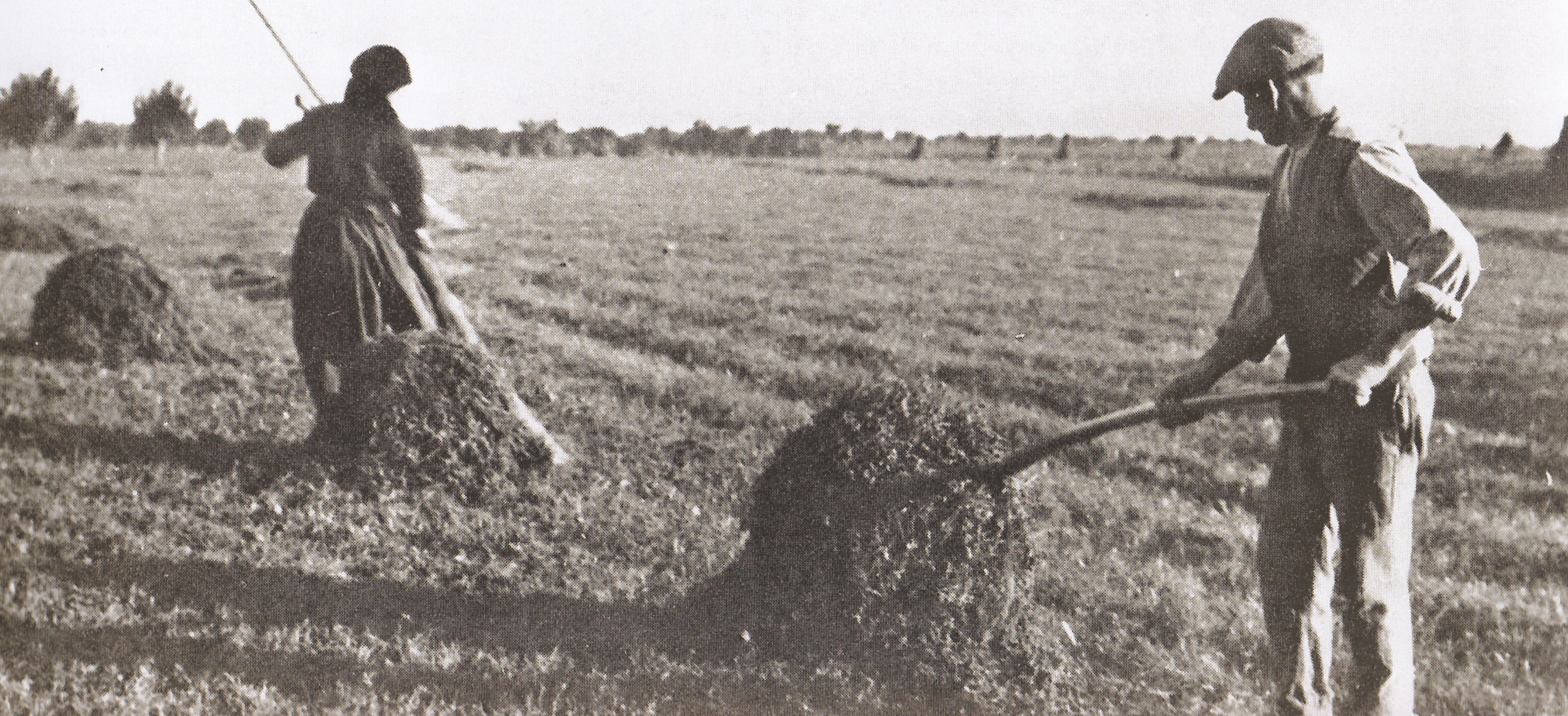 Working in the fields
In 2007, the Wiener Slawistisches Jahrbuch—a journal of the Austrian Academy of Sciences—published an article by Rasoslav Katičič of the Institute of Slavic Studies at the University of Vienna, on the polemic between Primož Trubar and Paulus Skalich. The article proved instructive.
Primož Trubar—a Catholic priest who, after the Reformation, became a Lutheran pastor—is regarded as the founding father of the Slovenian language. Trubar had published a translation of the New Testament into Slovenian. His translation was criticized—not on theological but on linguistic grounds—by an anonymous reviewer whom Trubar had no difficulty identifying as Paulus Skalich, a well-known figure among sixteenth-century Croatian Protestant humanists.
Katičič reviews the themes of the dispute in detail. What concerns us here is Trubar’s use of the terms Besjak and Besjaki (with their orthographic and linguistic variants Beßyakh and Bessiaker/Bessiacken).
First, Trubar denies his reviewer the right to criticize his Slovenian, on the grounds that he is not a native speaker of the language but a Besjak, a term Trubar uses to designate the Croats of the Zagreb region. On another occasion, in the preface to a Croatian translation of the first part of the New Testament published in Tübingen in 1562, Trubar writes—in the orthographically adventurous German of the 16th century:
Die Sclauen (d. h. Slavonier) die man sonst Bessiacken nennt / haben fasst Vngerische vnd Crobatische Sitten vnd Eigenschafft …
which means, more or less:
The Slavs (that is, Slavonians) otherwise called Bessiacken have almost Hungarian and Croatian customs and characteristics …
Without entering too deeply into which populations Trubar meant in each case, the fact remains that the father of the Slovenian language applied the term Besjaki, in the 16th century, to other Slavic populations—who do not appear to have been considered exiles or fugitives, nor even particularly dim-witted.
We have found no evidence of this term being applied to populations of Latin origin, and it strikes us as odd that a word used in the 16th century to designate other Slavic peoples should have been revived four centuries later to refer to a small community living along the Isonzo. Even if the argument from silence must be treated with caution, the absence of any intermediate citation weakens the hypothesis—not Gušič’s, but Domini and Miniussi’s—of a direct thread connecting bisiac with Besjaki/Bezjaki.
In short, there seems to be more than one reason to doubt that the story, as conventionally told, is the right one. We are, of course, always ready to revise our view in the face of new evidence.
But let us turn instead to Bisiac as a spoken language. According to the linguist Giuseppe Francescato, it derives from the dissolution of the Latin spoken in the Aquileian area, which, as it diversified, gave rise to Friulian in the Longobard zone and, along the Adriatic coastal strip, to Venetian—of which Bisiac is a variant. On this reading, Bisiac, like the dialect of Grado, would be the end product of an indigenous Venetian vernacular historically linked to the persistent Venetian presence in the area.
According to another interpretation, associated with Pellis, Bisiac would instead be a colonial variant of Venetian, developed on a Friulian substratum in areas distant from Venice, as a result of the prestige that the Serenissima and its ruling class projected beyond their own borders. Rather than spreading horizontally between contiguous linguistic communities, the language would have arrived from above—through the adoption of a socially more prestigious variety. The dilemma, then: home-grown or imported?
On this we are unable and unwilling to pronounce. If forced to take a position—proceeding largely by instinct—we would readily classify as imported the Venetian spoken within the walls of Palmanova (outside, Friulian is spoken) or among the middle and upper classes of Udine (the peasants have always spoken Friulian), while inclining toward “indigenous” for the Venetian variants—which they are—spoken at Grado and in the Bisiacaria.
But what is Bisiac, how is it structured, and how does it work? Linguists describing this spoken variety concern themselves with refined phenomena comprehensible only to fellow specialists, such as the use of clitic personal pronouns in subject function for the second and third person singular and the third person plural. In practice, this means that in Bisiacco one says ti te magni, lu el magna, and lori i magna (i.e. you eat, he eats, they eat), but not *noi ne magnemo (linguists have a habit of marking ungrammatical forms with an asterisk).
What strikes the non-linguist about Bisiac, at least on first encounter, is the clipped infinitive of verbs (e.g. cantàr, còrar, durmìr—to sing, to run, to sleep) and those odd superlatives in -on (boconòn, stracòn, duronòn—enormous, utterly exhausted, very hard) that tend to make outsiders laugh.
A charitable veil should perhaps be drawn over the confusion between subjunctive and conditional in Bisiac—here one says, without the faintest embarrassment, se no piovarìa (literally: *if it would rain). More noteworthy is the richness of terms drawn from German and Slovenian that populate the everyday vocabulary.
Here are some examples of German derivations: sìna (from Schiene) rail; strìca (Strich) line, stripe; còfe (Kopfweh) stupid; viz (Witz) joke, witticism.
And some from Slovenian: baba (baba) woman; zima (zima) cold; raza (raca) duck; cudìc (hudič) devil.
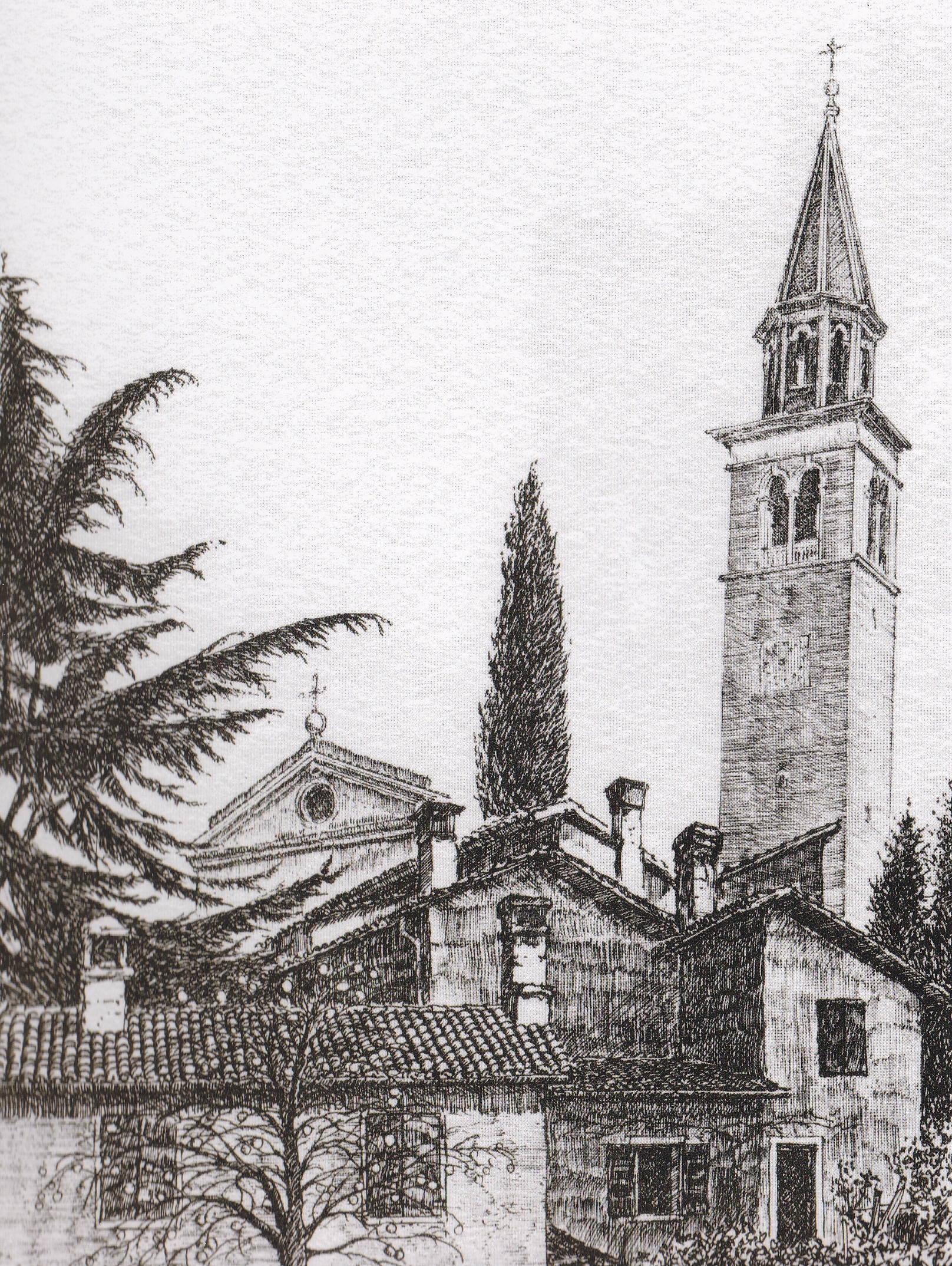 Sagrado (drawing by A. Bressanutti)
All students of Bisiac note that, although Monfalcone is the reference center of the Bisiacaria, anyone wanting to hear “true” Bisiac must move away from the city, where the language spoken is now in ciccara—a sort of Triestine, or a Bisiac so thoroughly contaminated by Triestine elements that it can no longer properly be called Bisiac. To hear the purest forms of this spoken language, one must go, according to Zamboni, to Pieris, Begliano, and Fogliano. In our view, Turriaco is not a bad option either—provided one steers clear of Sagrado:
The inhabitant of Sagrado, unlike, say, that of Fogliano, which is just a stone’s throw away, spoke with a Triestine vocabulary, but his pronunciation gave him away: and in the slow cadence of his sentences the original linguistic stock (Bisiac) emerged—not rough and brisk as in the mouths of other Bisiachi, but drawn out in a singsong manner, with curious elongations of the vowels and the final syllables of words.
Those wondering why Triestine influence is—or was—so pronounced in Sagrado will find a ready answer. Silvio Domini writes:
… the construction of the railroad, with a freight station at Sagrado; the presence there of a substantial group of specialized stonemasons (united in a Mutual Aid Society with the stonemasons of Fogliano) who had many ties with Trieste; the beginning of the fruitful activities of the electrotherapy clinic of the Triestine doctors Alimonda—these made Sagrado a fine residential center capable of hosting, especially for treatment, many Triestines. It was in this period, then, that the dialect of Sagrado became “Triestinized,” if one may say so, losing some ancient cadences and phonemes, but remaining always a Venetian dialect with nothing to share with Friulian.
Another observation from those who have studied the subject concerns the decline of Bisiac. We borrow from Wikipedia:
For some time now the spoken variety has been in sharp decline, having come under pressure from Triestine and, in more recent times, from Italian. As early as 1930, Pellis himself noted that it was spoken almost exclusively by adults and the elderly, surviving above all in the centers of Fogliano, Pieris, San Canzian d’Isonzo, Staranzano, and Vermegliano.
A word of clarification is called for here. Every spoken variety evolves over time, like everything else. The reasons are obvious: the context of use changes, new terms are coined, others fall into disuse, contact with different speakers increases. To speak of pure forms of a language—or dialect; any attempt to distinguish between the two holds only as a rough approximation—is linguistically meaningless.
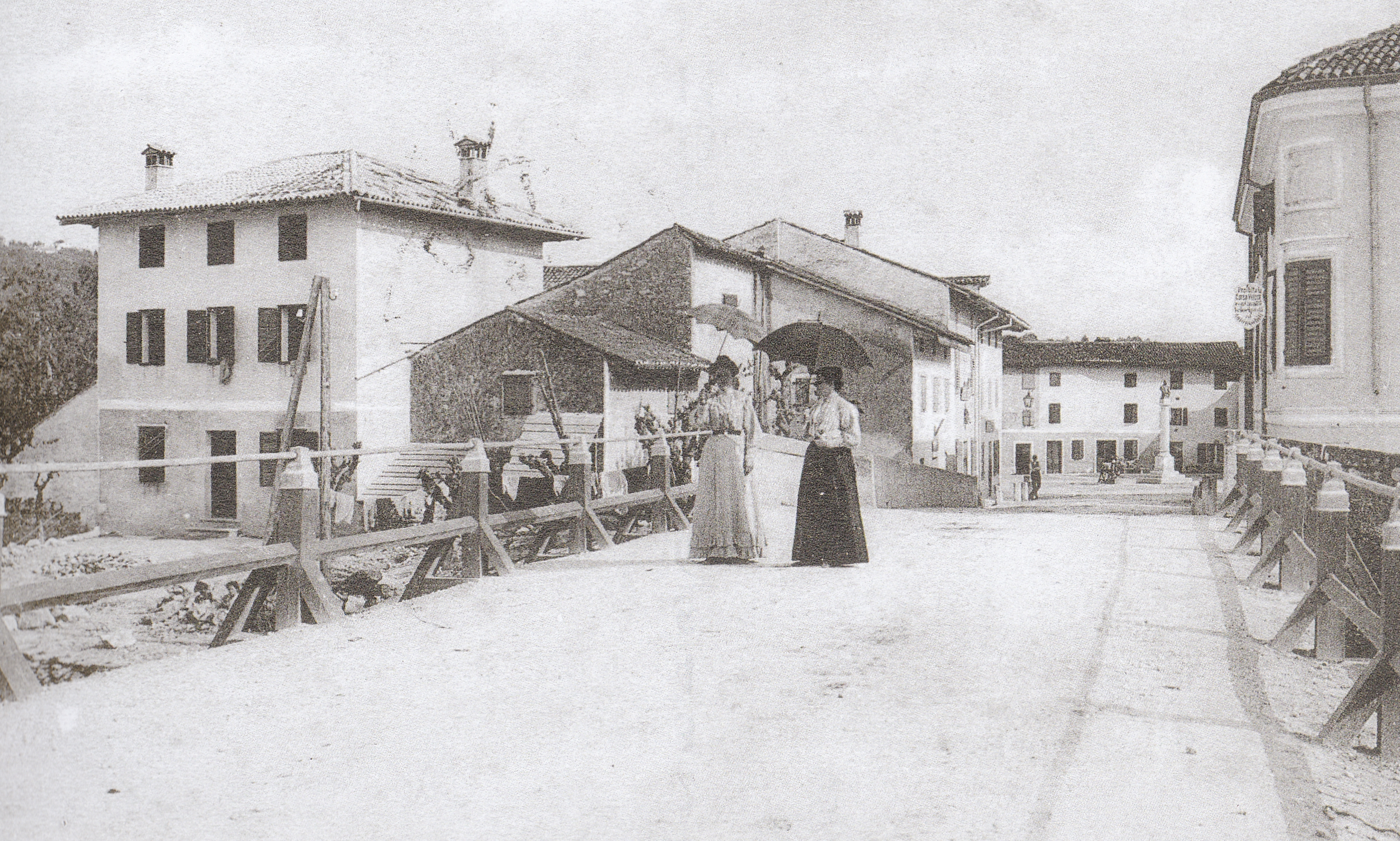 Visitors in Sagrado
More fruitful is to ask about the contexts in which a variety is used and its relationship with others. Here the situation is somewhat complex. Given that local spoken varieties coexist with the national language—as already noted—an interesting phenomenon has emerged in recent times. Traditionally, the relationship between language and dialect illustrated what linguists call diglossia—the coexistence of two codes used in different contexts: Italian as the official and formal language, the dialect as the language of the heart, used at home and with friends.
The introduction of Law 482/99 on the protection of historical linguistic minorities—implementing Article 6 of the Constitution—has produced a situation that might charitably be described as embarrassing. As we know, the road to hell is paved with good intentions. To begin with: someone, thinking to save a few pennies, convinced themselves that minorities, like the animals on Orwell’s farm, are all equal—but some are more equal than others. Under the Monti government a decree was proposed—and subsequently enacted—that introduced differential treatment between historical minorities with a reference state (those linked to France, Austria, or Slovenia) and those without (all the others). In practical terms, this meant that Slovenians would receive greater protection than Friulians. The law was immediately challenged by the Region of Friuli Venezia Giulia and subsequently declared unconstitutional.
In affirming absolute equality of treatment for all minorities, the law effectively introduced a new bilingualism: Friulian is granted equal dignity alongside Italian and may be used interchangeably with it. Hence a Regional Agency for the Friulian Language, radio broadcasts in Friulian, Friulian instruction in schools, and so on. The temptations of linguistic assimilation and cultural imperialism, it turns out, are always present. We return to the Magris article already quoted:
Some years ago, a bill—never passed—that would have introduced the teaching of Friulian in schools in the Bisiacaria as well had aroused the protests of the Bisiachi, fearful of seeing their centuries-old individuality absorbed and erased into the Friulian, so much larger and more robust.
An ethnic group that asserts itself does so, often, at the expense of a weaker one, thereby denying the very principle in the name of which it protests against the stronger state or nation that it feels is oppressing it; History is all a foaming, seething mass, in which bubbles eager to rise destroy one another, bursting one after another.
In short, if the Friulians have reason to be satisfied, the Bisiachi, the people of Grado, and the Resiani—the inhabitants of Val Resia who, though they speak an archaic form of Slavonic, would never accept being classified as Slovenians—have something to grumble about.
And now let us turn to our municipality. First, the name. Little is known about it with certainty, though etymologies—more or less fanciful—are, as usual, in no short supply.
We begin with the hypothesis of the inevitable mythical Roman legionary—a Turius, Turrius, or Thorius. In that case, as those who know about such things explain, Turriaco would be the prediale (in -acus) of a Latin personal name: a toponym derived from a personal name. Friuli, after all, is full of place names ending in -acco: Moimacco, Tavagnacco, Adegliacco; though it is a pity that Turriaco is spelled with a single c.
Remaining within the Latin hypothesis: there is said to have been a Turris aquae—a water tower—standing, in remote times, between the River Torre and the Isonzo. The Torre, moreover, was anciently known as the Turro: in this case Turriaco would be a toponym derived from another toponym.
The most widely accepted hypothesis, however, derives Turriaco from a Celtic term, tur, designating the aurochs—a species of wild ox, now extinct.
A coincidence that is no coincidence: in Slovenia there is a village called Turjak—of which more later—where a castle once belonged to the Auersperg family, a German dynasty that takes its name from its founder, the knight Ursberg. The family’s coat of arms bears the figure of the aurochs. Both Turriaco and Turjak, then, would take their names from the presence, in remote antiquity, of wild aurochs herds in their respective territories.
The village name appears in writing for the first time in a document of 1267. The Patriarch Gregory of Montelongo, rewarding a certain Luvisino of Castelvenere for services rendered, grants him (investivit) in liege fee—with obligations of residence and defense—four holdings (mansi): two situated at Saconzano (a locality that, as noted, remains mysterious) and duobus in Turriaco. Being in the ablative case, the name comes out perfectly. Other documents of roughly the same period cite the village as Turyach and Turriacho. And with that, the name is settled.
The village covers approximately five square kilometers and has no outlying hamlets. Within the municipal territory, however, there are localities whose names call for explanation.
The final stretch of Via Oberdan, beyond the irrigation canal, is known as Brasil. The name dates from May 1945, when units of the Eighth British Army—including Brazilian soldiers—were encamped there; the Brazilians, in the evenings, gave impromptu concerts to ease their saudade for their homeland. There is, incidentally, also a Brasil in the municipality of Fiumicello, just across the Isonzo. This one, coined between the late 19th and early 20th centuries, alludes to the fact that the stretch of uncultivated countryside reminded returning emigrants of certain overgrown Brazilian backlands.
North of the Brasil, in the area between the irrigation canal and Via Verdi, lies the locality of Ungarini. Popular tradition here too speaks of a military encampment—this time of Hungarian soldiers, as the name suggests—dating from the period immediately following the Congress of Vienna (1818).
The inescapable Puntin reminds us, however, that in 1715 the locality was already known as Ongarin, and that a document of 1725 calls it Ongarina. The explanations he proposes are intriguing. After noting that in Cassegliano there was a field known as l’Ongaria which formed a single unit with the one in question, he continues:
It is plausible that this is either a derivation from a surname Ongaro, or a distant memory of Hungarian raids. Concerning the first and simpler hypothesis, we note that in 1488 a Matheo Ungaro is attested in the Monfalcone area […], and in the eighteenth century there were families named Ongiar and Ongaro (Friulian and Venetianized versions). The surname derives, according to some scholars, […] not so much from the ethnic term unghero as from the Germanic personal name Hungar. This name goes back as far as the period of the barbarian invasions, with the characteristic Germanic positive mythologization of the Huns (Hunni).
On the theme of military derivations: the area extending from Via Diaz toward the railroad tracks is known as Manaruti. Popular tradition holds that the name comes from Mann in Ruhe (man at rest), the area having supposedly served as a rest and refreshment point for Austrian troops. Puntin, however, notes that the area was wooded and close to the Isonzo, and derives the name from the Friulian manarùt, meaning a small ax or hatchet. The military-derived place names of Turriaco, then, are considerably fewer than popular tradition would have us believe.
Geographically, the territory of Turriaco is entirely flat. The average elevation above sea level is 12 meters; the village stands 2 meters above the bed of the Isonzo. The soil, very fertile, is of alluvial origin, with a substratum of sand, gravel, and clay. The water table ranges from one meter below ground when the Isonzo is in flood to nine or ten meters during droughts.
The Isonzo is a defining feature of Turriaco’s landscape. Its current bed lies to the west of the village, but in antiquity it ran to the east. Nearby, the Isonzo is joined by its main right-bank tributary, the River Torre—almost always dry, but capable of extremely dangerous floods.
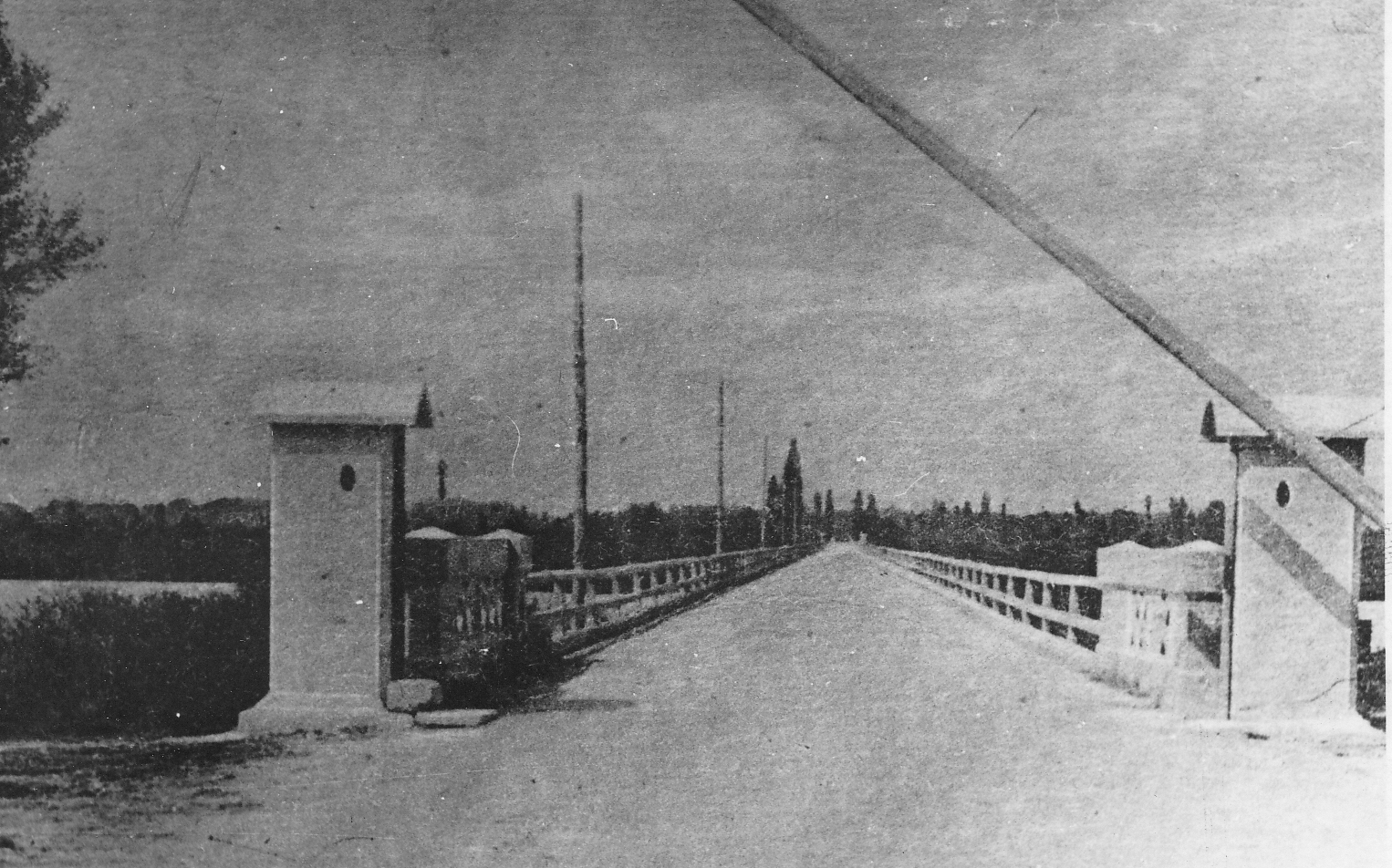 The old bridge over the Isonzo, built by the Army Engineers
Over the centuries, the inhabitants have had to learn to live with river flooding—which has also contributed to reshaping the local geography. One such flood, in 1490, destroyed among other things a small chapel that stood in the territory of San Piero.
Maps show that on this occasion the course of the Isonzo coincided with what is now the Isonzato (also called the Isoncello canal). In 1580, during another flood, the river broke into the Sdobba—at that time merely a short spring-fed stream—widening it and using it as a new outlet to the sea. Less than ten years later, in 1589, another flood reached the Pieris area, splitting equally between the Isonzato and the Sdobba. Between the two watercourses there remained a narrow strip of land that has been called Isola (Morosini) ever since.
Within living memory—or near enough—the flood of 7 December 1902 is still spoken of, when the Isonzo burst its bank near the railroad bridge and inundated the entire village with more than a meter of water. In 1904, work began to regulate its flow, leading to the excavation of irrigation and drainage canals. In November 1927 there was another devastating flood. In 1933 a major land reclamation project was undertaken that, through excavations, widenings, and reinforcements, made it possible to secure the area.
In the Civil Defense emergency plan, only a handful of dwellings at the ends of Via Roma and Via Diaz are classified as presenting a low hydraulic risk; the rest of the municipal territory is considered practically free of risk.
And since we are on the subject, it is impossible in these parts to avoid the question of seismic risk. The earthquakes that devastated Friuli in 1976—there were two, one in May and one in September—were felt very strongly in Turriaco as well, but caused no significant damage. Another earthquake had struck half a century earlier, on January 1, 1926, also without consequences. Knock on wood, everyone hopes Turriaco will hold its position among the low-risk zones.
In any case, the only real risks to which the territory is exposed are those connected with atmospheric events—thunderstorms, tornadoes, and hailstorms in particular. Of the latter, two of exceptional severity are on record. One occurred in 1902. Furioso describes it thus:
At around 2:30 in the afternoon of 28 July 1902, a black thunderstorm cloud coming from the direction of Lake Garda descended upon Turriaco. The anti-hail batteries then in use opened fire but to no avail. A hailstorm of exceptional violence struck, destroying in a very short time the entire harvest and all vegetation. Birds, hares, and other animals died in their hundreds under the blows of hailstones the size of hens’ eggs.
Following the hail came rain mixed with earth, and by evening it was as cold as in winter, the ground being entirely covered with hailstones and, in spots sheltered from the sun, they could still be seen two weeks later.
A famine and immense poverty naturally followed: families had lost everything, and Hungary sent large quantities of flour to relieve the hunger.
Another hailstorm of disastrous proportions struck on 4 July 1965. In addition to the complete destruction of the grape harvest—with effects on the vines that persisted in subsequent years—damage was inflicted on domestic and wild animals and on buildings, with windows, roof tiles, and even house walls broken. In the same month, on 26 July, during another violent storm a tornado struck, tearing off the roofs of houses and workshops and uprooting tall trees.
As already noted, the municipal population does not reach three thousand, of whom around 5.5% are foreign residents. At the time of writing, Turriaco is—together with Romans d’Isonzo—the only municipality in the territory of the former province of Gorizia to maintain an active CAS (Centro Assistenza per Stranieri: Center for Foreign Assistance).
The demographic balance is sustained by immigration, since, as elsewhere, the number of deaths in Turriaco exceeds that of births. Immigration, too, has always helped demographics along. In 1630, Turriaco had 202 inhabitants and 42 houses. Less than half a century later the figure had risen to 351—an increase of 75%. The explanation lies in the arrival of the Priuli counts, Venetian nobles. For the construction of their villa—today known as Palazzo Fonda—and its associated agricultural outbuildings, outside labor had to be recruited, local manpower being wholly insufficient. The Trevisan, Furlan, Padovan, Bergamasco, and Spanghero families settled in the area during this period—families that would go on to play an important role in the history of the village. In 1706 a baptismal font was granted to Turriaco, and from that point baptisms were registered locally; previously the registers had been kept at the Pieve of San Pier.
And since we are on the subject of records and documents: Turriaco became an independent municipality in 1848, having previously been a sub-municipality of Monfalcone. The first mayor (podestà) was Giovanni Marni. One of the new municipality’s first acts was the distribution of public lands to residents.
We give the floor to Vittorio Spanghero:
[…] every family became the owner of at least one parcel.
We may think that, on the level of social life, this truly extraordinary and unthinkable fact—for laborers, tenant farmers, and craftsmen—overturned the age-old rhythms of the entire population. Not everyone was equal to sustaining the expenses required to work the sterile and uncultivated lands of which they had so suddenly come into possession.
Many of them, unable to pay the tax burdens owed to the state or incapable of managing the property, were forced by a perverse process to surrender the small plots they had just acquired and to sell them to the highest bidder. Others, more prudent—or, if we prefer, more fortunate—established small complete agricultural enterprises with a cowshed and hayloft for the dairy cows, a henhouse, a pigsty, and the covered area for keeping the tools for working the land.
Alongside agriculture, the economy of Turriaco once rested on the weaving of wicker for basket-making. Several hundred basket-weavers lived in the casoni—wretched dwellings of reeds and straw bound together with a little mortar—near the river, where raw material was plentiful.
Cosolo writes:
Women, helped by the older children, took care of cutting and preparing the wicker, which had to be stripped and stored, ready for use during the winter months when the men, their fieldwork done, could devote themselves to making baskets, hampers, and a great variety of containers for domestic use. The women also took care of selling these goods, which were taken to the city on handcarts pushed by hand; traveling sometimes for whole days, they went as far as Trieste and Gorizia.
Through a Triestine shipping agent, they occasionally secured large contracts for the supply of large baskets (coffe), which, shipped by sea to Egypt, were used for washing cotton in the waters of the Nile. On those fortunate occasions, the village farmers too were recruited in large numbers, to meet the supply contracts to which the basket-weavers’ cooperative had committed itself.
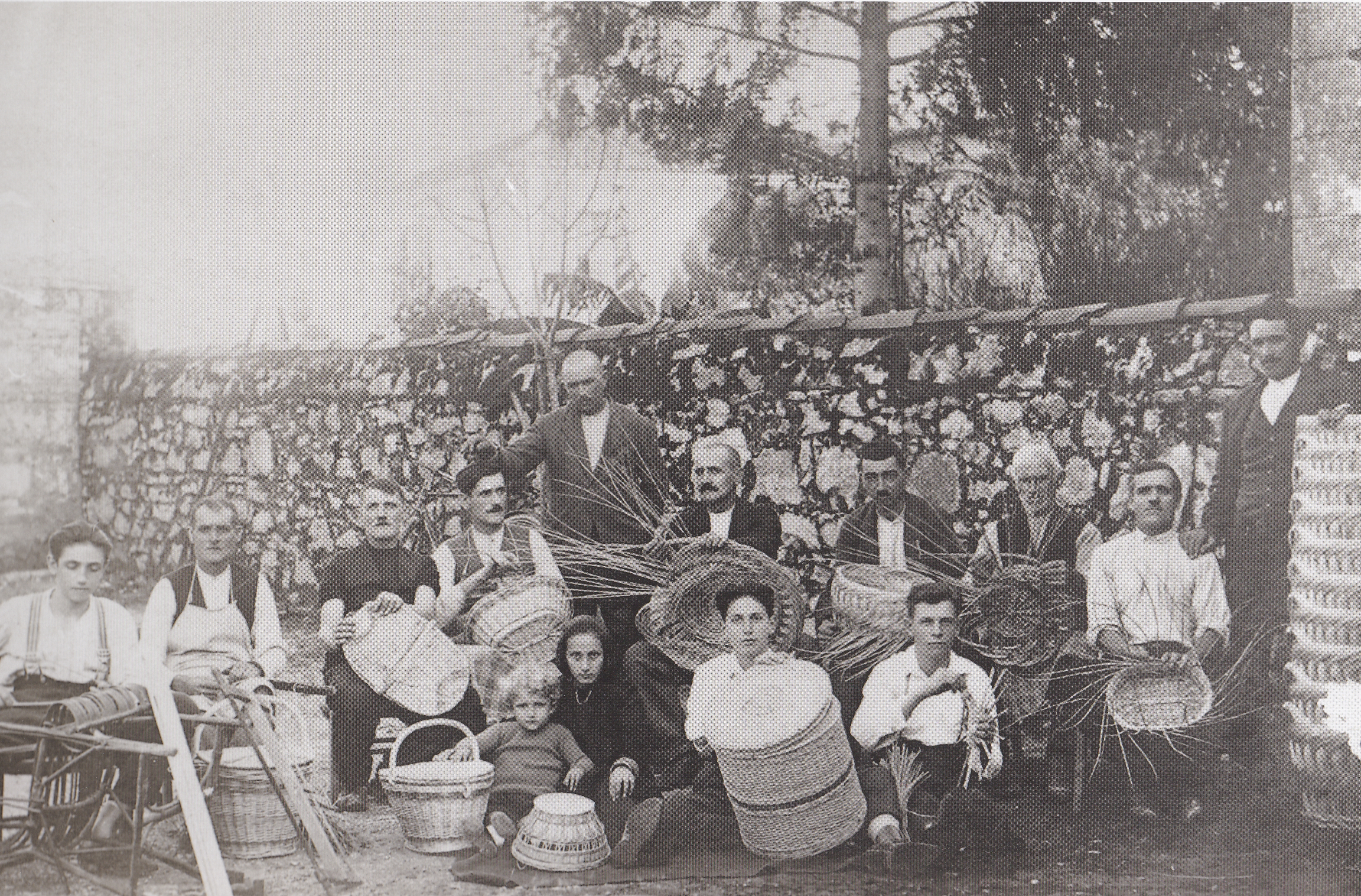 Basket-weavers at work
It remains to speak of the artistic and natural beauties of the village. For the artistic ones, no great effort is required: make your way to Piazza Libertà and you will see them all. On one side stands the parish church of St. Rocco; on the other, Palazzo Fonda (formerly Priuli).
Furioso managed to devote no fewer than eleven pages of his Storia di Turriaco to the Church—understood both as institution and as monument. We honestly could not do the same, and in any case we shall return to the subject when speaking of the band.
We would, however, like to say something about the bell tower. Built in Romanesque style beside the church, it stands 28 meters tall. Nothing extraordinary—certainly nothing to trouble the people of Mortegliano, who take pride in theirs, confirmed by very recent laser measurements to be the tallest in Italy (by a narrow margin over the more celebrated Torrazzo of Cremona).
At the top, in addition to the cross and a weather vane, there are two red lights for the benefit of airplanes. The runway of Trieste–Ronchi dei Legionari Airport, extending into the territory of Turriaco, comes to within a few hundred meters of here, and aircraft on approach to land fly genuinely low.
Seven flights of stairs lead up to the bell chamber. Why such precision? Because on more than one occasion there has been talk of having the band climb the bell tower to give a concert. Better, then, to find out in advance.
Inside the chamber are the three bells. Cast in 1875 by the firm Polli and Broili of Gorizia, two of the three were requisitioned for military purposes during the last war; all were subsequently recast and reconsecrated in the immediate postwar period. They are tuned, respectively, to D flat, E flat, and F. We doubt anyone has climbed the tower with a tuner to verify this, but that is what the Furioso writes, and we are inclined to believe him.
The other distinguished building in the municipality is the palàz—the villa in Venetian style built by the Priuli counts. A typical Venetian manor house, its façade features a fine portal with a stone arch and two balconies with elegant wrought-iron railings. In short, a perfect backdrop for the concerts held in the square. At the rear is a large park with handsome trees and a low turret that forms a single complex with the palazzo. The whole is listed as of public interest and protected by the Soprintendenza ai Monumenti e alle Gallerie.
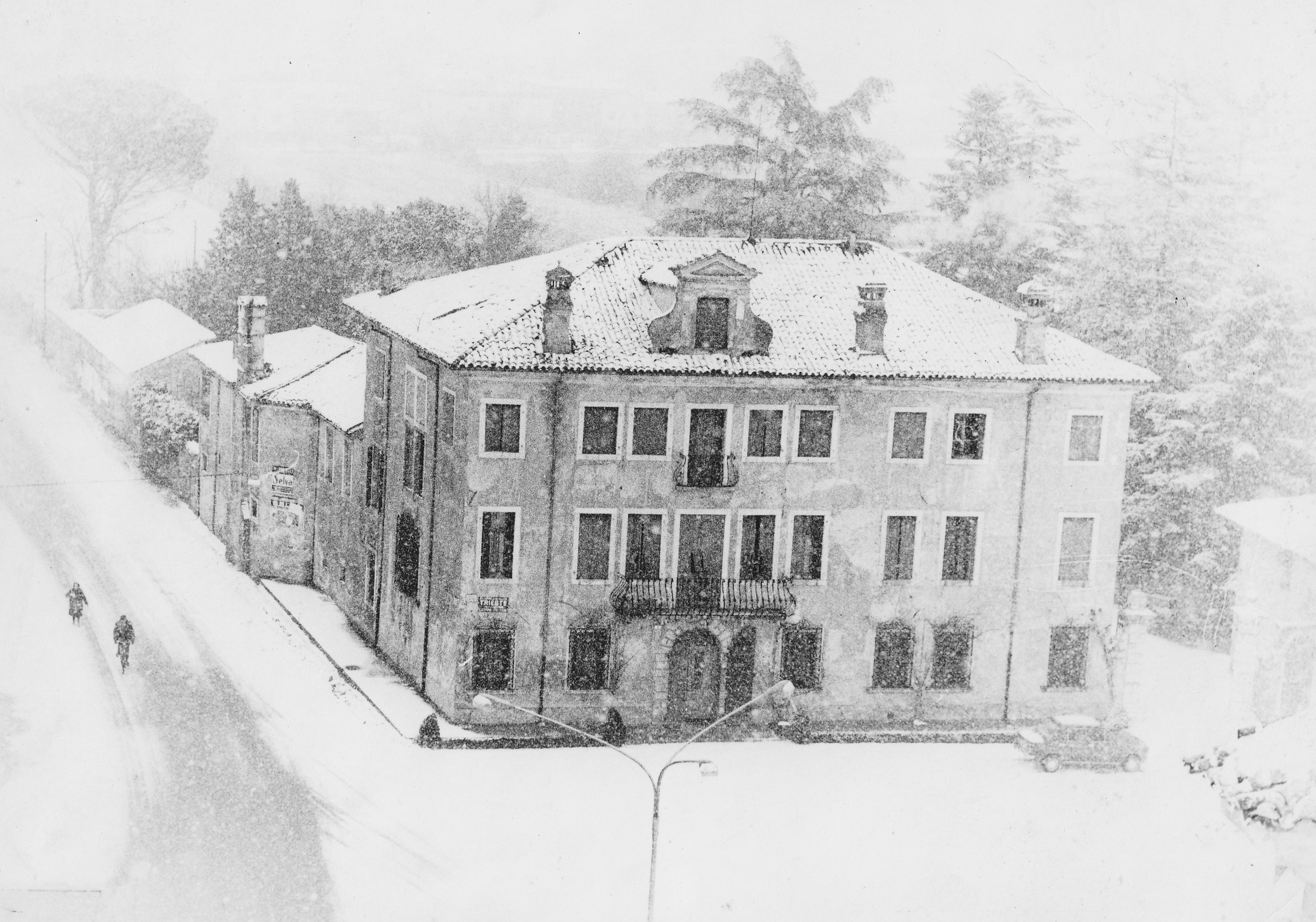 Palazzo Fonda under snow
If Turriaco is objectively rather sparse in artistic treasures, the situation is quite different when it comes to natural ones. The municipality contains the Parco Naturale dell’Isonzo—a place of rest and recreation where one can walk, take exercise, cycle, enjoy time with friends, and observe nature. The park is home to species including maple, alder, hornbeam, hazel, walnut, wild apple, poplar, downy oak, wild cherry, wild lime, and Siberian elm. Equipped with a children’s play area and a picnic area, it offers access to the riverbed at several points.
Finally, Turriaco is one of only ten municipalities in Friuli Venezia Giulia to have been designated a comune ciclabile—a cycling-friendly municipality—an accolade awarded by the FIAB (Italian Federation for the Environment and Cycling) to local authorities that implement concrete policies for bicycle mobility. The municipality’s three bike paths—named after singer-songwriters Tenco, Faber (De Andrè), and Gaber—allow cyclists to travel safely and comfortably.
And on today’s Turriaco, that is all—or almost.
Let us be clear from the outset: no official document attests to the founding date of the Turriaco band. On its origins we have only secondary sources, and from these it is not always easy to reconstruct how events actually unfolded.
What is fairly certain is the existence in Turriaco, in the second half of the 19th century, of a group of enthusiastic musicians who played in taverns, at village festivals and fairs, and, unfortunately, at funerals as well—events always common, given the epidemics, such as the cholera outbreak of 1855, that periodically devastated the area.
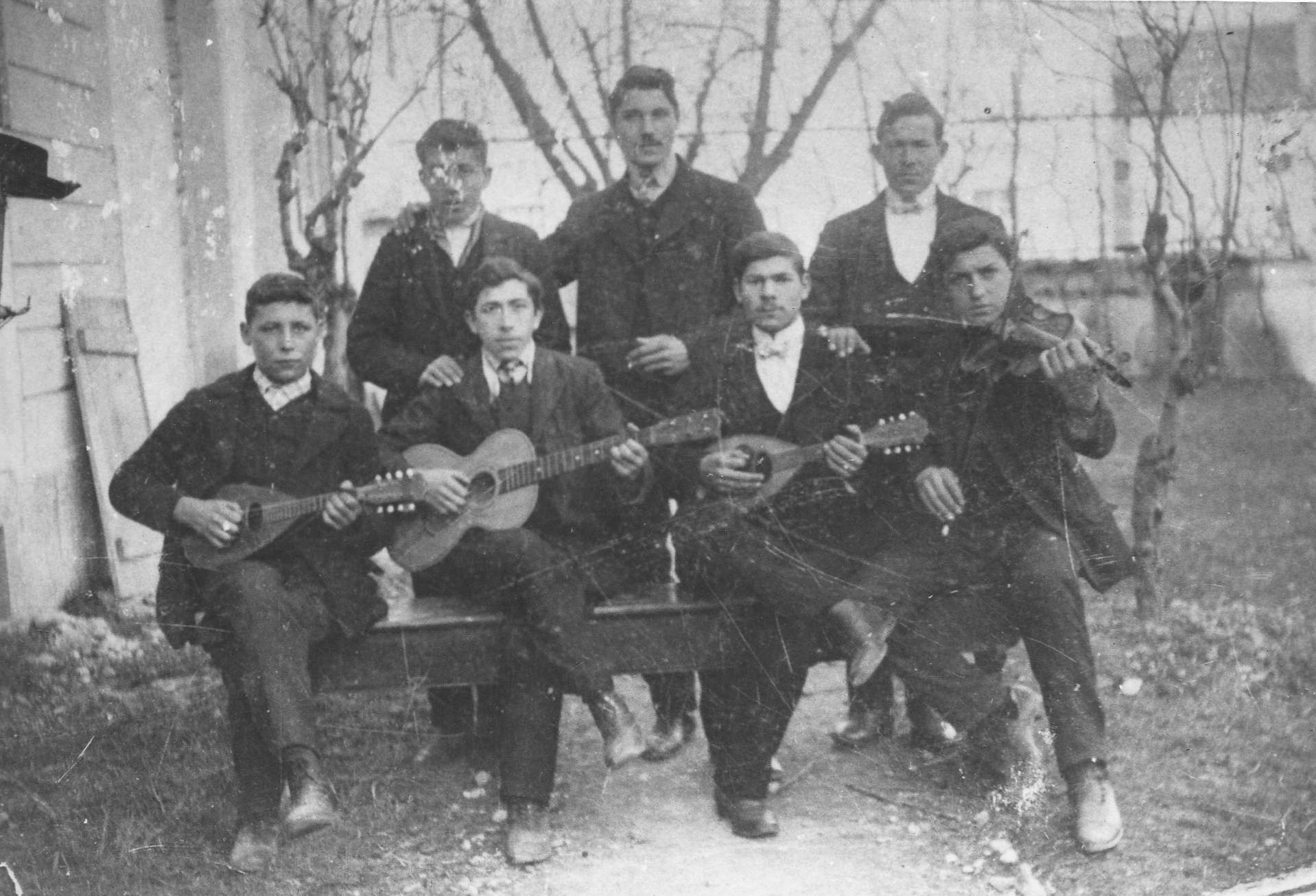 Musicians in Turriaco
Cosolo writes:
[…] that small group of enthusiasts decided it would be necessary to take the study of music more seriously. They therefore resolved to hire Maestro Guglielmo Schubert, who already conducted the excellent band of Grado, which in those days entertained guests during the seaside evenings of our great-grandparents and Austrian vacationers. And so it was that in 1870 the group of these players […] registered itself under the name of the Municipal Band of Turriaco.
Still according to Cosolo, the names of those pioneers were: Giacomo Cisilin, Gini Spanghero, Domenico Modest, Valentino Portelli, Benedetto Guanin, Giovanni Maria Clemente, Michele Clemente, and Carlo Spanghero.
Spanghero, in turn, writes:
1870 is the year identified as the birth of our Musical Band. This was a very important event and a source of pride for the social life of the entire village. The band was immediately loved and enjoyed great success from the very beginning, when it started giving concerts in the square and marching on holidays.
In the presentation of the exhibition Our Band, curated by the Circolo Culturale e Ricreativo Don E. Brandl in September 1988, one reads:
According to research by Maestro Silvio Domini, the year marking the birth of the band is 1870, when the musical ensemble was directed by Maestro Guglielmo Schubert from Grado, and performed at civic celebrations and religious festivities. The first Turriaco-born conductor of the band, however, was Luigi Clemente, clarinetist, organist, and director of the church choir.
Of the latter it is said:
During these same years, clarinetist Luigi Clemente was taking his first harmony lessons from Rev. Don Carlo Minghetti, at the time vicar of our village, so that in a short space of time, sustained by great perseverance, determination, and intelligence, he became organist, instructor of the church choir, and the first Turriaco-born conductor of the band.
According to Furioso, however:
The day of Corpus Domini in 1875 is the founding date of the local band. The founder was Luigi Clemente, a baker and church warden. In its first outing, during the procession for the aforementioned feast, only 7 members played. These were the pioneers of that famous Philharmonic Society, which has counted so many musicians in its ranks and has made Turriaco one of the villages where music is most appreciated and known.
Among the different accounts there are discrepancies in dates and names. What seems somewhat suspicious in Furioso’s account is the coincidence between the founding date of the band and what was probably its first public performance—at a ceremony that would feature the band regularly for decades to come: the Corpus Domini procession.
Some further details about this first performance are provided in the booklet published on the occasion of the (supposed) centenary of the band’s founding, in 1970. Here it is stated that
[…] in 1875, on the occasion of the Corpus Domini procession […] among other pieces, four religious marches composed by Maestro Schubert himself were performed.
As is plain, these are assertions that echo one another, sometimes contradict each other, and in any case cite no reliable source whatsoever.
Something new about the founding of the band came to light following a completely unexpected development: our success in tracking down Signora Domenica (Mimma) Czubert (!!), great-granddaughter of the band’s first conductor, who kindly agreed to speak about her ancestor. The testimony that follows was recorded at the lady’s home in Staranzano on 13 April 2000. We reproduce it in full, without corrections or editorial intervention, exactly as transcribed from the video filmed on that occasion.
From various documents (diaries, books, scores, etc.) that I found in my house in Grado, left in my father Mario Czubert’s care, and from events recounted by him or his brothers, I know something of my ancestors and their origins, since until now little or nothing has been written by anyone. No one has bothered to write or to ask the large number of relatives, while they were still alive, although it seems to me that my great-grandfather left something useful and enjoyable to all the citizens of Grado and the surrounding villages; those who still possess musical scores know something of this, though to get even part of them back the heirs had to wait a while.
My great-grandfather, Maestro Guglielmo Czubert, was born in Prague on 15 June 1830. His family then moved to Bechlin (Bohemia), a town near Prague. He studied and completed his higher education at the Conservatory, where he taught both privately and as a faculty member until he was sent into exile for his political ideas, which were contrary to the regime.
We must pause for a moment to consider what 1848 meant for the Austro-Hungarian Empire and for all of Europe.
He made several stops before arriving in Grado, passing through Hungary and then Austria to Trento, where he composed the “Workers’ March” with words by a man from Trent, a certain Rossi—a march still played in Grado on May Day; from Trento he moved to Pola, where he directed the Imperial Austro-Hungarian Military Band and also conducted the Franz Lehár’s orchestra [?!]. I believe he met his wife, who was of Dalmatian origin, in Pola. Her name was Natalina Stiglich; they married and moved to Grado, where they had no fewer than 11 children, several of whom died in infancy, as unfortunately happened all too often in the previous century.
They settled in Grado in 1861, and he managed to bring together 24 members for the founding of the band, four of whom, over time, were his own sons. One of these was the youngest in the group, named Guglielmo, like his father.
All the instruments of the entire Grado band were the property of Maestro Czubert, who also gave private music lessons on various instruments to citizens outside the band in the municipality of Grado. He lived in Grado in the building of the Music School, now in a state of complete disrepair.
He often travelled to Turriaco, where he brought together local members and founded the Turriaco band, now known as the “Società Filarmonica,” specifically in the year 1870, on the 5th of May.
He was also involved with the bands of Fiumicello and Aquileia. He directed the bands of various villages, where he gave music lessons to the children of noble and well-to-do families.
In those times, many festivals were organised—for the feasts of patron saints and otherwise, for tombolas and events of every kind, for this or that notable who was staying in the area during the summer season.
In the second half of the 19th century, many foreigners came to Grado—Hungarians, Austrians, Czechoslovaks who were compatriots of Maestro Czubert. Dances and tombolas, always with the band present, and naturally polkas, mazurkas, waltzes, and marches were never lacking; almost the entire repertoire was music composed by the maestro himself, which created a village joyfulness enjoyed by young and old alike, and by the visitors.
For the procession to the Sanctuary of the Madonna on the island of Barbana, celebrated on the first Sunday of July, he composed Adagios with a musical meaning and effectiveness quite remarkable for that time. Motor boats did not yet exist; the fishermen of Grado made their bragozzo boats available, and one travelled by rowing—every turn or stroke of the oar accompanied by a musical beat from the band. In effect, they rowed in time to the music.
The maestro also wrote several funeral marches—from what I know, as many as 17 of them—and they are still performed both inside the church and during the procession. The funeral cortège always proceeded on foot, accompanied by the band all the way to the cemetery. At the moment of interment the band played softly; at the moment of farewell the drum was rolled as the priest cast earth onto the coffin, then came the second roll for the family, and the third for the assembled community. It was a ceremony rich in meaning and deeply moving.
On 4 April 1900, drinkable water flowed from the fountains of Grado. The band played throughout the island for two full days and two nights without interruption. This particular chapter of the band’s activity has never received its due. As one can see, there are many gaps in so many things and over so many years.
In Grado, squares and streets have been named after figures who were perhaps not overwhelmed with glory, while we children, grandchildren, and great-grandchildren would have been content with a simple acknowledgment—from the civil or the religious authorities—of the maestro’s life and work.
Guglielmo Czubert left behind a trained and well-prepared choir and band, but the musical instruments gradually all disappeared, along with many scores from the rich repertoire, and over time various citizens appropriated this artistic heritage even though none of it belonged to them.
In conclusion, Czubert can be described as a stern man, fond of hunting and nature, of good food and the social life—a personality of elevated culture, and without doubt an illustrious citizen of the lands then under Austro-Hungarian rule.
In his later years he received from the Municipality of Grado an annual pension for his services of 500 Austrian crowns. He ended his earthly wandering in Grado on 18 May 1914.
We have reproduced this testimony in full—including the grievances that Signora Czubert wished to air—because it outlines, in rich detail, not only the maestro’s personality but also the world he inhabited and the ties he maintained with the bands he directed, founded, or helped to found.
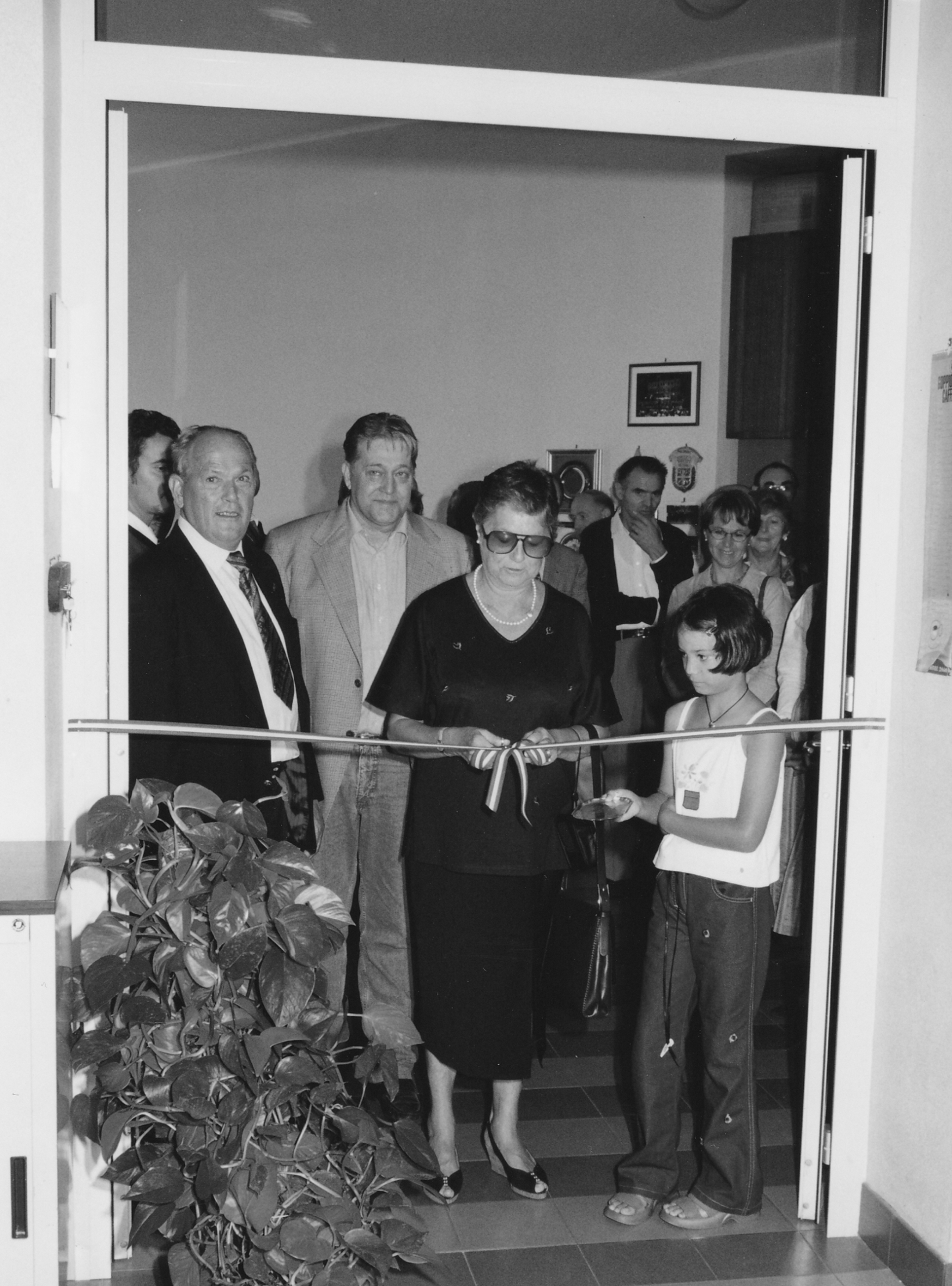 Signora Czubert inaugurates the exhibition for the 130th anniversary of the founding
Some of the information reported above is quite striking. First and foremost, the question of the surname. All sources cited previously referred to the band’s first conductor as Schubert. We now learn that the surname was in fact Czubert.
Among the languages spoken in the Habsburg Empire, the consonant cluster cz appears in Polish and Hungarian (though in the latter case it occurs only in older surnames) but not in Czech, the language spoken in the region where the maestro originated. In both Hungarian and Polish, the cluster has the sound of a soft ch, roughly as in “cheese.” Transliterated into Italian, it would sound like Ciubert. This is a surname uncommon even in Bohemia (where Czuber is fairly widespread) but which was—and still is—found in Italy. Among those registered in the early-twentieth-century military conscription lists held in the State Archive of Gorizia for the Municipality of Grado, there appear a Filippo, a Guglielmo, a Francesco, and a Mario Czubert. A quick search on the web will confirm the current presence in Italy of people bearing that surname.
Secondly, the confirmation of the founding year of the band is significant: it is 1870, and Signora Czubert adds the exact day: 5 May. That day was a Thursday—but it was not a Corpus Domini (which was always celebrated on a Thursday), since in 1870 that feast fell on 12 June. And, while we are reconstructing the calendar, 5 May could not refer to the Corpus Domini of 1875 either, which fell on 27 May. In short, Signora Czubert’s testimony is flatly incompatible with what Furioso claimed.
At this point, either Furioso is right or Signora Czubert is right—unless both are wrong, a hypothesis we prefer not to entertain. In light of the above, and pending the discovery of a document that settles the matter once and for all, we feel perfectly comfortable continuing to regard 1870 as the year in which the Turriaco band began its existence.
Also notable in Signora Czubert’s account are the references to what must have been the repertoire under Maestro Czubert’s direction—apparently consisting mostly of his own compositions, whose disappearance we can only join the great-granddaughter in lamenting. It seems more than reasonable to suppose that the marches already mentioned were performed at the band’s first public outing, and that the maestro had little difficulty re-orchestrating and rearranging them to suit the technical level of his players—a level that, one imagines, was not particularly elevated.
On the first few decades of the Turriaco band’s life, information is extremely scarce. To understand the context—social, political, economic, and cultural—in which it operated, and to supplement the absence of reliable facts with plausible conjecture, we need to broaden our discussion somewhat.
Toward the end of the 19th century, relations among the inhabitants of these lands began to be troubled by the rise and intensification of two types of conflict: one ethnic, the other political.
After centuries of peaceful coexistence, disputes began to flare between the Italian and Slovenian communities, fueled on one hand by the emergence and hardening of opposing nationalisms, and on the other by an Austrian policy that, faithful to the principle of divide et impera, sought to exploit these divisions to its own advantage. In particular, to offset the weight of the Italian component—numerically a minority but more influential socially and economically, and considered more inclined toward irredentist ideas—the Habsburg government tended to favor the Slovenian component, regarded as more loyalist.
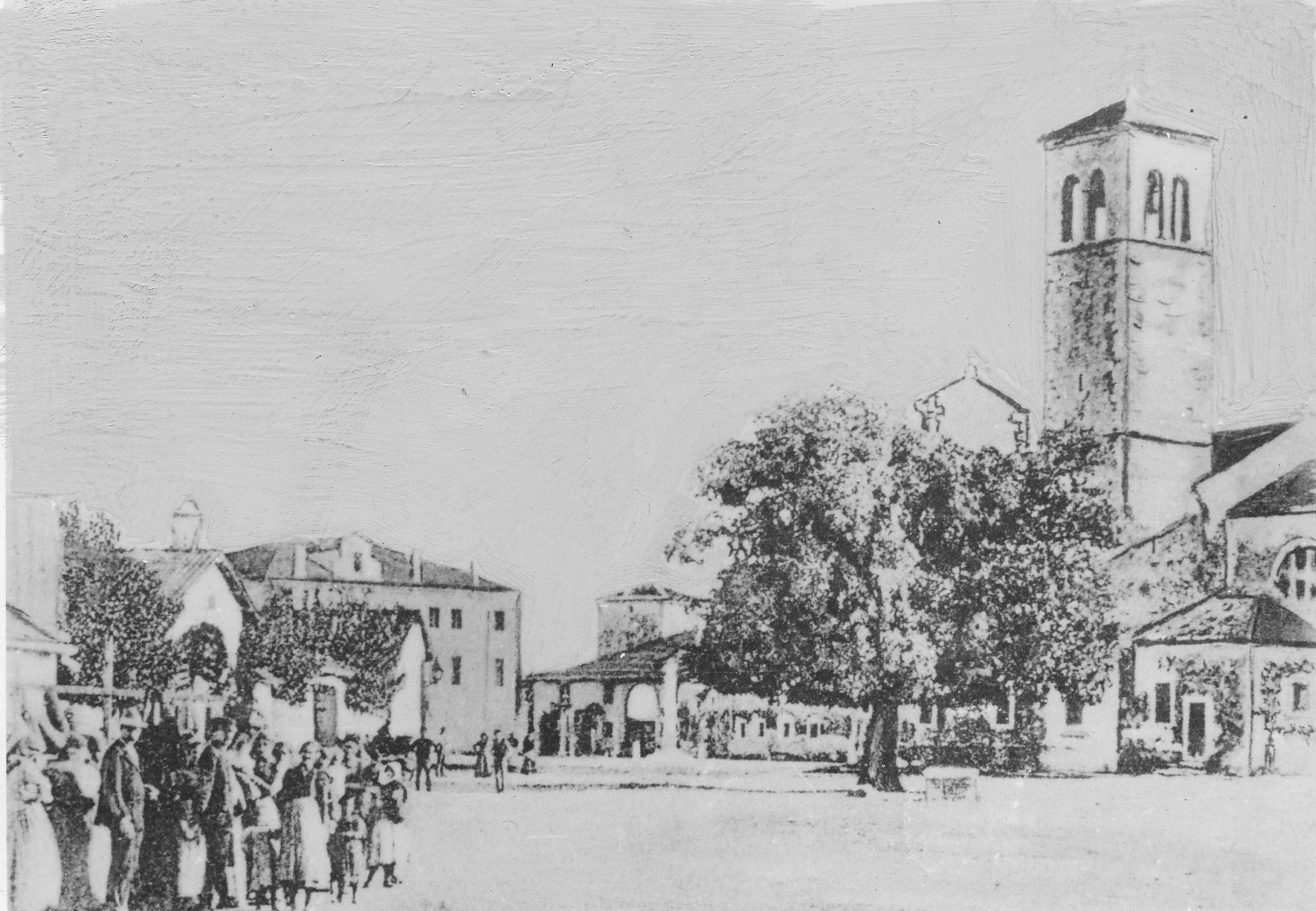 The Turriaco square in the early twentieth century.
This attitude had its origins in the imperial order issued at the Council of Ministers on 12 November 1866—immediately after the conclusion of what we know as the Third War of Independence, which had returned Veneto to Italy—by which it was prescribed to
[…] decisively oppose the influence of the Italian element still present in some Kronländer, and to aim at the Germanisation or Slavicisation, depending on circumstances, of the areas in question with all energies and without any consideration.
In plain terms: the plan was to set one ethnic group—the more loyal one—against another that aspired to independence.
In the same period, the emergence of new political movements—Socialism, in particular—alongside those already well established, such as Catholicism and Liberalism, introduced a lively new dialectic into the Habsburg world, whose defining traits included a deep suspicion of novelty and a corresponding inertia. It is worth noting, in this connection, that irredentist sympathies tended to cluster among the secular and liberal element of society, while the catholic world was solidly loyalist and pro-Habsburg.
The first document we have found in which the band is mentioned is the account of the visit that Emperor Franz Joseph paid to the province and city of Gorizia on September 12 and 13, 1882. A full report of this visit appears in L’eco del litorale—a periodical that described itself as religious, political, literary—which, published between 1873 and 1918, gave voice to those catholics who, in absolute loyalty to the emperor, nonetheless defended the Italian character of these lands.
The passage that concerns us is taken from the article published on Sunday September 17, 1882 under the title His Majesty the Emperor in the Province and City of Gorizia:
As the slowly moving train passed through Sagrado station, H.M. was greeted by the national anthem played by the Fogliano band and by three cheers from all the people gathered there, headed by the municipal representatives. Here too, both the station and the nearby houses were adorned with flags. At 7:00 the imperial train entered Monfalcone station, where gathered to pay homage to H.M. were the municipal delegation of Monfalcone with all the deputies of the municipalities of the district, the deans of Monfalcone and Duino, H.H. Prince Hohenlohe, the district judge with all the employees of the various departments, the veterans’ divisions of Ronchi and Monfalcone, the schoolchildren, and the entire population of Monfalcone and nearby places.
Greeted by the national anthem played by the two bands of Turriaco and Monfalcone, by the firing of mortars, and by thunderous cheers from the population, H.M. was pleased to step down from the carriage. The mayor of Monfalcone, Sig. Trevisan, paid homage to H.M. in fitting words on behalf of the city of Monfalcone and all the municipalities of the judicial district, after which H.M. allowed all the gentlemen present to be presented to him by Councillor Vintschgau, to whom he was graciously pleased to address kind words; he then reviewed the veterans and the schoolchildren, addressing kind words to the teachers.
The climate in which these visits took place—and the intentions behind the reporting of them—is made plain by the following passage, from the same article.
Twice during the long procession the national anthem was sung in Italian and Slovenian, and the public seized every opportunity to acclaim the Sovereign. The pen feels incapable of reproducing the moving sublimity of this homage, which coming from the heart went, we do not doubt, straight to the nobly paternal heart of our most beloved Sovereign. It was a homage worthy of the one who inspires it, but which also highly honours the sentiments of rectitude and loyalty of our good population; it was a solemn and eloquent triumph, and we hope it will have spoken clearly to those who, after all these events, might still wish to impute to us aspirations or sentiments that were eloquently disproved by the memorable day of 13 September 1882, on which the Princely County of Gorizia declared in the most solemn and explicit manner how happy and content it finds itself under the beneficent wings of the Habsburg Eagle.
The band reappears in the historical record in 1898, on the occasion of the most auspicious event of His Majesty’s Jubilee. Franz Joseph, crowned Emperor of Austria on December 2, 1848, was celebrating 50 years on the throne. Turriaco marked the occasion by erecting a monument. The account of all the festivities appeared in Il patriottico Friuli, a publication issued for the occasion that, despite our best efforts, we have been unable to locate. Fortunately, we can draw freely on what Spanghero quotes from the original source. Here is what it says of Turriaco:
The modest monument of Turriaco was erected through voluntary donations, and the Municipality contributed a substantial sum, taking on as well the costs of the inauguration celebrations, which took place amid the most fervent expressions of rejoicing on the memorable day of 2 December 1898.
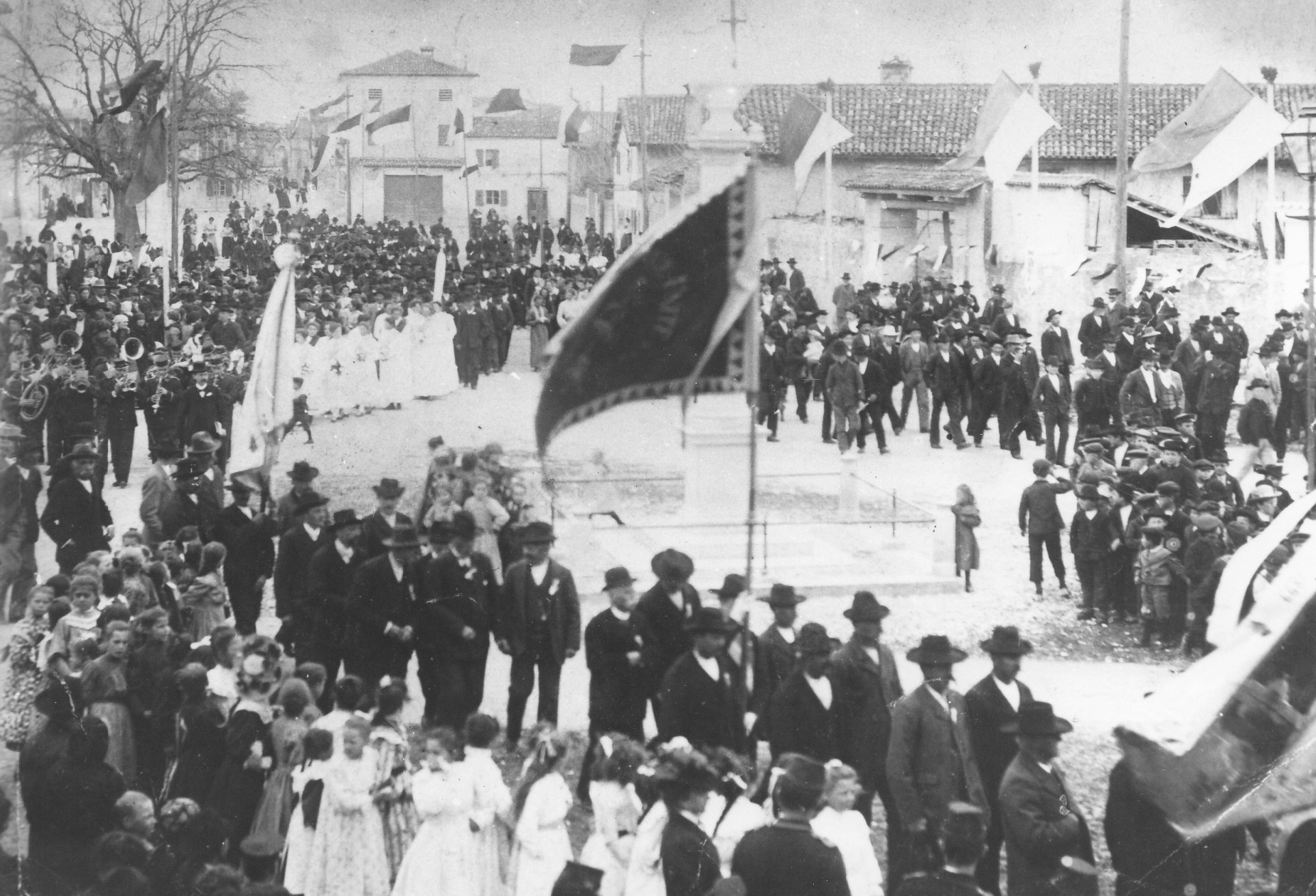 Celebrations for the 50th Jubilee of H.M. Franz Joseph
The modest monument consisted of a Doric column supporting a marble bust with the effigy of the celebrated emperor (who was, of course, still alive!). On the base of the column appeared the following (translated) inscription:
ON THE 2ND OF DECEMBER 1898 AFTER 50 YEARS OF REIGN OF HIS MAJESTY FRANZ JOSEPH I TURRIACO ERECTS THIS MEMORIAL
The account of that memorable day, again drawn from Spanghero’s quotation, is worth reading in full:
At 6 in the morning the village band, playing as it went, marched through the streets of the village, which from the early hours was entirely decked out in festivity and flags. At 9 the band went to the Town Hall, where it struck up the popular anthem “May God preserve Austria’s Kingdom and the Sovereign Emperor,” and then accompanied the municipal delegation, the teachers, and the schoolchildren to church for the solemn divine office with the Te Deum. The Very Reverend Parish Priest Don Andrea Furlani gave an occasional address after the Gospel. The church was crowded.
Towards one in the afternoon the band gave a concert in the square, begun and ended with the popular anthem. At 3 o’clock the band went to meet the Government Delegate, Sig. de Galli, who had come to attend the unveiling of the monument to His Majesty. As the covers fell, warm acclamations and the strains of the popular anthem greeted the effigy of the august Monarch. The Parish Priest blessed the monument and gave a brief address, noting the patriotism of the population and closing with a triple “Hurrah!” An occasional anthem was then sung by the fine amateur chorus, accompanied by the band.
In the evening there was illumination, which proved magnificent, and the band again marched through the village, stopping in front of the house of the mayor Pietro Montanari, where the popular anthem was repeated several times, each time received with enthusiastic acclamations.
We can be certain that without the band the celebrations would have been a very different affair. Note, too, the full-time deployment of the band itself, which took the stage four times without, as far as we know, too much grumbling.
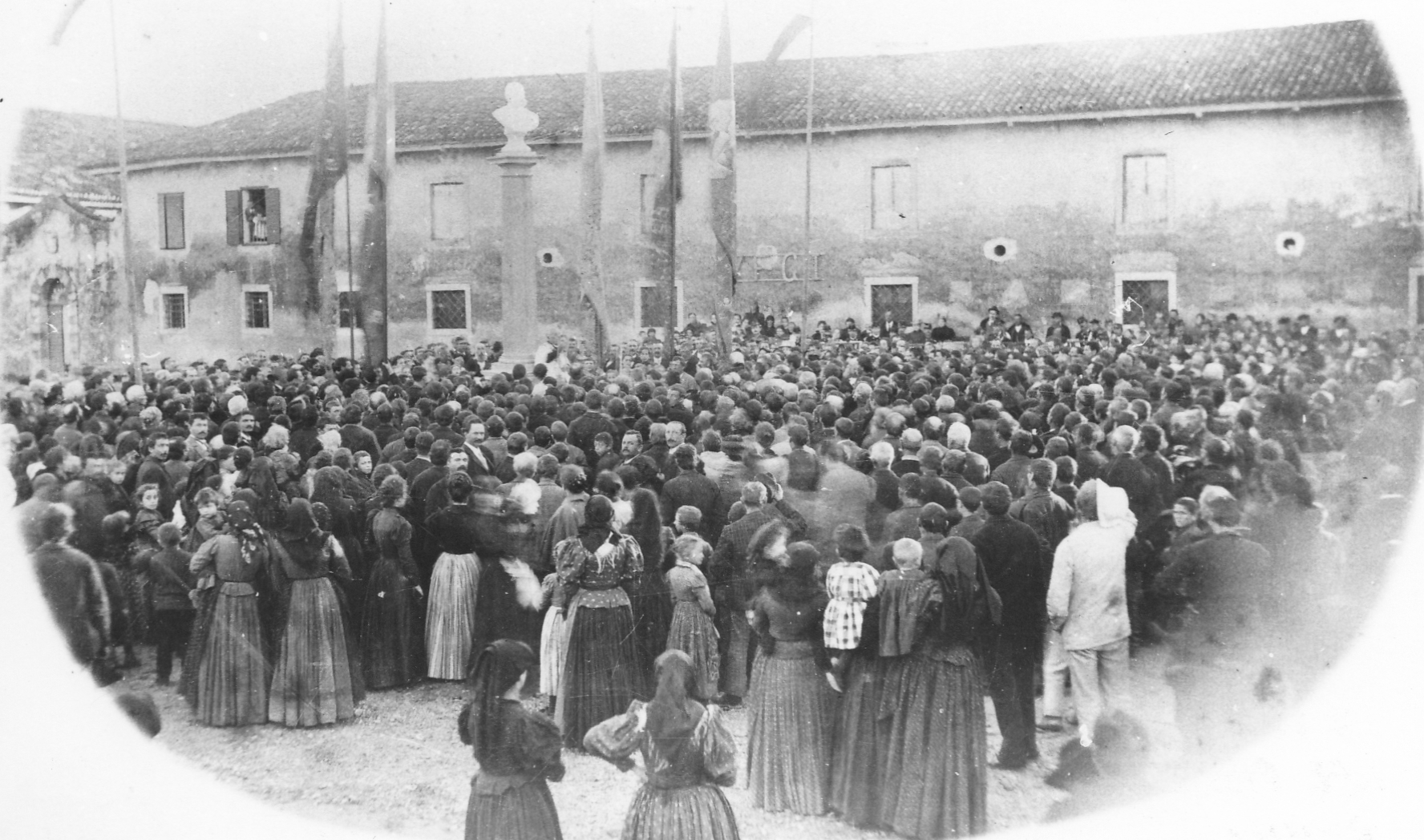 Jubilee celebrations (with the monument in the background)
Of all the 1898 celebrations, the most enduring memory is not the monument to Franz Joseph—destroyed by an Italian shell in 1915, rebuilt in early 1918, and definitively demolished after the arrival of Italian troops at the war’s end—but a wonderful photograph, the very first ever to depict the band in uniform.
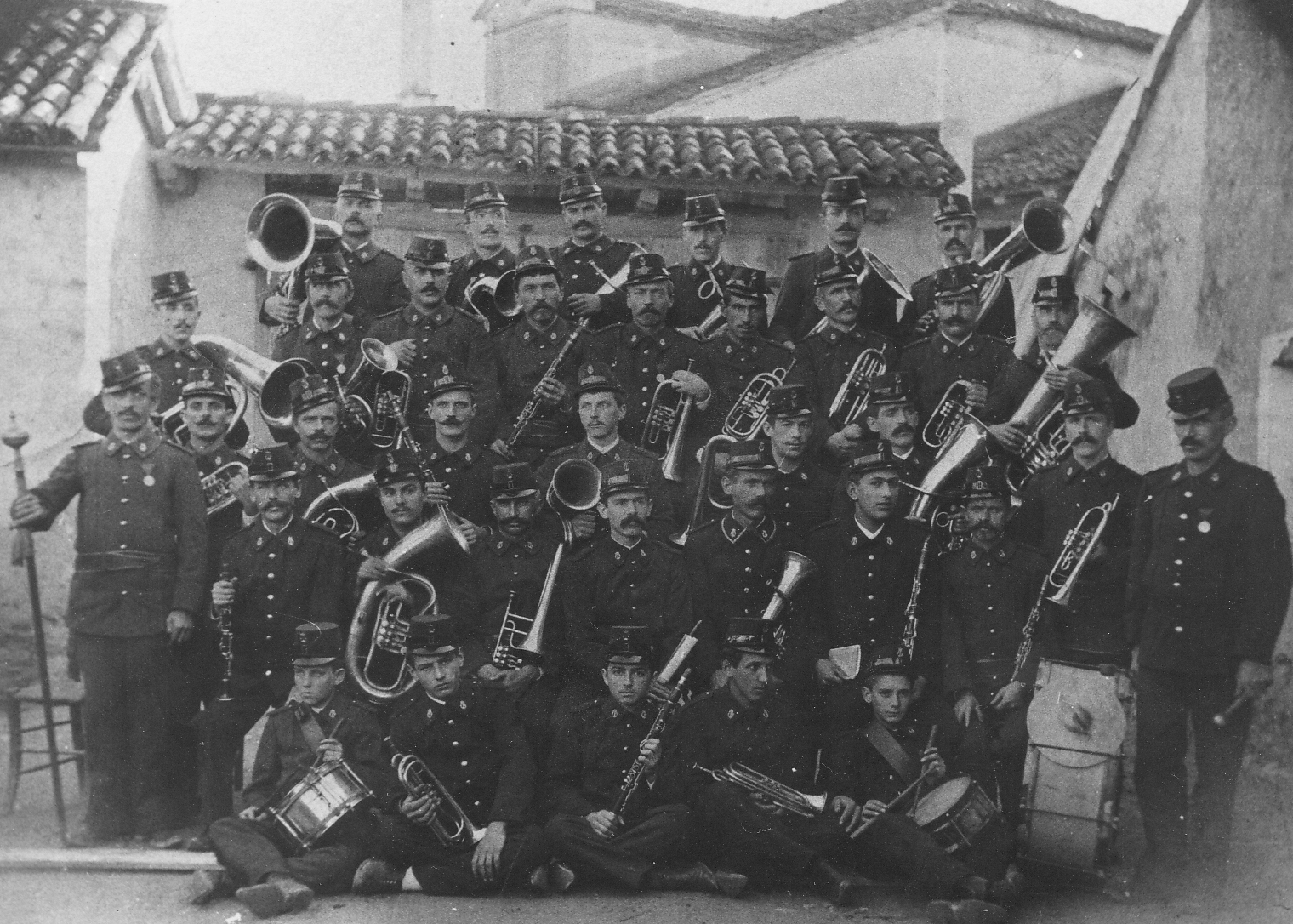 The band in 1898
The names and surnames (and nicknames, where they had them) of those depicted have been carefully preserved. Since this is a photograph taken at the end of the 19th century, we can list them—together with their respective nicknames—without fear of incurring the wrath of any privacy authority.
First row from the back: Gasparo Clemente (Galineta), Giacomo Gregorin (Meto de Miuti), Eugenio Spanghero, Giovanni Cristin, Eugenio Calligaris (Galiot), Luciano Tomasella.
Second row: Marco Cusma (Marco de Nando), Francesco Cosani (Checco Nisio), Giuseppe Cisilin (Bepi della Luigia), Luigi Cosani, Giacomo Cosani, Antonio Spanghero (Toni Gardisan), Isidoro Clemente, Giovanni Caneva, Giovanni Cusma (Zaneto Damian).
Third row: Carlo Torre, Antonio Biasutti (Toni Bidin), Michele Clemente (Michele Bagat), Domenico Biasutti (Menego Bidin), Gino Reatti, Antonio Franzot, Riccardo Clemente, Giulio Cusma, Santo Cosolo.
Fourth row (seated): Giacomo Simonit (Meto Scopet), Antonio Cosani (Toni Cosanel), Antonio Spanghero (Toni Vizeli), Rodolfo Clemente, Nicolò Tomasella, Emilio Tomasella, Lorenzo Tomasella (Enci).
Last row (seated on the ground): Arturo Tomasella (Turo de Enci), Angelo Tomasella, Vittorio Spanghero, Luigi Cusma, Cesare Biasutti (Cesare Bidin).
A fine commentary on this photograph is provided by F. Gon in the article The band of yesterday and that of today, published in the booklet issued in 1990 for the 120th anniversary of the founding.
Uniforms of unmistakable Austrian style, rigid nineteenth-century moustaches: this is how the members of the band […] present themselves, posed before the photographer in the distant year of 1898, in what is the first official photograph to have come down to us and which still today hangs in the Society’s music room.
Severe gazes, faces carved by the hard labour in the fields that in those days occupied the entire population of a small village like so many others, on the edge of the Venetian plain, at the periphery of the domains of the powerful House of Habsburg. And yet from those same eyes—more accustomed perhaps to scanning the sky for an approaching storm than a musical score in search of a missing semitone—there shines through, today as then, the dignity, almost the pride, of those who were conscious of being an integral part of something esteemed and important: the band.
Certainly, in an era when illiteracy was still widespread and one’s best suit had to last a lifetime, the ability to read not only words but actual musical notes—or the privilege of wearing a uniform that had nothing to envy the uniforms of the imperial army—represented an understandable source of distinction and pride for those who belonged to it.
With the turn of the century came a defining moment: the foundation of the Società Filarmonica di Turriaco, and with it a new name—and a new institutional form—for the band.
On 9 November 1900 the statutes of the new society were submitted for approval to the Imperial and Royal Lieutenant’s Office of Trieste. On 19 November the Lieutenant’s Office forwarded the matter to the Imperial and Royal District Captaincy of Gradisca, which in turn sent the relevant dispatch to the founders with a note dated 28 November. On 9 December 1900—exactly one month after the application was filed—the founding assembly of the society was held. As everyone here knows, Austria was an orderly country, and the efficiency of Habsburg bureaucracy has by now entered the realm of legend. (On many other, less praiseworthy aspects of Habsburg governance, it has always seemed best to draw a discreet veil.) But, in that spirit, let us too proceed in order.
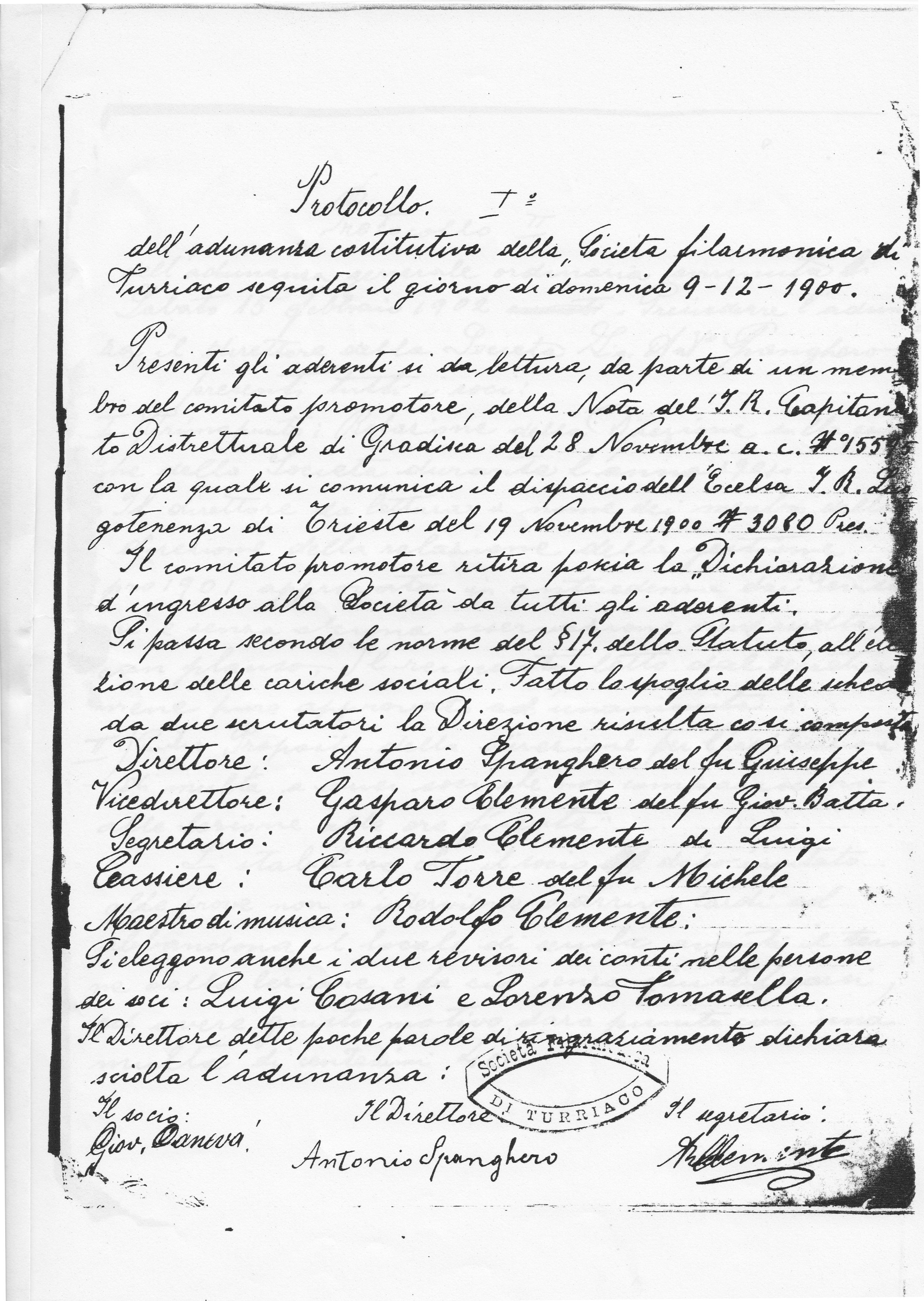 Minutes (or Protocol) of the “founding assembly” of the Philharmonic Society
The original statutes of the Società Filarmonica di Turriaco have been lost, but a copy made at a later date is held in the State Archive of Trieste. The statutes set out in meticulous detail the purposes, structure, and functioning of the society.
Article 2 defines the purposes for which the society was established:
2. The purpose of this institution is to cultivate, among the members who compose it, the art of music by keeping together and instructing the elements necessary for an orchestra, a band, also engaging in the field of singing, and performing both in Turriaco and, if called upon, elsewhere, whether in private or in public, deploying its activity in concerts, dances, and other spectacles, subject to the licence of the competent authority.
The following article establishes that:
3. Those persons may become members of the Society who, by means of an examination taken before the Society’s conductor, demonstrate knowledge of how to practise the art of music in one of the branches mentioned in article 2, who are of irreproachable conduct, and who have reached the age of 15.
The word examination and the phrase irreproachable conduct signal at once that one is in a different world from the one to which we are accustomed.
Equally revealing is what follows:
7. A member is expelled from the Society who: a) falls three consecutive monthly contributions into arrears; b) compromises the decorum and good reputation of the Society; c) fails to demonstrate irreproachable moral conduct.
The following article specifies that, while members in arrears may be readmitted after three months’ suspension (and, presumably, after settling what they owe), those expelled on either of the other two grounds may never be readmitted.
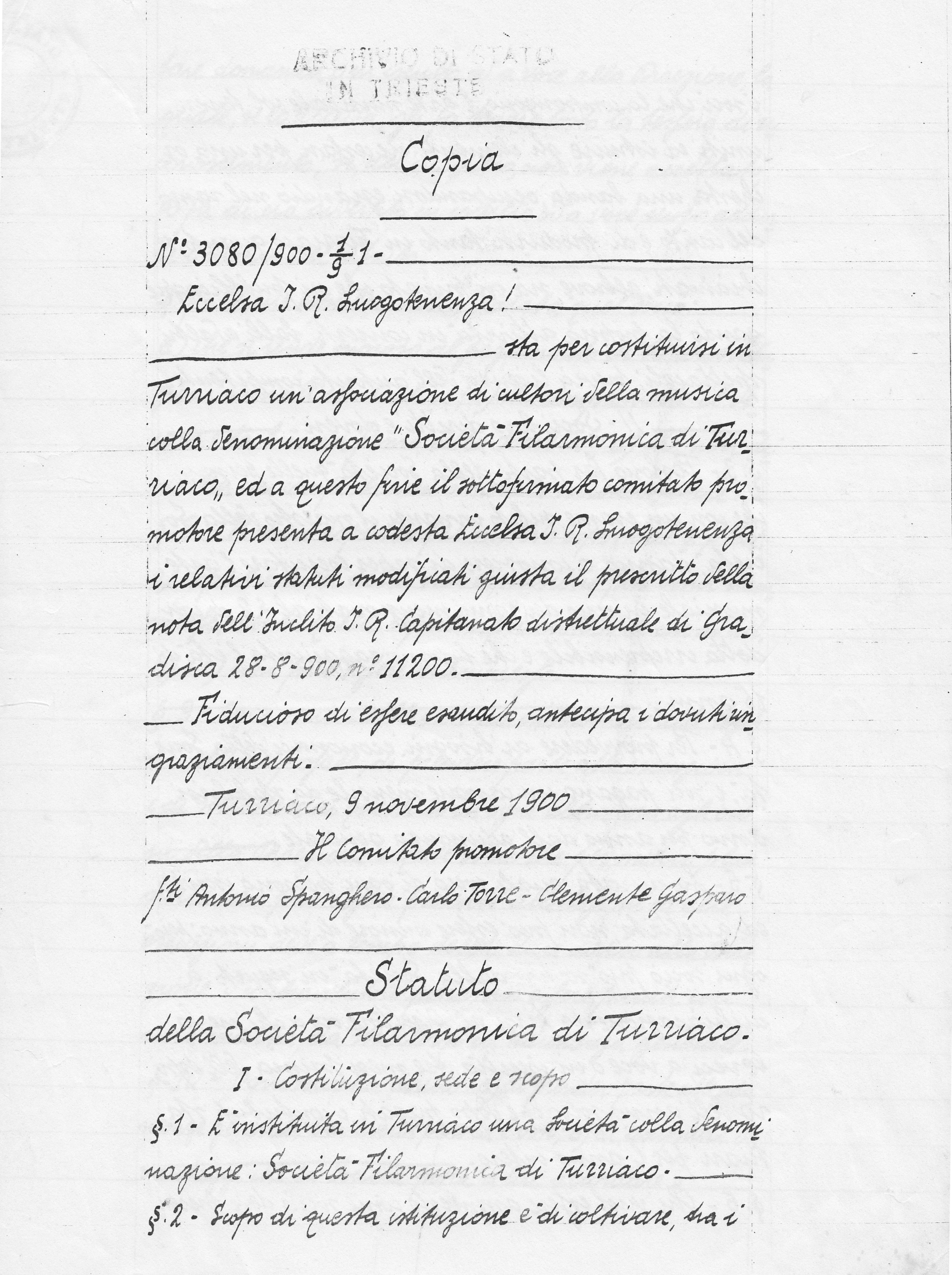 Statutes of the Società Filarmonica di Turriaco (1900)
Among the obligations of members we find that:
9. Every member is obliged to attend lessons at the times set, to take part in performances, and to submit in this and in all other matters to the orders of the Board. A member who for a justifiable reason cannot attend lessons or performances must give timely notice to the Board. Those in breach may be punished with a fine to be determined at the general assembly.
The remaining articles, reproduced in full in Appendix A, regulate the convening and conduct of assemblies, describe the structure and functioning of the governing bodies, and establish the procedures for amending the statutes and for the possible dissolution of the society.
On 9 December, as noted, the founding assembly was held. The Board elected was composed of:
Auditors of accounts: Luigi Cosani and Lorenzo Tomasella.
The inventory drawn up at the time of the founding shows that the Society’s endowment (or facoltà, as it was then called) consisted of:
and furthermore:
plus other minor items, for a total value of 742 crowns.
That business was conducted seriously from the outset is clear from the minutes of the second general assembly, held on 15 February 1902. After approving the Board’s report on activities carried out in 1901—the Society’s first year of life—the assembly turned to the proposed imposition of a fine on those members who did not appear at lessons at the times set.
It is established that a member, having been invited to rehearsals, who does not attend or arrives late or leaves the rehearsal room before the lesson is over, and does so without justification or valid reason, shall be punished with a fine of 40 centesimi.
The weight of such a sum becomes apparent from the third item discussed at the same meeting, which fixed the monthly membership fee.
The assembly, having noted that the monthly fee of the previous year was sufficient to meet the needs of the Society, resolves that for 1902 as well it shall be 50 centesimi.
The fine, in other words, was anything but symbolic—amounting to nearly a full month’s subscription. Finally, at the same meeting:
A regulation proposed by the Board is accepted, containing general rules to be followed by the Board itself in the formation of the musical corps that is to present itself at public or private performances, and in the remuneration to be given to the member musicians for their services at the said musical performances.
Which is to say: at that time, the members of the Turriaco band were paid to play!
If the inter-ethnic conflicts of those years, given the small size and homogeneity of the local population, never seriously touched Turriaco, the same cannot be said of its political ones. Compounding personal animosities and the usual village feuds, these divisions reached the band as well, splitting it into two factions: the Clemente family, sympathetic to the Catholic movement, ranged against the Tomasella family, whose sympathies lay firmly with Socialism.
To mock their rivals, the two sides could think of nothing better than to invent nicknames for each other, faithfully handed down to the present day. The Clemente faction were called salamari—the meaning (derived from salami) transparent enough—while the Tomasella men were the pitioti (here it helps to know that pitiòt meant thin, watered-down, low-quality wine).
Not content with having two bands instead of one, Turriaco saw its musical offering expand still further when the Clemente family formed a dance orchestra that was a great hit on the tavolàz—the wooden platform on which people danced at festivals and fairs.
The success the rivals enjoyed throughout the surrounding area promptly moved the Tomasella family to form their own orchestra.
There is still a memory of the trip that in 1906 Emilio Tomasella made to Trieste, returning with four violins and a double bass to equip the new ensemble. The direction of the group was entrusted to Maestro Scaramelli, hired for the purpose. When funds to pay the maestro eventually ran dry, the orchestra passed to young Silvio Cosolo, a clarinetist and violinist who found himself promoted on the spot to the role of unpaid director. Turriaco thus became known for its two bands and its two dance orchestras—which, for a village of roughly 1,300 inhabitants, is no small distinction.
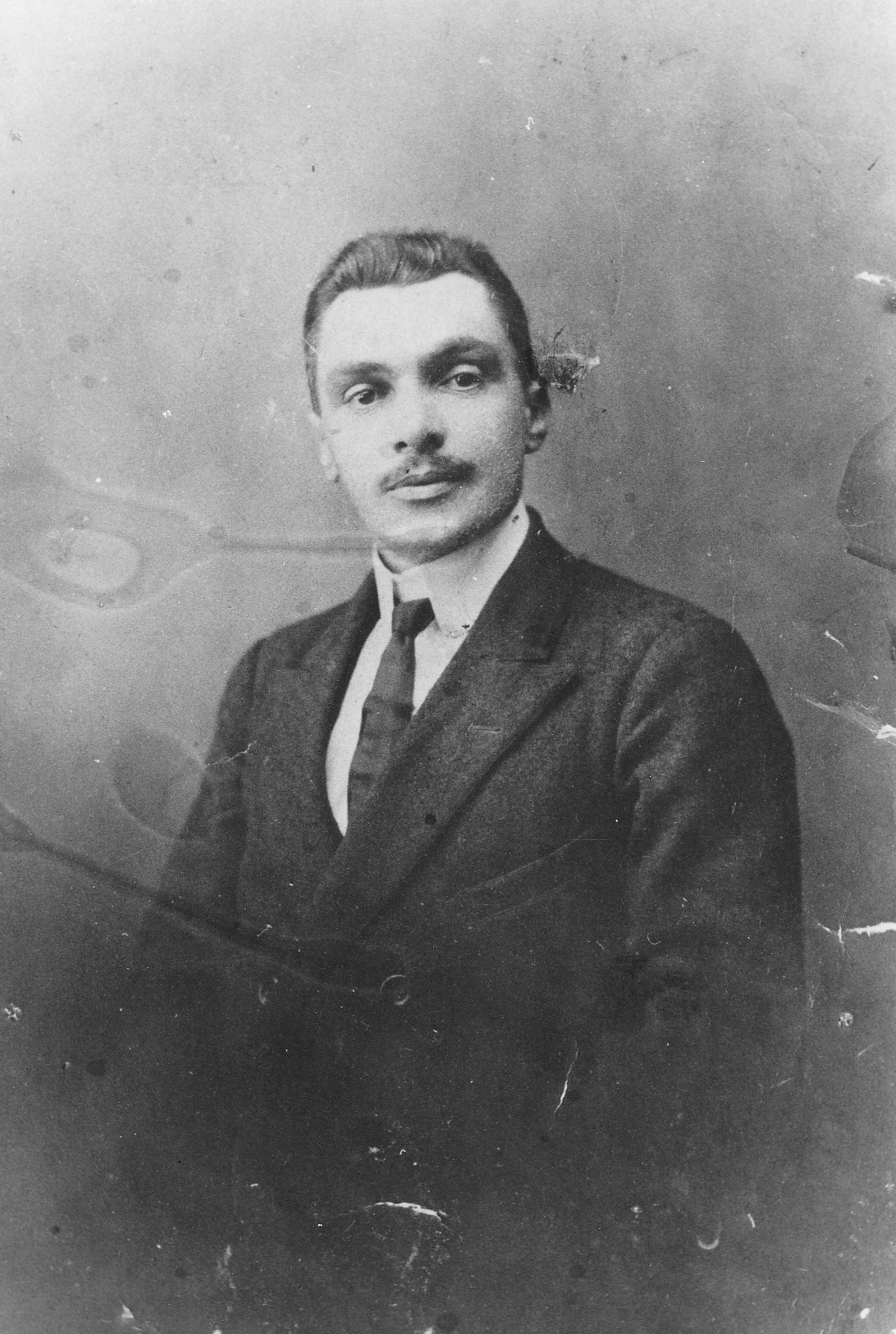 Silvio Cosolo
A small but necessary digression before we move on. If the reader has by now begun to lose track of the various Clementes, Tomasellas, Cosolos, Spangheros, and the rest, they may take comfort in knowing they are not alone.
At the municipal elections of April 1903, the vote count became muddled between Luigi Clemente son of Santo, a Clericalist who received 38 votes, and Luigi Clemente son of Michele, a Liberal who obtained 40. The votes that carried no patronymic were all assigned to Luigi son of Michele, who had openly declared for the Liberal party leader Giuseppe Cosani, and Cosani was duly elected. The Clericalists lodged an appeal and refused to attend sessions of the municipal council, depriving it of a quorum and effectively paralyzing it. The appeal was upheld, the Council declared null, and pending new elections, the defrauded Luigi son of Santo was appointed Municipal Administrator. The delicate business of handing over power and settling the accounts between Cosani and his successor was resolved—with the help of an official sent from the Provincial Accounting Office—without too many incidents, and the village could at last be governed again.
The subsequent elections confirmed Luigi Clemente son of Santo as mayor. His term proved troubled as well, largely due to financial difficulties in managing the municipality—a story from which, it must be said immediately to forestall any slander, Luigi Clemente’s reputation emerged spotless: he personally covered, out of his own pocket, the shortfalls that arose during his administration. The full story is told in Vittorio Spanghero’s essay and is well worth reading, if a copy can be obtained.
On 28 July 1914, Austria declares war on Serbia. It is a war that will engulf the world, and one that we—before certain revisionist impulses took hold—have always called the Great War. It will be the first of the great massacres and tragedies of the 20th century, and it will end with the disappearance of the Habsburg Empire and its passage into that myth which, at least in these parts, at least for some, still endures as a form of nostalgic regret.
Italy does not enter the war immediately, and for nearly a year in Turriaco one hears only the shots of hunters. There is, however, a mobilization: all able-bodied men between 18 and 36 are called to arms.
The overwhelming majority of the population is pro-Austrian—loyal subjects of His Imperial Majesty—as is the clergy, solidly so (which will surprise no one). The few who openly side with Italy are immediately interned in Austria. By way of reciprocity, as soon as the Italians arrive in Turriaco, those considered to be on the wrong side will be interned somewhere in the peninsula—starting with the parish priest, Don Eugenio Brandl, who is promptly dispatched to Piedmont.
On May 34, Italy enters the war, and Turriaco finds itself on the front line. The Austrians blow up the bridges over the Isonzo and retreat to the Carso. The civilian population is moved to safer areas. Only the gendarmes from Pieris remain.
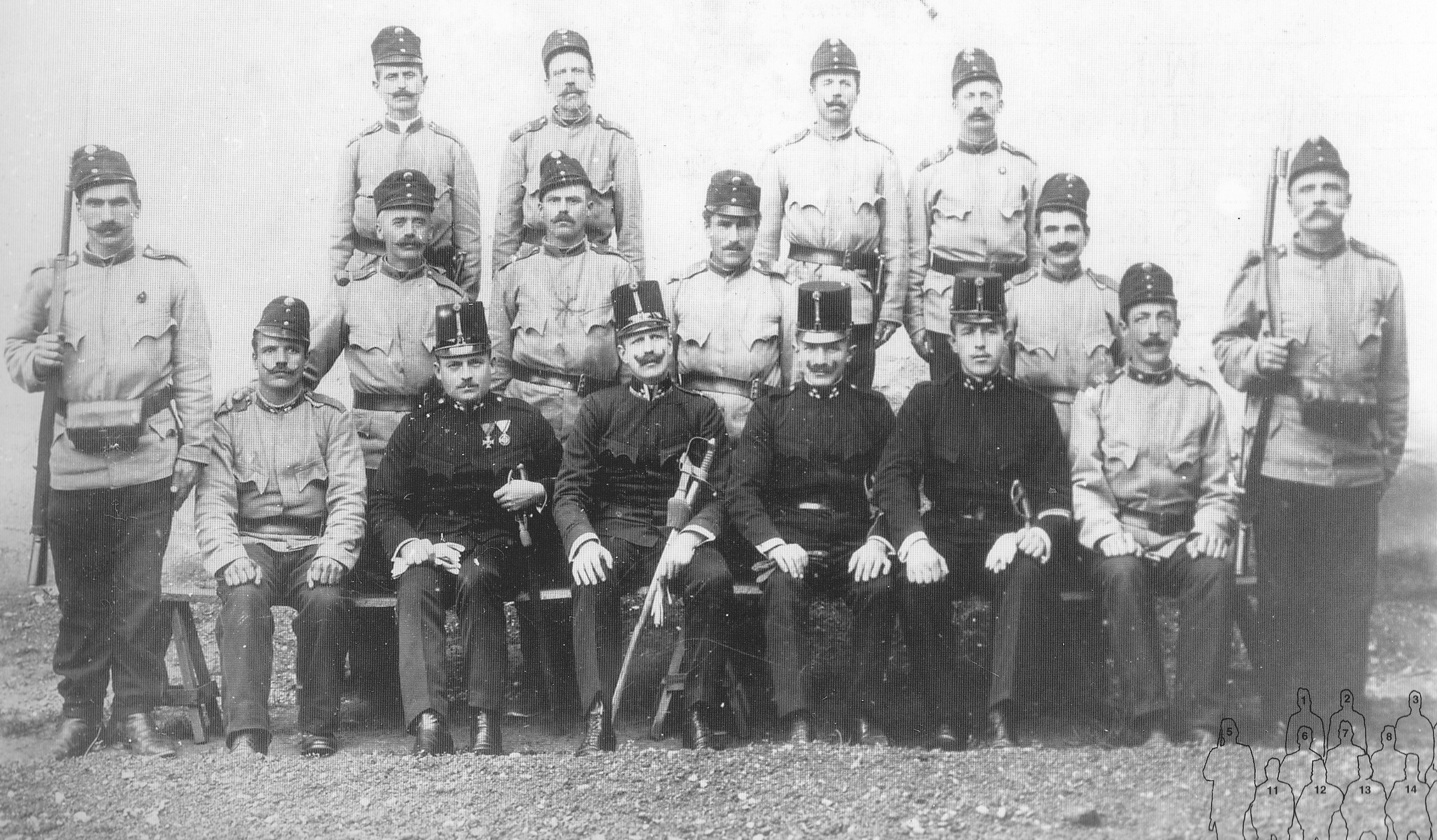 Territorial Service Gendarmes
The Italian High Command war bulletin of June 7 reads:
On the lower course of the Isonzo, military bridges having been thrown across in the face of the adversary, strong units, preceded by brilliant cavalry reconnaissance, have already crossed to the eastern bank where they are fortifying themselves. The aim is thus to obtain also on the Isonzo, as on other fronts, the necessary freedom of manoeuvre; and operations have been initiated for the day when the employment of the main forces is decided. Our losses are relatively slight.
The Italians, in the form of the 13th Infantry Regiment, had entered Turriaco two days earlier, on 5 June. The relatively slight losses would be a distant memory when the employment of the main forces was decided.
Of the band during this period, one might think there is nothing to say. And yet in some way it continued to live and to make music—not in Turriaco, but in Wagna.
Wagna is a locality in the district of Leibnitz, in Styria, which during the First World War housed a Flüchtlingslager—a refugee camp that took in civilians, the vast majority Italian but also Slovenian, evacuated according to prearranged plans from areas close to the Austrian defense lines on the Isonzo, the Carso, and the naval base of Pola. Built between October and November 1914 to accommodate refugees from Galicia, by spring 1915 the camp had grown to the scale of a small town.
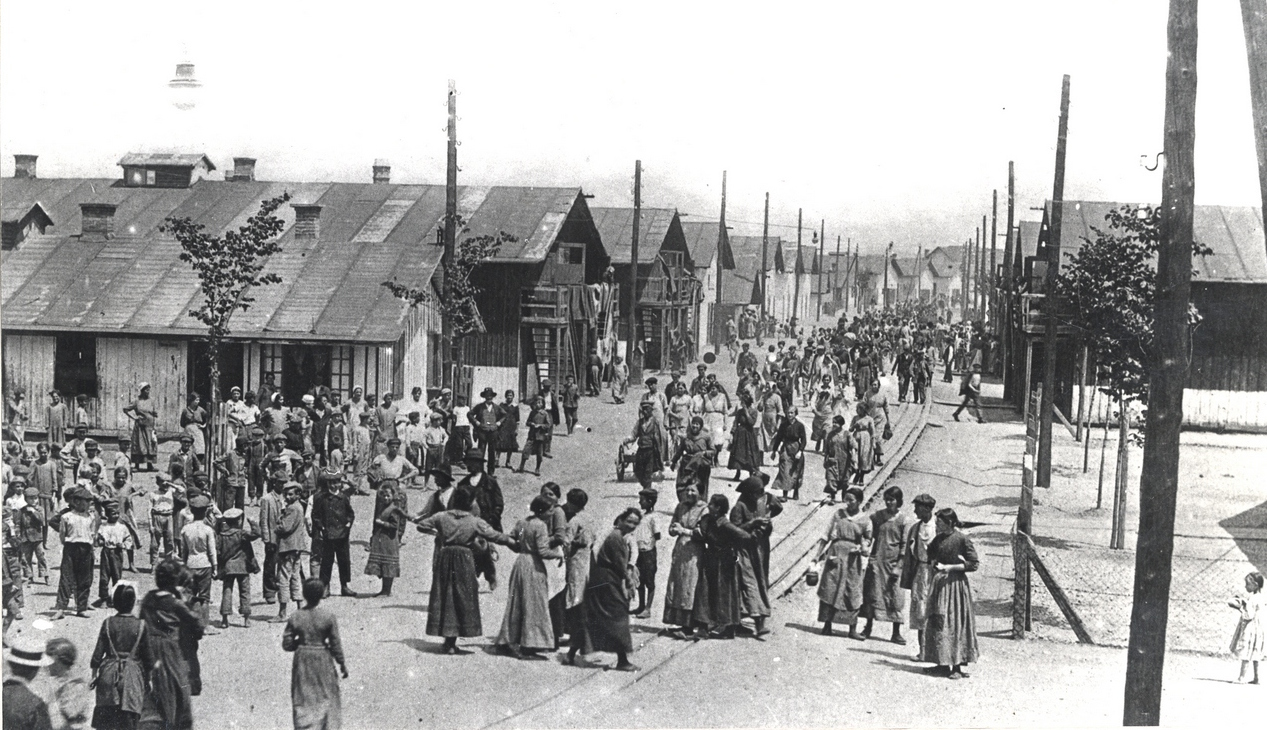 The Wagna camp
In addition to the barracks—each of which could house 400 people—the camp contained a church, two schools, a bazaar, kitchens, and service buildings. Priests, teachers, doctors, and people of standing occupied smaller and better-appointed quarters.
Situated, as regulations required, at a suitable distance from inhabited centers, the camp held not only refugees but internees. The two categories had a different legal status. Refugees who could support themselves financially could avoid living in the camp; internees were confined there by police order, either as citizens of enemy nations or as individuals considered politically suspect.
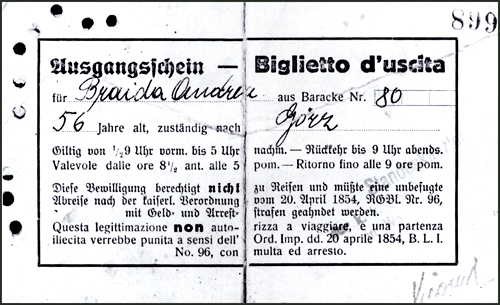 Exit permit from the camp
In the summer of 1915 the camp was divided into three sectors: one for refugees from Galicia, one for regnicoli—Italian citizens resident in the territories of the Empire—and one for Austrian citizens of Italian language from the war zones. The Italian population of the camp numbered around 5,000 in total. The different sectors were separated by metal fences, and contact between internees and refugees was strictly forbidden.
Among those who lived in the Wagna camp during the war was Rodolfo Clemente, the band’s conductor.
Born in Turriaco on 18 August 1873—and thus 25 years old at the time of the Jubilee concert—he had attended the elementary schools of Turriaco and the carpentry school of Mariano before studying music at the Trieste Conservatory, where he graduated in composition.
[…] having learned bookkeeping, he was taken on by Mons. Faidutti as auditor and inspector of the Rural Banks. His technical competence, his probity, and his modesty were appreciated by all. More than an inspector, he was an adviser to the administrators.
At Wagna, Clemente became a collaborator of his old friend Augusto Cesare Seghizzi, choral conductor and composer, whom he had known at the Conservatory. Together they managed to assemble a choir of nearly 150 young people and an orchestra of some fifty members, who performed both inside and outside the camp.
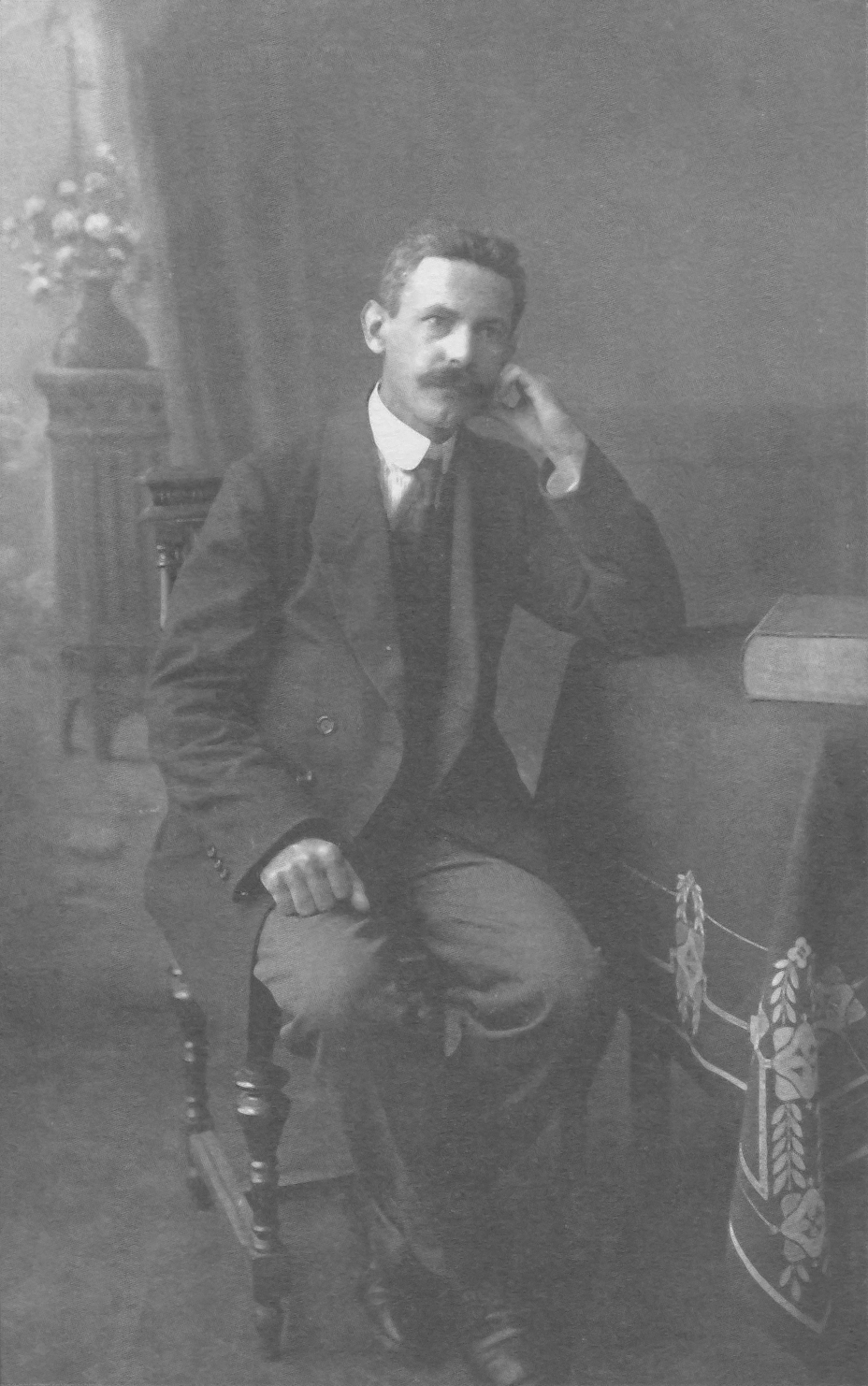 Rodolfo Clemente
One might wonder whether any of those musicians were from Turriaco. It is not impossible: the number of refugee families from the village in Austria amounted, according to Furioso, to 16, and among their members there could easily have been a band player who was either too old or unfit for active military service.
Life at Wagna is recounted with a wealth of detail and considerable vivacity in articles published between 1915 and 1918 in L’Eco del Litorale, signed with pseudonyms or fictitious names. It should be noted, however, that these pieces offer less a faithful chronicle than an embellished picture of daily reality—a life characterized by hunger, hardship, and privation that grew steadily worse as the conflict dragged on.
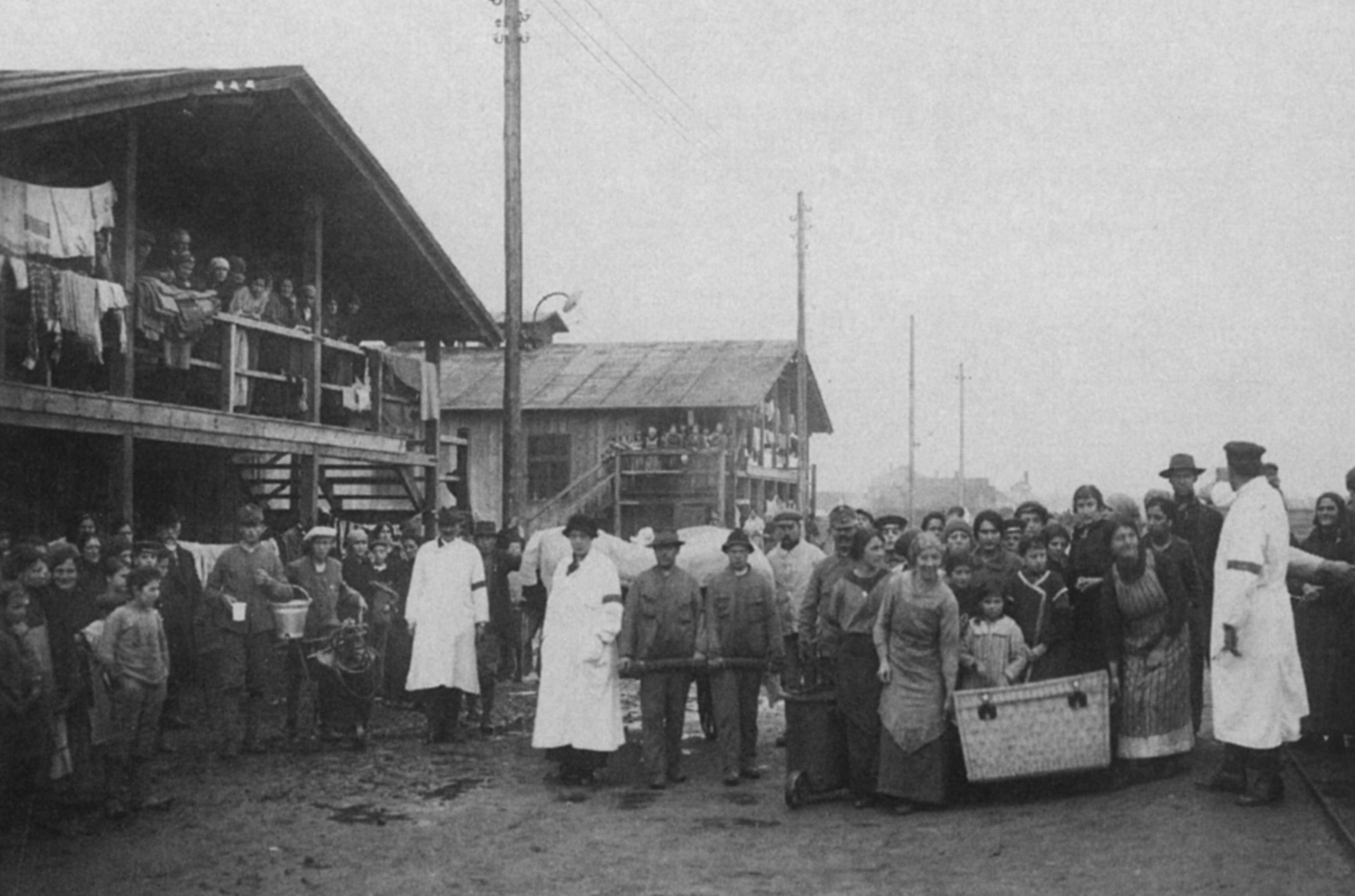 Disinfection of the barracks
An article dated 15 January 1916 comments on a performance of Gli Innamorati by Goldoni—cited by the author as Innamorato—staged by a company formed in the camp:
[…] On the afternoon of Epiphany, before a hall packed with spectators—among them almost all the gentlemen of the Administration—the new little theatre was inaugurated. Goldoni’s sparkling comedy was admirably sustained by the fine group of amateurs: Misses Glavich, Romano, Codilia and Zucchelli; and Messrs. Pedicchio, Silvestri, Talantin, Milloch and Louvier.
We make no distinctions, but say only in general that if they continue to study seriously, limiting themselves perhaps at first to easy comedies of lesser scope, they will in future be able not only to draw applause from the crowd but also to satisfy more rigorous critics. Meanwhile, a sincere word of praise to all, and especially to the fine instructor Prof. Tomasi, who, given the environment and local circumstances, can be said to have passed a fairly arduous test with satisfaction. Miss Codilia was also appreciated for a song: “Serenata.”
During the intervals the amateur orchestra, conducted by our excellent Maestro Clemente, performed several pieces from Verdi’s “Rigoletto.”
The great opportunity for Seghizzi, Clemente, orchestra, and chorus came when they were invited to give a concert in Graz. L’Eco del Litorale of 3 February announced the news:
For Sunday the 6th of this month our music and singing school has been invited to take part in a charity concert to be held in Graz, in the Sofiesäle [sic]. Our fine amateur orchestra of gentlemen will take part with an artistic programme, together with a children’s choir who will perform songs.
The concert evidently went well, because shortly afterwards (on February 16) we find the following:
It is said that within the coming month of March the orchestra and choral forces of Wagna will go to Vienna to give a concert there. You can imagine the anxiety and enthusiasm with which especially our children will prepare themselves to present themselves worthily in the capital before that most refined and exacting public.
followed, on March 3, by this update:
Preparations are in full swing for the great charity concert that our refugees will give in the capital on 30 March. The programme of musical and vocal pieces has been chosen with excellent artistic taste. The choral forces number around 400 persons, among girls, children, and young women. Appropriate national costumes are being prepared for the singers, who will, among other things, perform a medley of our finest ancient villotte , the magnificent prayer from “Moses,” and the famous “Psalm” of Benedetto Marcello.
Our fine music conductors Seghizzi and Clemente have their work cut out in arranging, orchestrating, and rehearsing the abundant musical material that will be performed at this concert. We hope that—given the efforts and expenses connected with this artistic-patriotic enterprise—it may be crowned with gratifying success.
The concert was a great success. L’Eco del Litorale gave it wide and detailed coverage, returning to the subject a couple of days later to report the comments of the Viennese press and add its own observations.
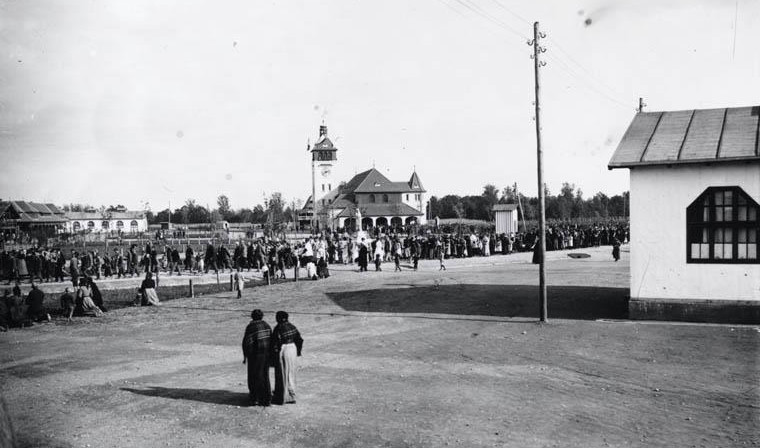 General view of the camp
On July 16, 1916 another significant event took place. Don Pietro Sepulcri, originally from Selz near Ronchi, himself a refugee at Wagna with his family, had been ordained a priest by the Prince Archbishop of Gorizia only a couple of days earlier. Now he celebrated his first Mass. The ceremony, held in the parish church of Leibniz, was attended in force by the camp’s residents, the authorities, the entire Military College—which rendered honors—and Mons. Faidutti, archdiocesan delegate for the spiritual care of the refugees, who had come expressly from Vienna.
L’Eco provided, as usual, a rich and detailed account. On the musical aspect of the event—the part that most concerns us—it wrote:
For the solemn occasion of the first Mass of Don Pietro Sepulcri, Maestro Augusto Seghizzi, organist of the Gorizia Metropolitan Cathedral and currently music and singing teacher at the imperial and royal camp of Wagna, composed the Mass “Dona nobis pacem,” dedicated to his friend Maestro Rodolfo Clemente—a beautiful musical composition for two treble voices with organ accompaniment.
The style used in this work is that followed by several contemporary composers, in which, while respecting the liturgical prescriptions, at certain points the sacred text is interpreted in a somewhat dramatic manner, which gives the music life and ensures that from the very first hearing it finds its way into the listener.
Homophonic for the most part, and with a melodic line that is consistently clear, this Mass is not difficult to perform and proved genuinely well-suited to a boys’ choir such as that directed on Sunday by Maestro Seghizzi.
The harmonisation, on the other hand, is done with a certain richness of means and according to modern principles; the modulation is always fluent while remaining within the bounds of reason.
Aesthetically too this composition presents itself well; particularly appreciated were the Kyrie, the Et incarnatus, the Sanctus—with its quality of grandeur—and the Benedictus.
The Ave Maria, also by Maestro Seghizzi, written in imitative style and performed at the Offertory, was found equally praiseworthy.
The performance was generally judged to be more than commendable in its entirety—and this must be acknowledged all the more readily given that the choir was composed of a hundred boys and girls from the camp’s elementary schools, none of whom could read music, and that the time available for preparation had been very short.
At the organ was Maestro Rodolfo Clemente, devoted deputy and affectionate collaborator of Maestro Seghizzi in all his current musical endeavours.
Don Sepulcri went on to become the first parish priest of Staranzano when that parish was established in 1935. The author of these pages may be permitted a personal recollection: he was fortunate enough to know him briefly—for a few months before Don Sepulcri’s death in January 1957—as a religion teacher in first grade.
A couple of years later, while attending middle school and grappling with his first Latin, the author was serving as an altar boy during Vespers when his eye fell on a sheet tucked between the pages of the psalms. It contained a prayer beginning with Domine salvum fac Imperatorem nostrum Franciscum Josephum, which Don Sepulcri continued undeterred to raise to the Almighty, heedless of the fact that salvum could by now only be understood in a spiritual sense—the beneficiary of the prayer having passed into eternity on November 21, 1916.
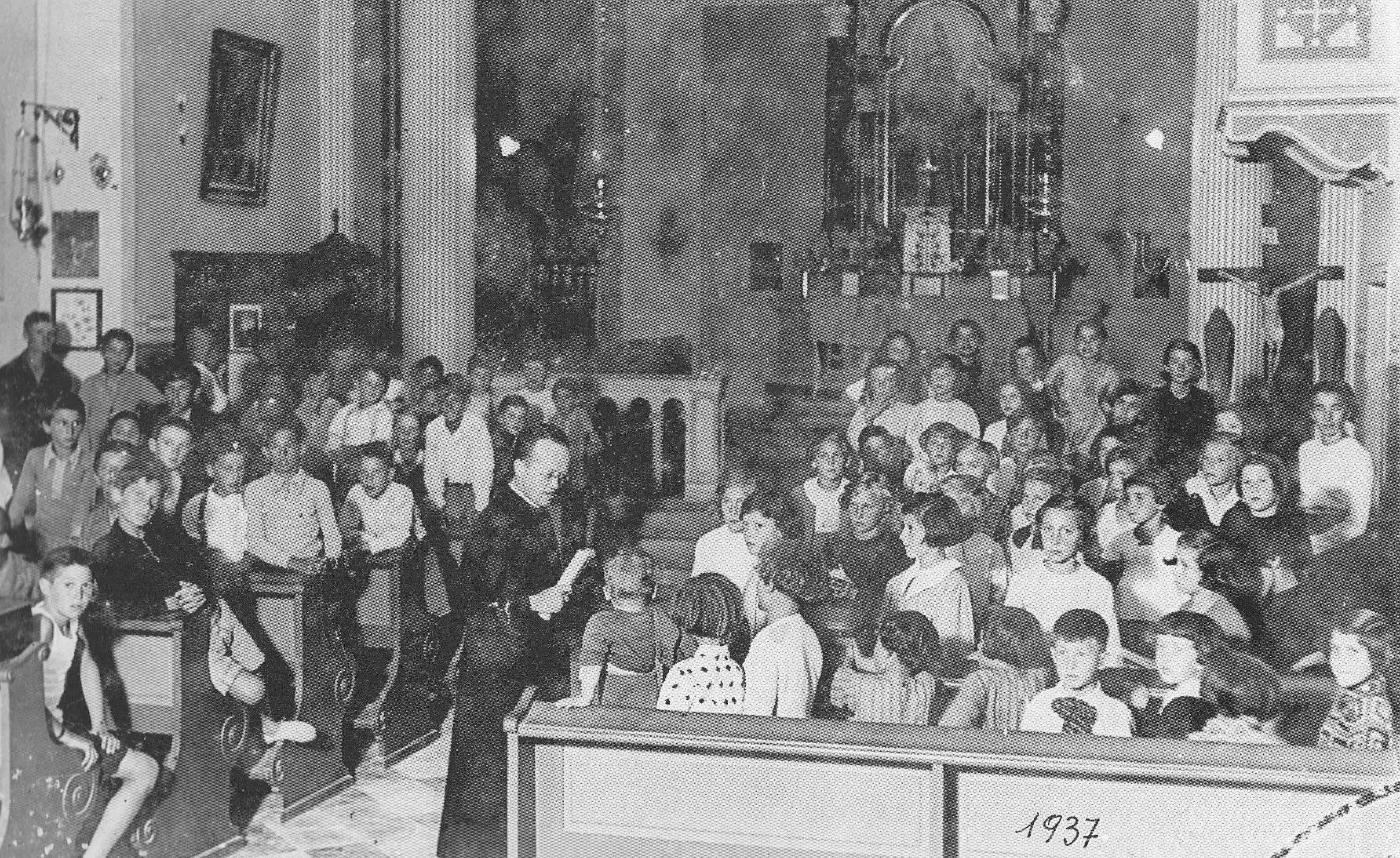 Don Sepulcri teaching catechism in Staranzano (1937)
One final note from Wagna. On 2 December 1916, to mark the passing of the late emperor, Maestro Seghizzi’s Requiem Mass for two treble voices and orchestra was performed in the camp church. After a detailed and perceptive musical analysis of the work, L’Eco del Litorale concluded:
The Mass was conducted by the composer himself, Maestro Seghizzi. The performance was refined, delicate, and impeccable. The small choir of boys and girls from the camp’s elementary schools deserves special commendation. These youngsters, under the expert guidance of their conductor, overcame in a very short time all the difficulties the composition presents; the same may be said of our little orchestra, which played with the most praiseworthy collaboration of the magical violin of Miss Nives Luzzatto, whose splendid artistic gifts are widely celebrated. At the organ was Maestro Rodolfo Clemente, whose profound knowledge and proven experience in music greatly contributed to the success of the work.
We have dwelt at some length on Wagna, and on the music made there, partly to avoid spending too much time on the war’s more harrowing events. It is nonetheless necessary to touch, if only briefly, on the effects the conflict had on life in Turriaco itself.
From the first days of the war, the Italians are in Turriaco. The command post—first of a division, then of an entire army corps—is established at Palazzo Mangilli. The Duke of Aosta finds hospitality there on several occasions, as do a succession of distinguished visitors: King Vittorio Emanuele III, the Duke Calvi di Bergolo, the Duke of the Abruzzi, Princess Iolanda of Savoy, and generals Cadorna, Giardino, and Grazioli. The village is also visited by the poet Gabriele D’Annunzio and the writers Ugo Ojetti and Sem Benelli.
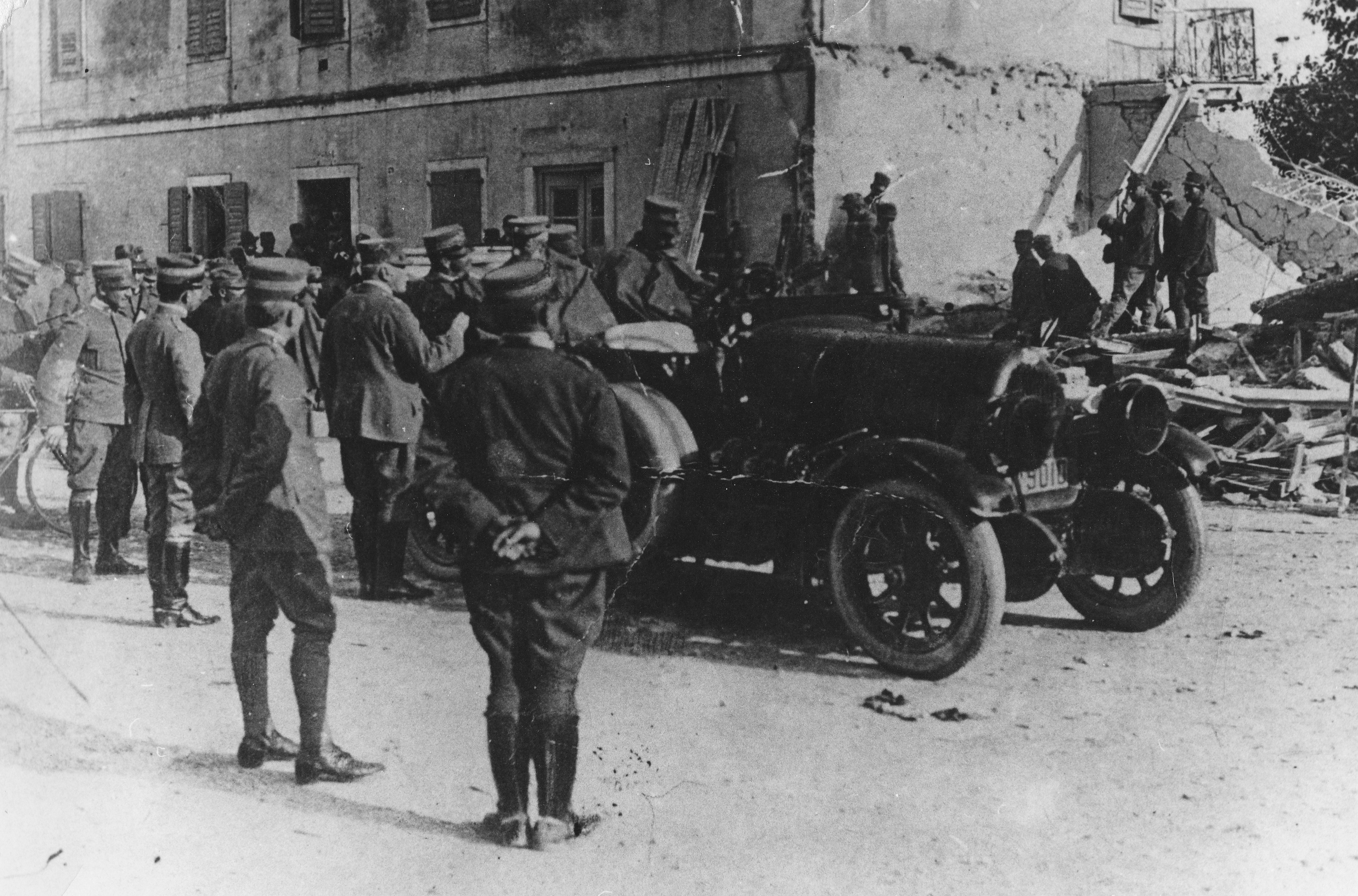 King Vittorio Emanuele III visiting Turriaco
Villa Fonda is used as a field hospital. Another hospital is set up in the Rest Home, and the wounded are accommodated as needed in the school and in the church as well.
The inhabitants share the soldiers’ hardships and dangers. On July 7 an Austrian shell kills Domenica Cosma; on October 9 another lands on a house in what is now Via Oberdan and kills Angela Minin and her three daughters on the spot.
Further shellings destroy buildings, inflict casualties, and bring down the hackberry tree that stood in the middle of the square. On August 5, 1916 Via Oberdan is hit again: this time the three Cristin brothers lose their lives, aged 19, 18, and 11.
Meanwhile, the civil administration has been replaced by a military one, and decisions are taken under the full powers conferred by the Supreme Command of the Royal Army. Efforts are made to restore some semblance of normality. Schools reopen, staffed by Italian military personnel with teaching qualifications who, after a period of retraining, are detached from their units and assigned to local educational authorities. Technically this is School during the period of war in the presence of the enemy—and as such, one cannot afford to be too particular.
Since the classrooms are needed for other purposes and it is in any case too dangerous to remain within artillery range, when the weather permits, lessons are held in the so-called communication trenches outside the village.
The relationship between the Turriaco children and their new teachers proves difficult and marked by misunderstandings. The nickname bucàl bestowed on one of these teachers—whose identity is on record but whom, for obvious reasons, we decline to name—says it all. (Speakers of the local Bisiac dialect require no translation; for others, it is perhaps best left untranslated.)
This is, after all, a collision between two worlds that had until then remained substantially unknown to each other. Even the celebrated exchange between Benito Mussolini—a qualified teacher who fought the war as a Bersagliere—and a little girl from Pieris, recorded in the future Duce’s war diary, captures something of this friction:
“What did you learn at school today?”
“Gnente (Nothing)”
“Would you like a little bread?”
“Màgnetela! (Eat it yourself!)”
From a fine article entitled Books and Propaganda by Vittorio Spanghero, published in the widely read local periodical iMagazine, come the following two episodes.
The first features the teacher Torquato Perazzotti and his mixed fourth-year class of 1916. Having just been introduced to his pupils, the teacher asked those who could write to step forward. When the entire class moved, Perazzotti flew into a rage and began distributing insults, insisting that only those who could actually write should step forward. When everyone advanced again, the teacher asked incredulously: “Don’t tell me you can all read and write?” Evidently nothing in his experience had prepared him for what went on in a Habsburg Volksschule.
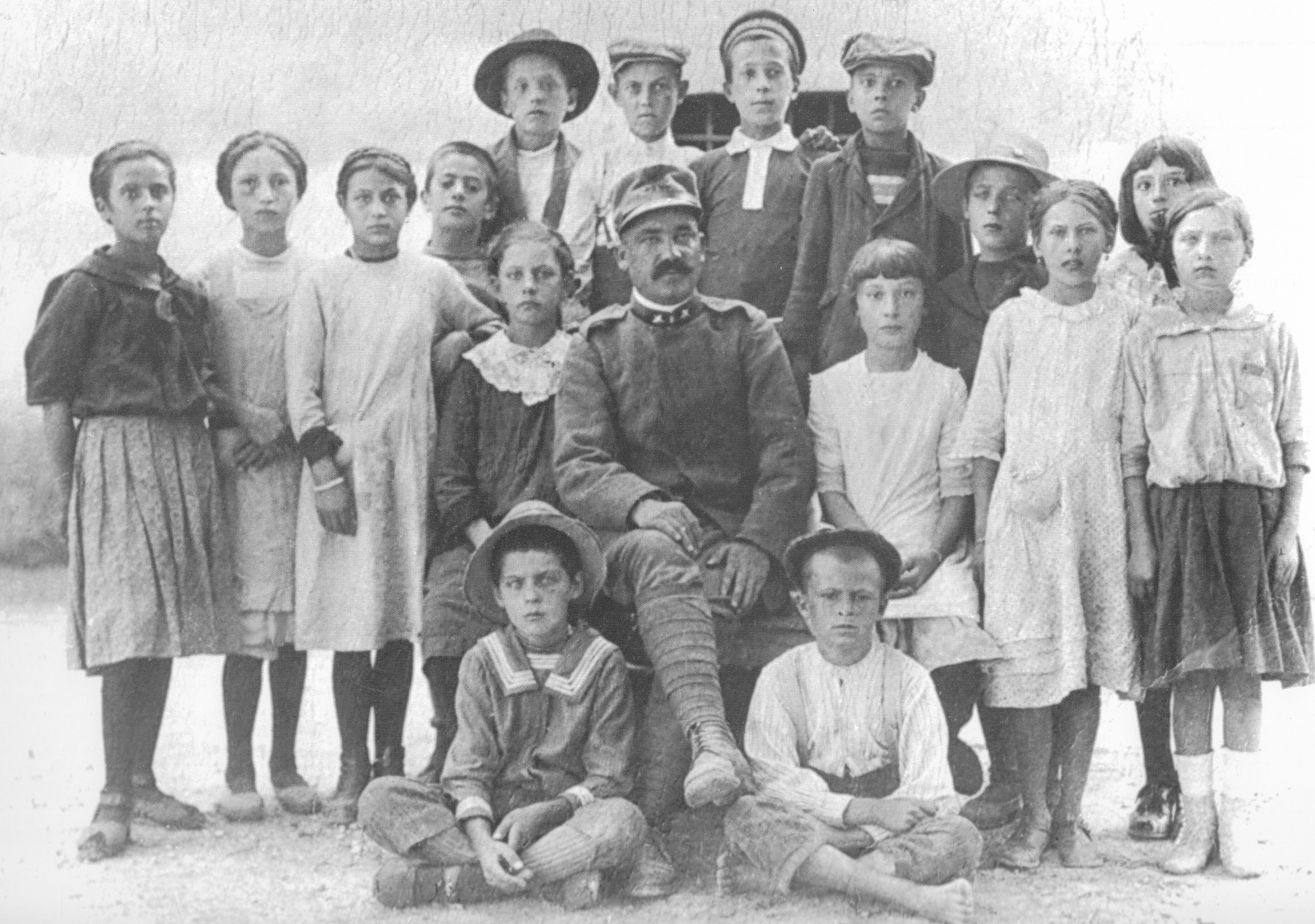 Teacher Perazzotti and his class
To encourage families to accept the new educational approach, the administration provided school materials free of charge, together with a mid-morning snack of bread and cheese and a lunch made from whatever remained of the soldiers’ rations.
Spanghero also records a scene in which a group of children wait in line for their food ration from the carabiniere in charge of distribution. As he is about to serve one child, the boy behind him calls out:
“No la ghe staghe dar a lui che’l xe austriacante!” (Don’t give it to him, he’s an Austrian sympathiser!)
“Ah, an Austrian sympathiser,” says the carabiniere. “Let’s see then”—and turning to the waiting boy: “If you want your ration you must shout: Long live Italy!”
The child comes to attention, raises a salute, and shouts: “Long live Austria!” Then runs away.
An Italian officer who had witnessed the scene reprimands the carabiniere: “Go after him and give him his ration. And learn from him what it means to love one’s country.”
If relations with the children are not always easy, those with the adult population go rather better. There are only 122 men left in the village; the rest is women and children. The soldiers’ presence creates opportunities for small commerce and occasional work—women washing linen and uniforms, farming families selling food to the troops.
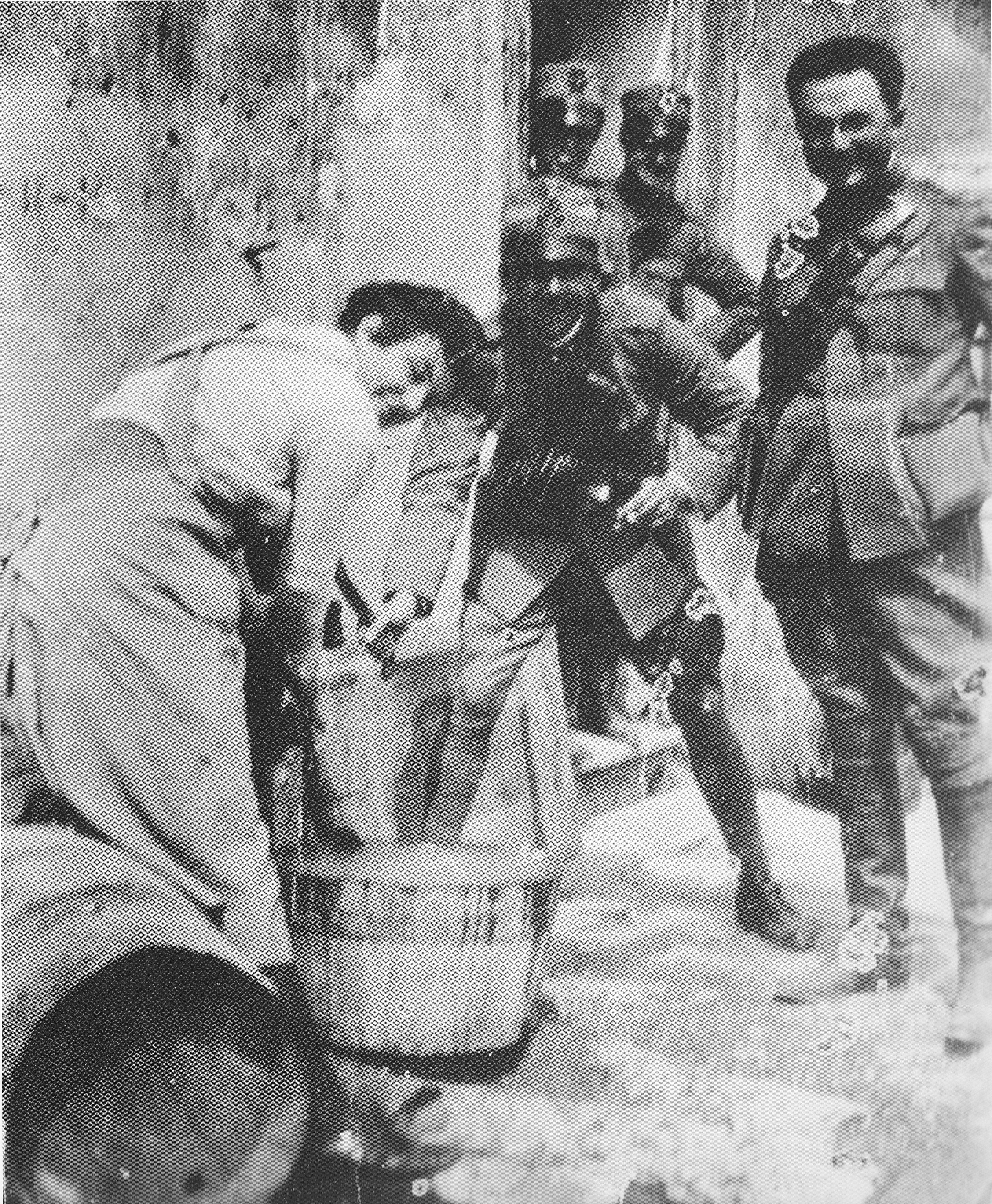
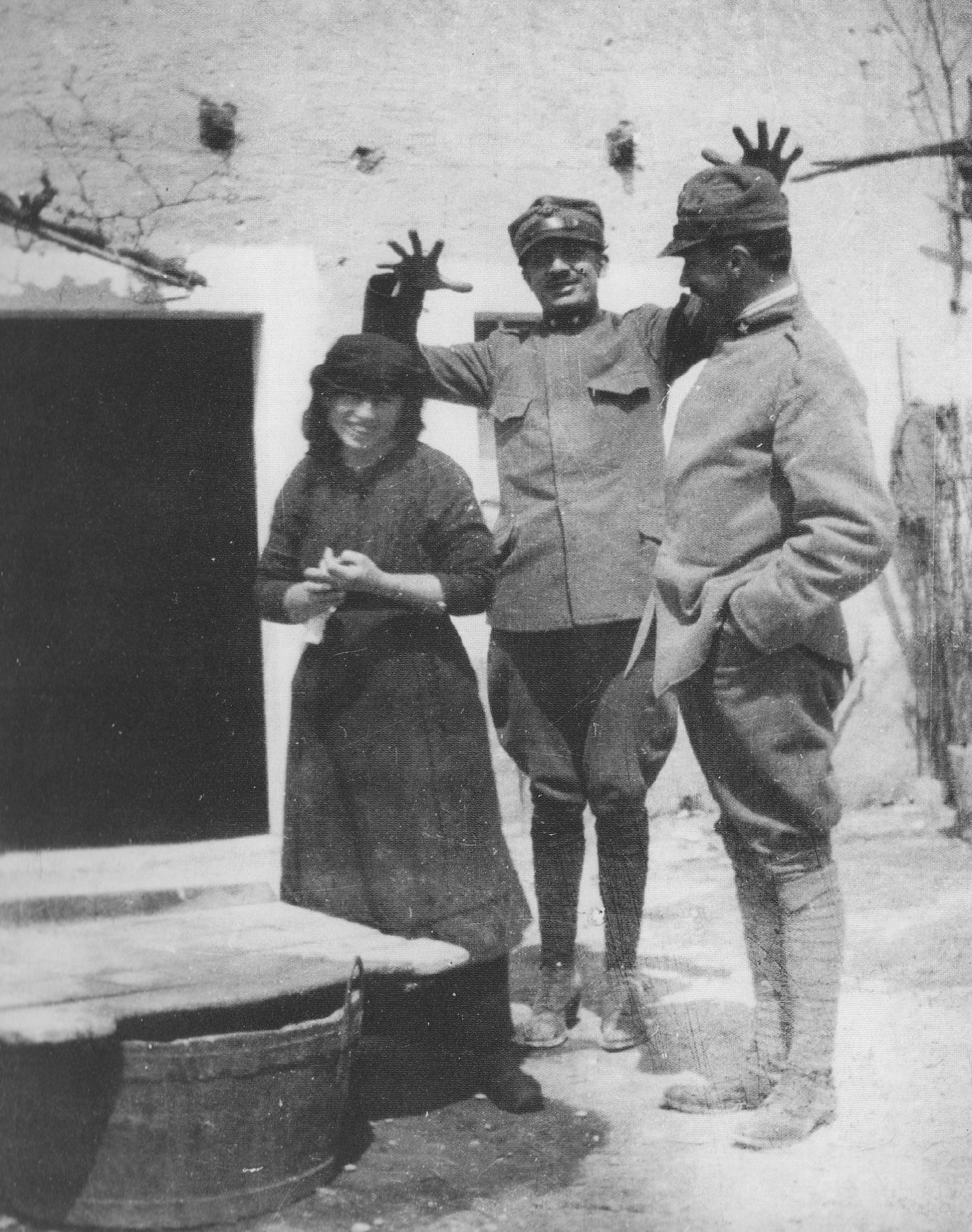 Village girls fraternising with Italian soldiers
Following Cadorna’s directives, a trench is dug from Cassegliano to Begliano; men and women of the village work on it under military engineers’ supervision. Between 1915 and 1916 the bridges over the Isonzo, the Torre, and the Roggia are built. In 1917, in the aftermath of the rout at Caporetto, these bridges are blown up to slow the Austrian advance, and water floods the entire village.
With the retreat of the Italian troops, Turriaco reverts to Austrian control. Those who had sided with Italy follow the retreating columns. The joy of those who prefer the double-headed eagle to the House of Savoy’s coat of arms is short-lived, however: the hunger of ‘18 soon extinguishes every enthusiasm.
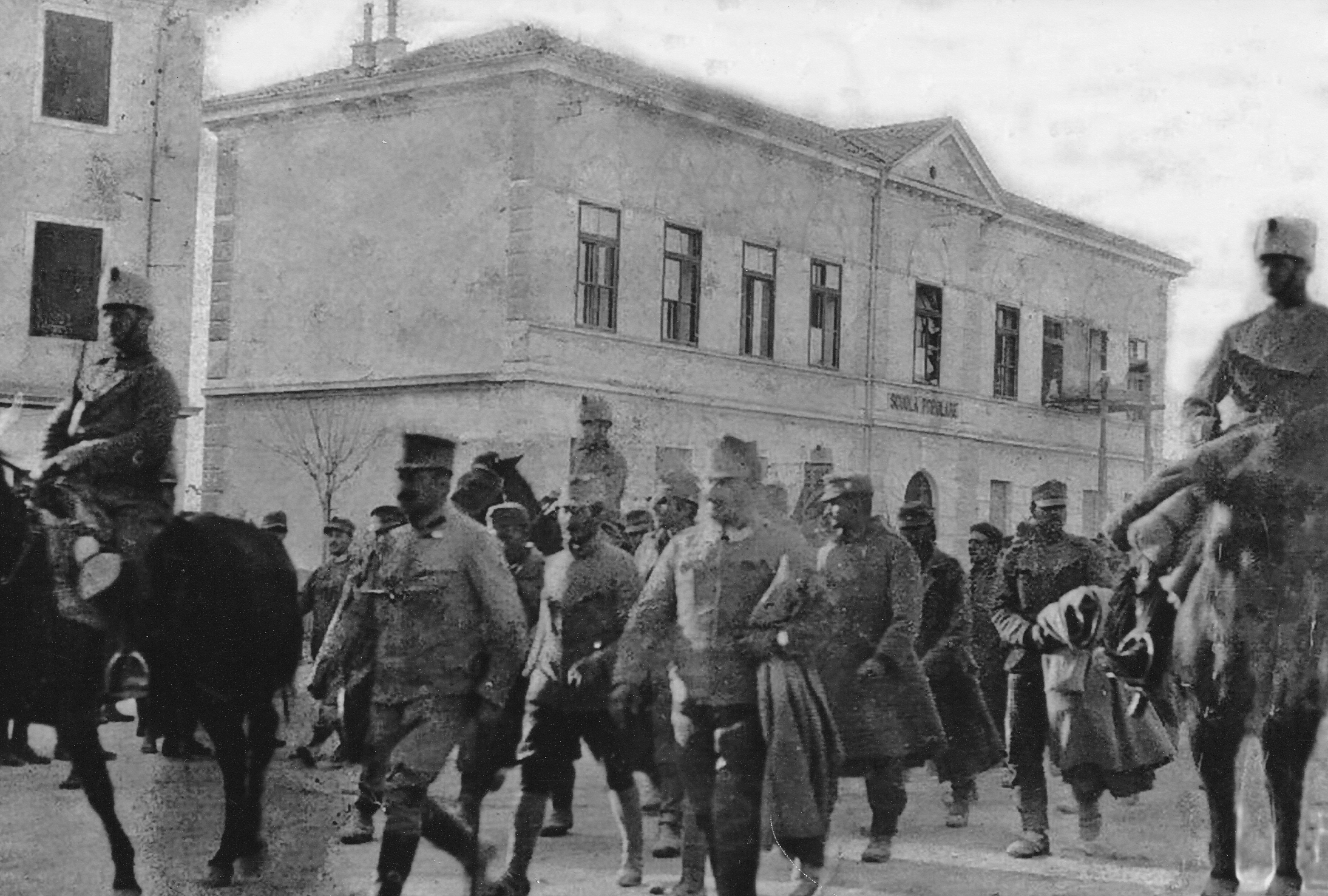 The Austrian troops return
In November 1918, with the Battle of Vittorio Veneto, the war reaches its end. The toll can now be counted. Of the 270 who had left for the front, 33 soldiers and one civilian refugee died far from home; 53 were wounded in combat. In the village, a further 14 people died from war-related causes. Public buildings and private dwellings suffered severe damage. The useless slaughter, execrated by Pope Benedict XV, left scars that would persist for decades—and that already foreshadowed yet more terrible catastrophes to come.
The war had finally ended, leaving behind millions of dead, abandoned fields, shattered trade and commerce, rampant unemployment, and the inevitable misery that followed. Our villages now became part of the Kingdom of Italy, though many people missed the Empire that had come before. Soldiers, refugees, and internees slowly made their way back to Turriaco. Everyone was trying to restore some semblance of normalcy to what people everywhere were now calling the terre redente — the redeemed lands.
On February 21, 1919, the Commissioner for Autonomous Affairs of the Province of Gorizia appointed one Riccardo Clemente as mayor of the municipality. His first official act concerned the slaughterhouse tax (!), and his second reinstated the town messenger and the field warden.
On April 9, a currency exchange was ordered. Austrian crowns were withdrawn, and each crown could be exchanged for 60 Italian centesimi.
In May, Father Brandl resumed leadership of the parish, replacing Father Beniamino Bianchi of Pieris, who had been tending to the spiritual needs of the community in his absence. On the pastor’s return, the Furioso manuscript provides some useful details:
By decision of the Mayor, dated October 8, 1919, the curate was assigned an annual stipend of 480 lire, effective May 14, 1919 — the day of Don Brandl’s return from internment. On October 18 the curate’s office submitted another petition requesting an increase to the stipend, with back pay running to June 1915, the date of the internment. The Mayor partially accepted the request, setting the stipend at 1,200 lire but leaving the effective date unchanged.
When the archbishop came to visit, it was decided that the Commissioner would receive him at the edge of town and that the band would play marches near the rectory.
Ah yes, the band! Once the conflict ended, the soldiers returned, the instruments were recovered, and activity slowly resumed. The two rival factions — the Clemente camp and the Tomasella camp — had reunited, and the band now had a respectable roster. In truth, even at the height of their rivalry, the two groups had never failed to perform together at the village’s important events. They had never skipped the Corpus Domini procession or the procession of the Madonna. The reunion was celebrated in 1920 with a memorable concert. Rodolfo Clemente remained as bandmaster, Silvio Cosolo was vice-master, and Albino Tomasella served as president. The world had changed, but the names stayed the same.
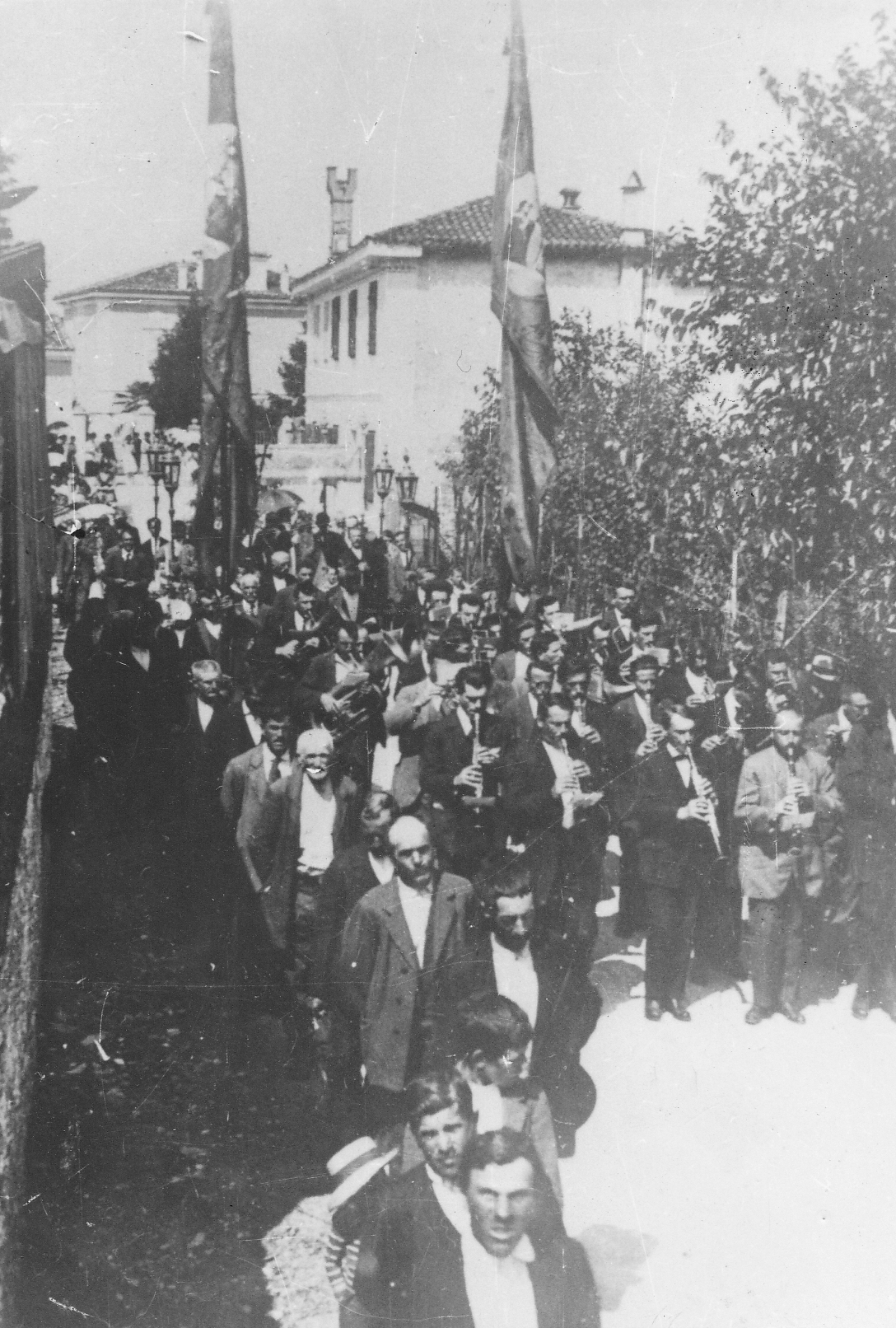 Madonna Procession (1919)
The most significant event of that early postwar period in which the band took part was the great pilgrimage organized for the return of the image of the Madonna to the Sanctuary of Monte Santo, attended by the faithful of the Archdiocese of Gorizia.
The sanctuary stands at the top of a hill (681 m) on the Bainsizza plateau, facing Monte Sabotino, separated from it by the Isonzo River flowing far below in a narrow, sunken valley. For centuries, the sanctuary has witnessed the events that have swept across these lands. Built in 1544 on the ruins of a church destroyed during the Turkish invasions, demolished on orders from Emperor Joseph II in 1776, and rebuilt in 1793, it houses an image of the Virgin held sacred by the people of the Gorizia region.
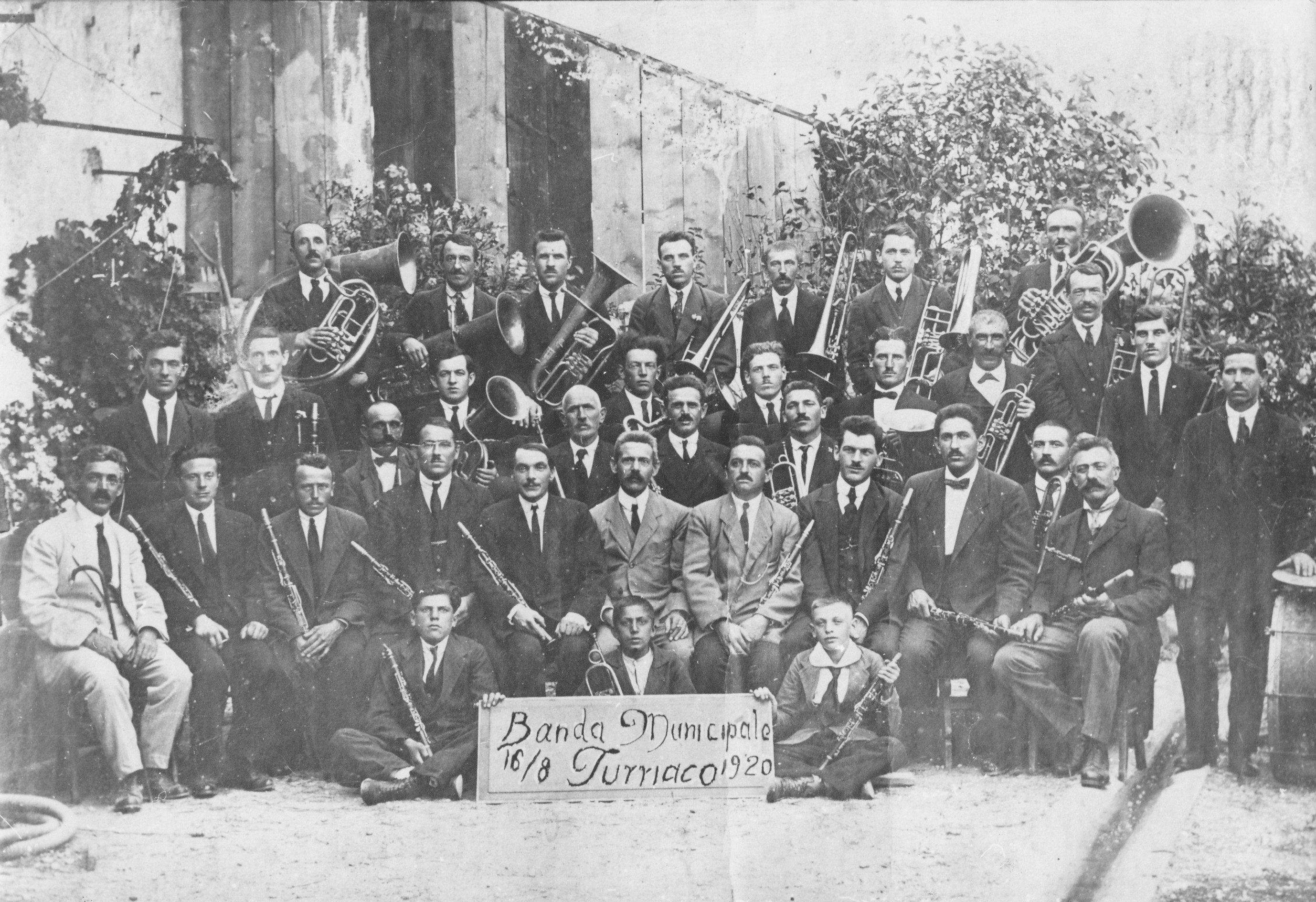 The band in 1920
During the war, the sanctuary had sat squarely in the middle of the Austrian defensive line anchored on the heights of Plave, Vodice, Monte Santo, San Gabriele, and the Karst. For over a year, hell broke loose on those mountains. The first bombs fell on Monte Santo on June 5, 1915. By June 23, the Franciscan church and convent had been destroyed by incendiary shells. On October 18, at seven in the morning, the sanctuary was leveled for good.
The image of the Madonna, however, survived. As a precaution, and with good timing, it had been moved to nearby Gargaro, from where, in May 1915 and under military escort, it had been transferred to the Franciscan convent in Ljubljana.
On October 2, 1922, with reconstruction still unfinished, the Madonna of Monte Santo returned in a solemn procession from the Cathedral of Gorizia — where the image had been brought for the occasion — through Salcano and the Gargaro pass, back to its rightful home. The popular turnout was massive. According to contemporary accounts, the procession included representatives from the following municipalities or parishes (in alphabetical order): Begliano, Capriva, Cerovo, Cormòns, Cosana, Dolegna, Drežnica, Farra, Fiumicello, Gradisca, Libušnje, Lokavec, Lucinico, Merna, Monfalcone, Moraro, Mossa, Peuma, Podgora, Podsabotin, Ranzano, Romàns, Salcano, S. Andrea, S. Floreano, S. Lorenzo, S. Pietro di Gorizia, Sagrado, Staranzano, Tapogliano, Vertoiba — and, out of alphabetical order but obviously not absent — Turriaco.
The procession also included the four parish priests of Gorizia, the Franciscans, the Salesians, the Capuchins, the Fatebenefratelli, the faculty of the Theological Seminary, the Marian congregations, various Catholic organizations, authorities of every rank and denomination, and much else besides.
The band was there too, as mentioned, and no doubt acquitted itself well — but given the vast crowds and the density of events that day, it found no place in the written accounts. A photograph, however, captures it alongside the Daughters of Mary and confirms its presence.
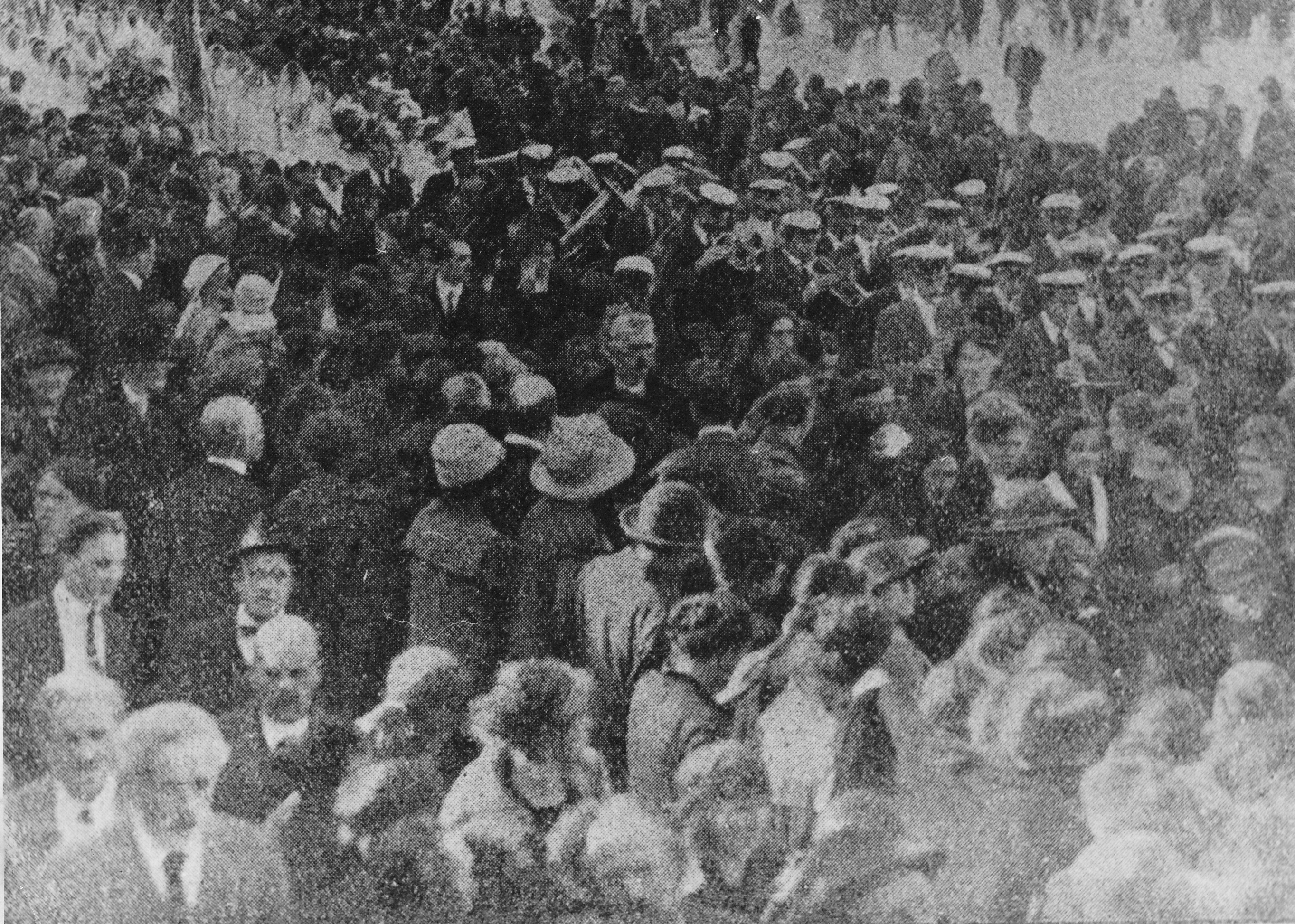 The band at the procession for the transfer of the image of the Madonna of Monte Santo
Rodolfo Clemente was still leading the ensemble. Cosolo states with confidence:
Under his direction, the band made a remarkable leap in quality, winning first prize at the Regional Band Competition held in Udine in 1924, before a jury chaired by none other than the great Pietro Mascagni.
Some maintain that Turriaco didn’t actually win the top medal, though the prize it did receive was still significant. Others suggest that Mascagni’s presidency of the jury was honorary only. In general terms, however, the following assessment is hard to dispute:
With a full band of 40 well-trained and even better-conducted musicians, the Turriaco Philharmonic earned well-deserved honors at the gatherings in Monfalcone and Trieste and at the Udine band competition, repeatedly demonstrating a distinctive interpretive sensibility, a high level of artistic preparation, and excellent ensemble playing.
During this same period, while Turriaco no longer had two rival bands, it did see the birth of the Turriaco Symphony Orchestra, founded by the young maestro Silvio Cosolo, which performed a number of refined concerts. The orchestra’s life was unfortunately brief. On June 2, 1923, Silvio Cosolo died at only 33 years of age, plunging the entire village into grief and despair. His funeral, paid for by the municipality, drew an enormous crowd. What remains of him is the memory of his boundless love for music and the many pieces he composed that are still part of the band’s repertoire — among them the Hymn of the Philharmonic and the celebrated March (of S. Cosolo), which served as the band’s signature opening number for every parade and every performance. That march has recently been re-orchestrated by the Philharmonic to suit a modern instrumental ensemble.
Silvio Cosolo was commemorated in 1934, on the eleventh anniversary of his death, with a symphonic concert conducted on that occasion by Maestro Rodolfo Clemente, during which Mario Spanghero offered a moving tribute in his memory.
If we have started using Roman numerals, it was not by accident. The turbulent politics of those years had brought Fascism to power, and once again Turriaco had a new set of people in charge.
On November 7, 1924, the church held a solemn Te Deum of thanksgiving for the failed assassination attempt on Mussolini.
On November 11, things went sideways. It was the feast of St. Martin, and also the birthday of His Majesty Vittorio Emanuele III. A band concert had been scheduled for that evening. The concert did not take place — or, if it started, it was cut short by force. Exactly what happened is unclear.
One version, passed down through the years, is that when the local Fascist leaders asked the band to play Giovinezza — the Fascist anthem — they were told that the piece was not yet in the repertoire. Whether or not it’s true, the story is plausible. Or at least well invented. (There is one further possibility, perhaps more credible: that the response was indeed given, but that the episode refers not to the Turriaco band but to the one from Ronchi, directed by the well-known maestro Kubik.)
What remains certain is that on November 21, a decree from the Prefect of Trieste dissolved the Philharmonic Society and transferred its assets to the State.
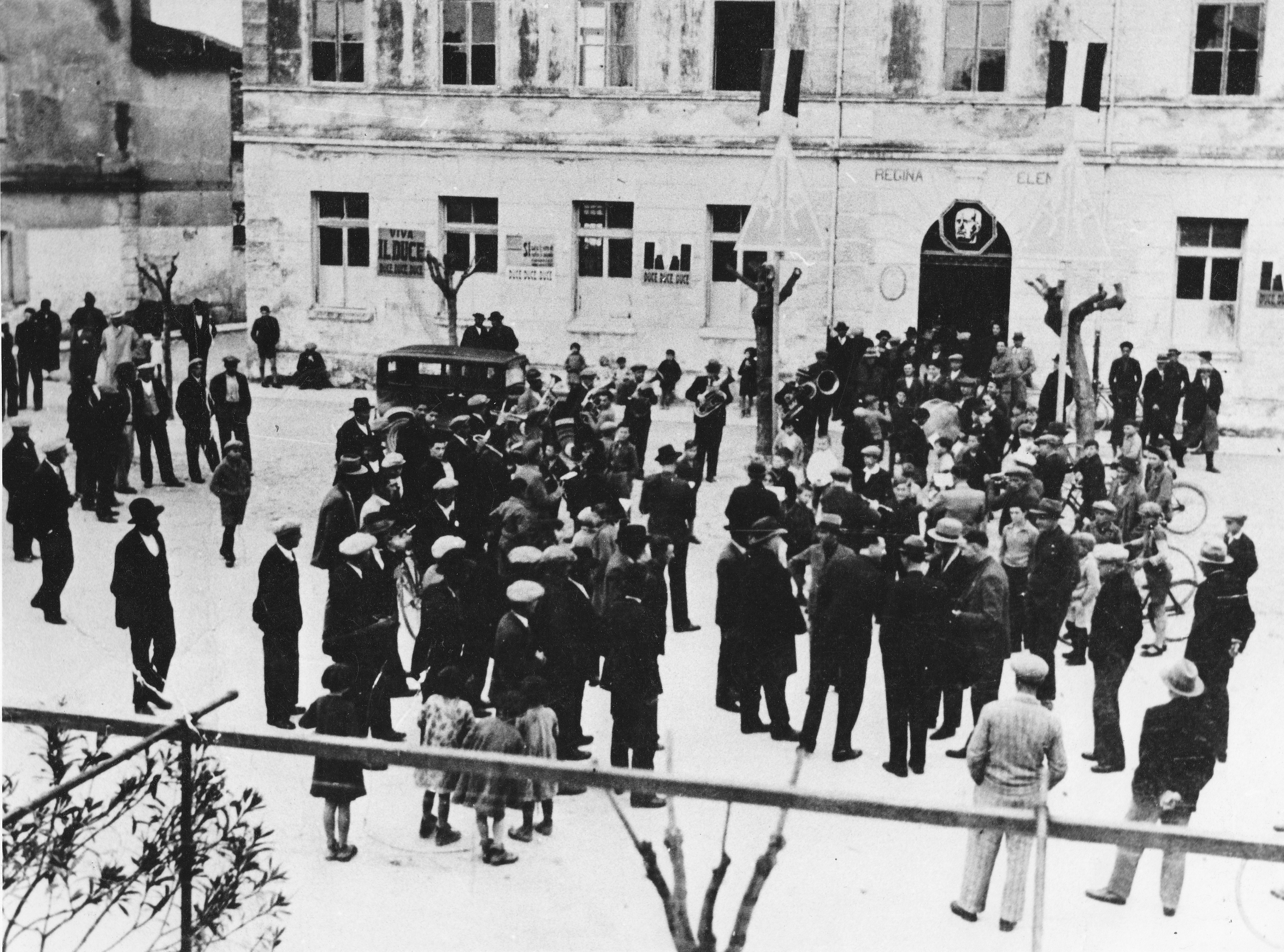 Performance in front of the school (is this from November 1924?)
Setting aside exceptional episodes, Fascism didn’t have a particular grudge against bands — it simply demanded to be the only one capable of controlling them, just as it demanded to control everything that moved on Italian soil. Technically, that’s called a dictatorship. And in a dictatorship, some very strange things happen. For instance, the use of certain pronouns might be banned. Part of the population might be forbidden to speak a language they’ve always spoken. And the Italianization of surnames not ending in a vowel might be, let’s say, strongly encouraged.
To understand where the population stood, it’s worth looking at the results of the general election held that April — the first after the Fascist coup. Turriaco had 272 registered voters, all of them male, of course. The results were as follows:
And, just to make perfectly clear how things worked in those days, it’s also worth citing the resolution approved by the Municipal Council on May 16, 1924, requesting:
[…] to humbly petition that His Excellency Benito Mussolini, head of government and Duce of Fascism, deign to grant the high honor of being counted among the honorary citizens of Turriaco.
If something doesn’t add up when you compare those two facts, it’s not hard to figure out why. And while we’re doing political analysis, the transformation of most Turriaco residents — in just a few years — from loyal Habsburg subjects into supporters of Marxism should come as no surprise. The explanation lies less in ideology and more in the sense of belonging, security, dignity, and social justice that both political forms, in their different ways and with their different emphases, managed to offer or at least to promise.
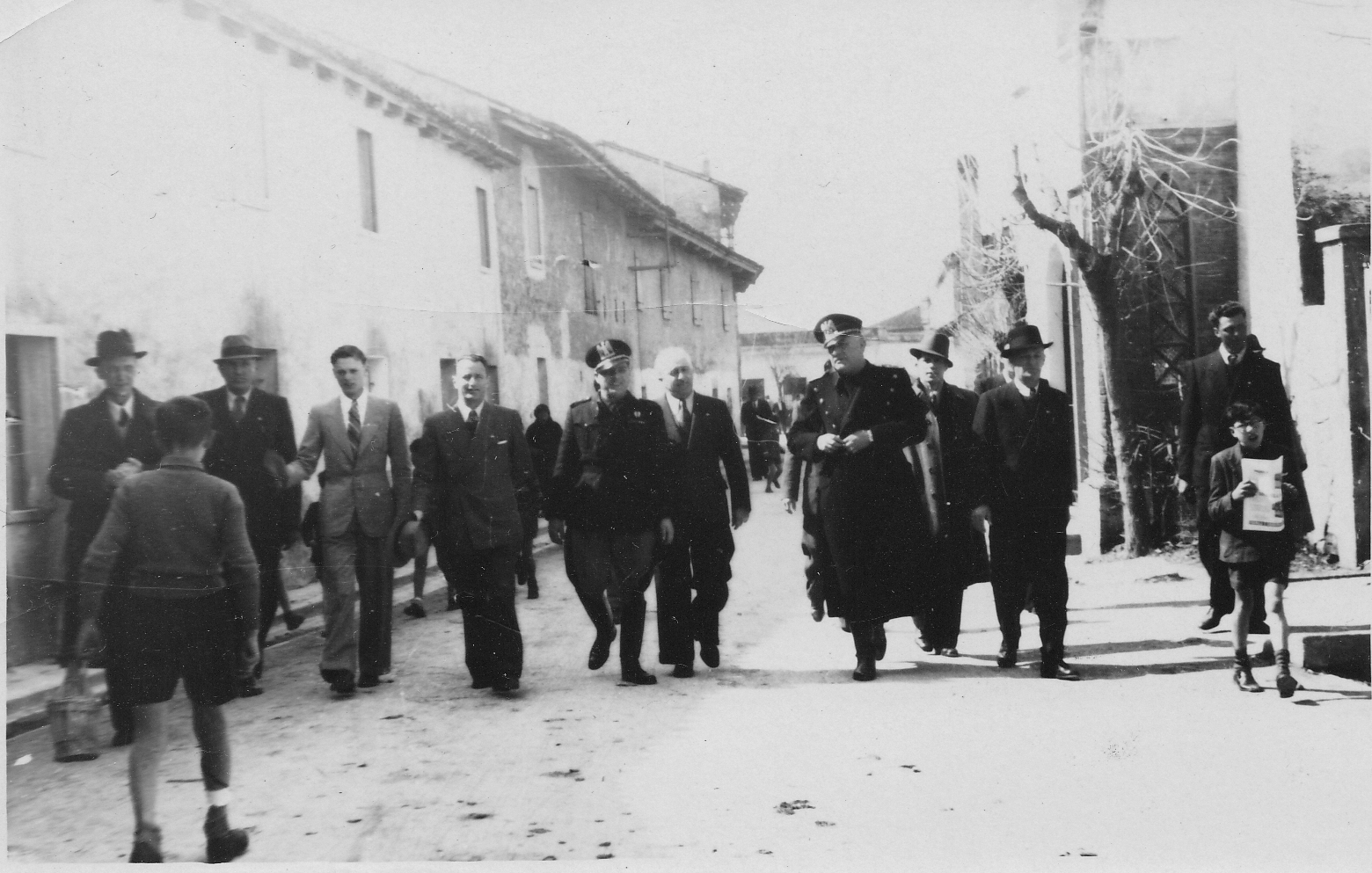 Officials and notables of the National Fascist Party
Nearly six years would pass before the band, after its forced suspension, could begin functioning again. By 1930, the director was Giuseppe Clemente, Rodolfo’s brother. For a brief period the ensemble was also led by Silverio Clemente, before he moved to Taranto to teach at the Conservatory there. The student instructors included Angelo Tomasella, Mario Spanghero, and Valerio Spanghero.
On May 30, 1931, following a well-orchestrated press campaign, the government dissolved all the youth circles of Catholic Action. At the local level, the approach was fairly light-handed — in part because it was hard to find any real pretext for intervention. In Gorizia, a notice issued by the local circle, dated April 1, was seized by the authorities because of the following sentence:
[…] especially in this present hour, in which troubled human Society is passing through one of the most dangerous periods in history, and in which the eternal fate of so many souls must be decided.
Still in Gorizia:
The commissioner overseeing the closure expressed his regret at the measure, declaring himself a Catholic, but saying that those were his orders.
In protest, Pope Pius XI ordered the suspension of all processions so as not to expose religion to mockery. That year in Turriaco, the band did not play on the feast of Corpus Domini. And that was news.
On September 2, however, an agreement was reached between the Holy See and the government, and the circles everywhere resumed their activities under the name of Catholic Action Associations. For the Madonna feast procession on September 8, the band was back in place.
Using the younger members of the band, the local Fascist branch established the Opera Nazionale Balilla band and the fanfare of the Gioventù Italiana del Littorio (G.I.L.), which performed at the commemorations and rallies celebrating the glories of the regime.
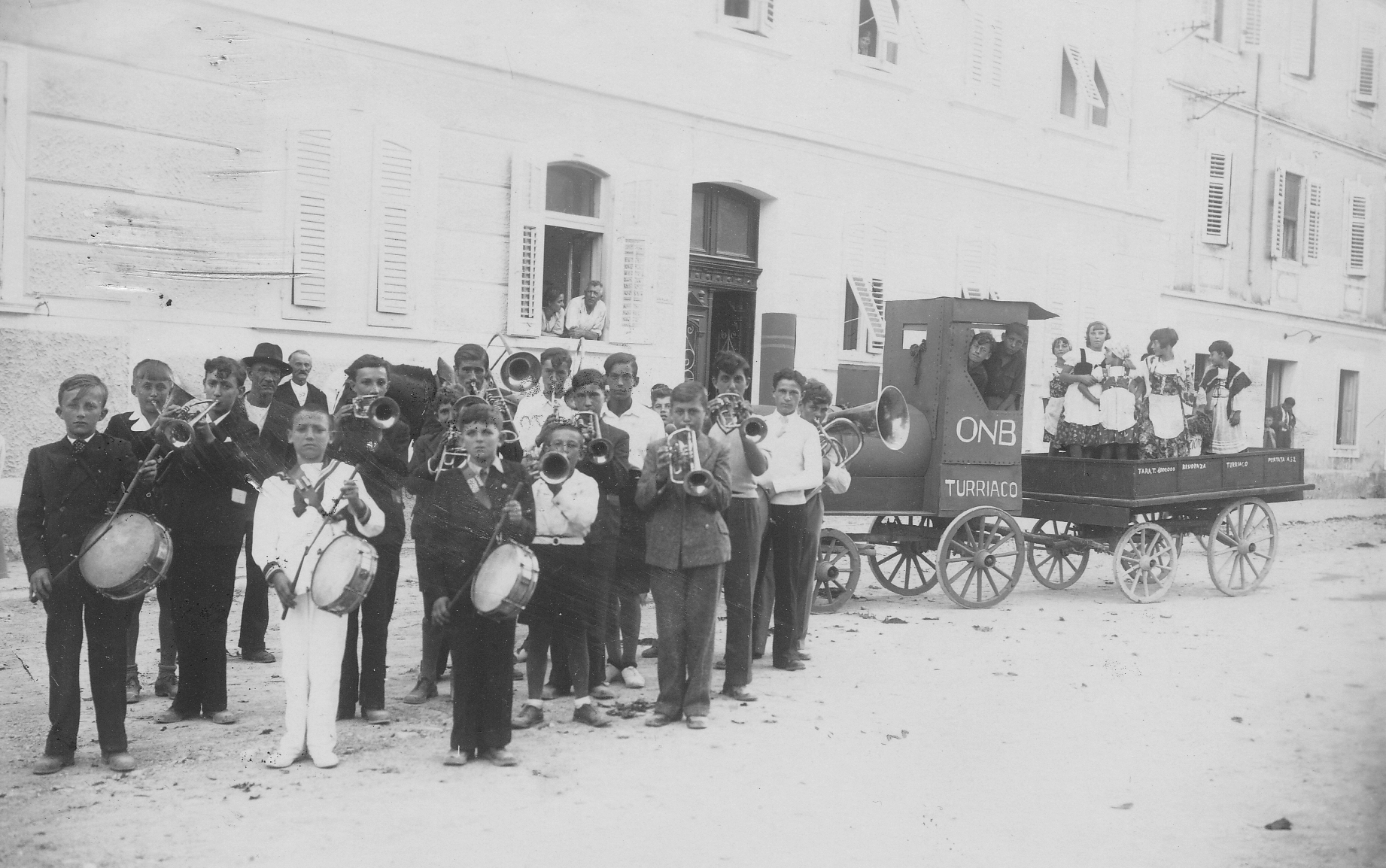 The Opera Nazionale Balilla band
On November 19, Amedeo di Savoia Aosta paid a visit to Turriaco. A large ceremonial arch was erected in his honor between the church and the Martinuzzi grocery store. The future Viceroy of Ethiopia and hero of Amba Alagi — at the time a guest at Miramare Castle, a place not exactly known for bringing good fortune to its occupants — was received with great fanfare by the civil and religious authorities. The band was naturally on hand to play the royal march.
On May 13, 1934, music again filled the square in Turriaco — this time from six bersaglieri fanfares present at a rally during which a commemorative plaque was unveiled on the house where the Garibaldian Giuseppe Mreule once lived. That evening, there was dancing in the square.
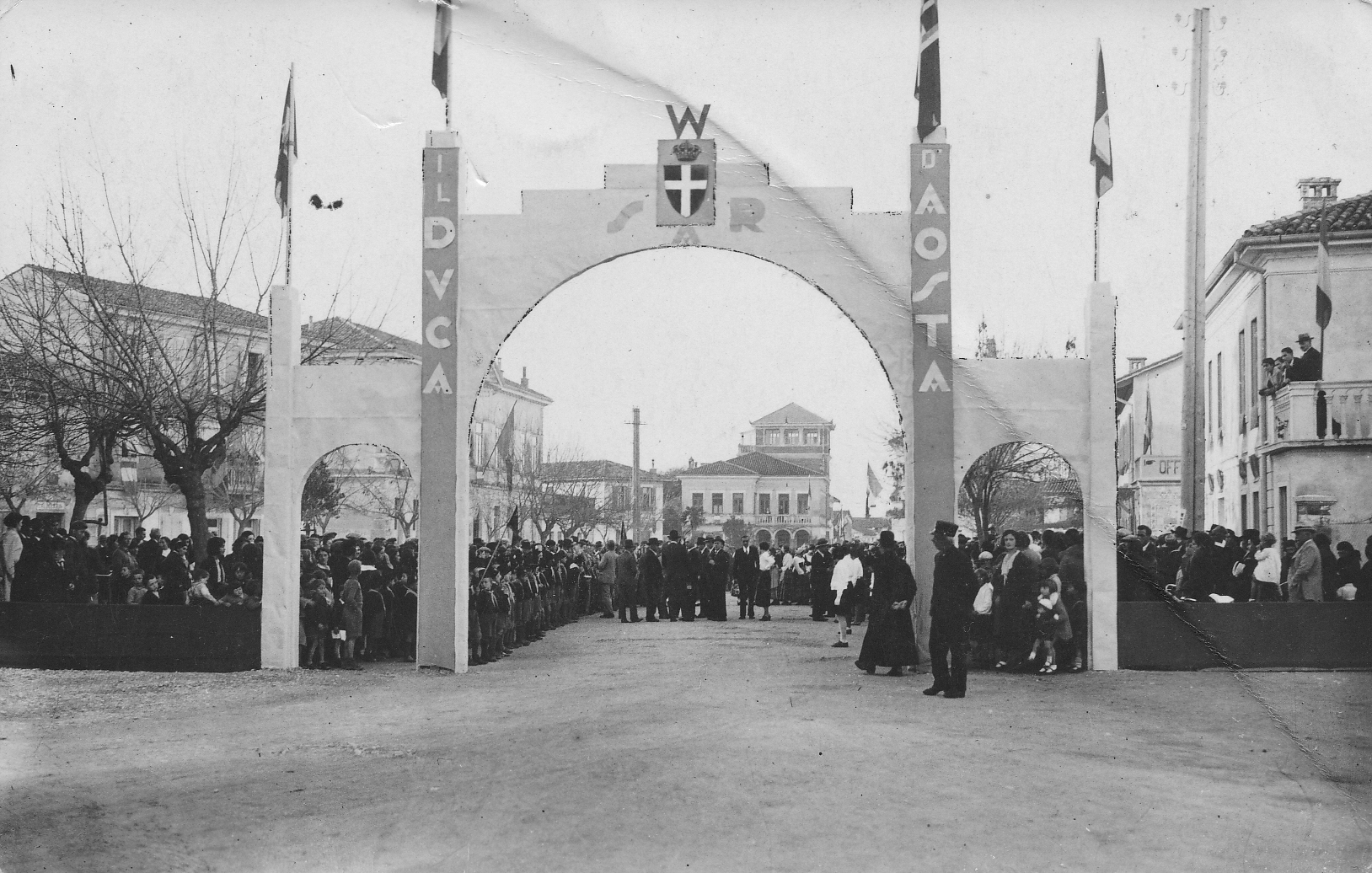 Celebrations for the visit of the Duke of Aosta
A piece of news that has nothing to do with the band, but says something about the mindset of Turriaco’s residents. On December 18, 1935, 416 brides offered their wedding rings on the altar of the Madonna for the Fatherland. In proportion to the population, Turriaco ranked first in the Province for the number of gold rings donated. (We limit ourselves to reporting this fact without offering too many editorial comments.)
On June 11, 1936, the Corpus Domini procession took place. Due to internal disagreements among the players, the band did not participate — for the first time ever. That too was news.
The band made amends on September 8, 1938, showing up in full force for the grand Madonna procession, attended by some 400 men and 1,000 women. On September 18 and 19, Benito Mussolini visited Trieste and Monfalcone, and 400 people from Turriaco traveled to those cities to cheer him on. How many of them belonged to the band remains unknown.
On September 1, 1939, Germany invaded Poland and the Second World War began. Italy declared itself non-belligerent, but that wouldn’t last long.
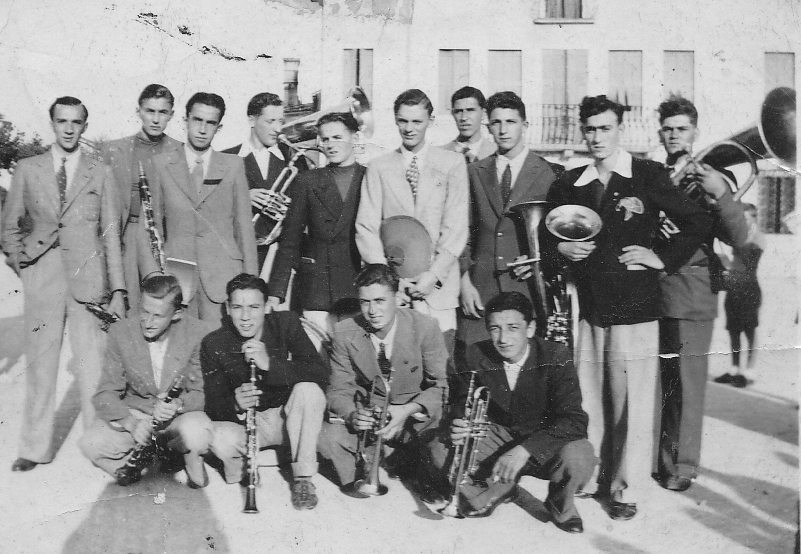 Young band members in Turriaco (1939)
On June 10, 1940, at six in the evening, the bells of Turriaco rang out in alarm. The Fascist organizations had called everyone to the square to hear the speech Mussolini was about to deliver from his usual balcony:
The hour of supreme decision has struck. The declaration of war has already been delivered to the ambassadors of France and England.
The people didn’t want war. No people wants war, if you take them one at a time. But when they all come together, things can change — which is how those newsreels of the period managed to show us cheering, almost jubilant crowds.
There was no reason to worry much, anyway. Victory was certain: Vincere, e vinceremo! The German armies — whose faithful allies we couldn’t wait to become — were sweeping across Europe. Paris was about to fall, and London would soon follow. It would all be over in no time.
And yet, the day after Mussolini’s speech, the Prefecture of Udine published detailed air-raid instructions in Il Popolo del Friuli: public lighting switched off, windows blacked out, headlights on cars, motorcycles, and bicycles covered with blue paint. A ministry circular had suggested that the tape used to seal windows could actually be quite decorative, if applied with imagination (there’s always someone who gets the joke a little too late). Still, one was beginning to sense that this might not all be smooth sailing.
Those called up to serve needed no persuading that things weren’t going well. Those left at home could figure it out simply by looking at their plates.
From May 6, Law 577 was in effect — the law introducing food rationing and ration books. A first taste (pardon the pun) had already come in September 1939, when Germany entered the war and brought with it a ban on selling or serving meat on Wednesdays and Fridays. Now that Italy was in the war too, the restrictions mounted with Rossinian crescendo:
Hunger began bearing down hard on those living on wages alone. According to a survey conducted by the University of Trieste in 1942, roughly two and a half million families were going hungry in the full physiological sense of the word, and at least as many more had inadequate nutrition. Altogether, more than 40% of those surveyed were living below the minimum food threshold.
And the problems didn’t stop at food. Salt, soap, sewing thread, tobacco, tires — all had become practically impossible to find for quite some time.
Meanwhile, the bad news from the front had started arriving in Turriaco.
In 1941, Remigio Passon of the Julia Division and Grenadier Rodolfo Stormi (Sturm) were wounded in Albania, while Mario Tonzar and Antonio Gregorin were taken prisoner by the British in Egypt. In the Mediterranean, Mario Viscovig was reported missing.
And furthermore:
[…] on September 11, 1942, Corporal Aldo Volpatti — his widowed mother’s only son — died on the Don River. Also from Russia came news of around ten men listed as missing. They never came back. Mario Verginella was also listed as missing; he had been aboard the cruiser Alberto da Giussano, struck by two torpedoes off Cape Bon. Things went slightly better for the Turriaco men taken prisoner, who were interned in Russia, India, Egypt, South Africa, and even in the United States.
Back home, people were trying to survive, but it was hard. On October 7, 1942, the church bells were requisitioned for the war effort. From December 19 to February 15 of the following year, schools were closed because there was no way to heat them.
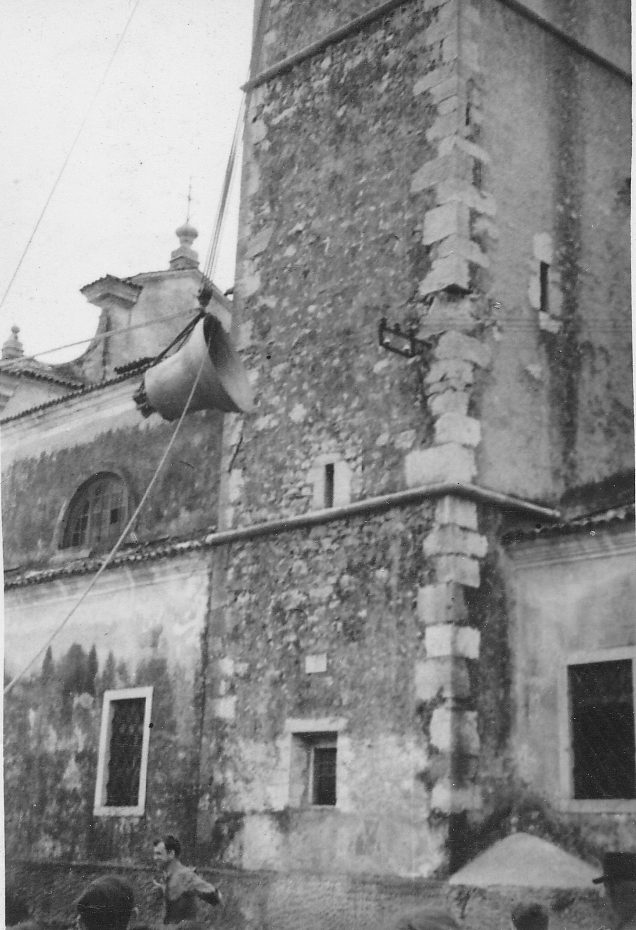 The bells removed from the church
1943 opened with the German defeat at Stalingrad. The wind had shifted, and the Wehrmacht was no longer invincible. In March, a wave of strikes centered in Turin shook northern Italy; Hitler received the news with great displeasure. An economy battered by three years of war was on the verge of collapse. On April 7, Bolivia declared war on the Axis — when it rains, it pours. On July 10, Patton’s Seventh Army landed in Sicily.
On July 23, 1943, the Duce became cavalier Benito Mussolini, and Fascism fell. The following day, Turriaco took to the streets to celebrate the fall of the regime and tear down its symbols. Only the symbols were destroyed: no one was harmed for anything that had happened during the twenty years of Fascism.
In the days that followed, the arrival of armed guards quieted things down. A curfew was imposed from nine in the evening to five in the morning. Everyone was waiting for the war to end.
On the evening of September 8, the radio broadcast Badoglio’s message announcing the signing of the armistice. It seemed as though everything was over. It wasn’t.
The Germans were not at all pleased that Italy had surrendered. They quickly moved to establish the Operational Zone of the Adriatic Littoral (OZAK, from the German Operationszone Adriatisches Küstenland), covering the provinces of Udine, Gorizia, Trieste, Pola, Fiume, and Ljubljana. Removed from the jurisdiction of the newly established Italian Social Republic and placed directly under German military administration, the zone was, in effect, annexed to the Third Reich.
One of the benefits of being governed by the Germans consisted of, shall we say, the architectural improvements the occupiers saw fit to introduce to the area. For example, a group of rice-milling buildings in the San Sabba district of Trieste was converted into the first and only extermination camp in Italy, complete with a proper crematorium.
The facility was put to use in April 1944, when the bodies of 71 hostages — chosen at random from prisoners in Trieste’s jails and killed in reprisal for the explosion of a time bomb in a cinema in Opicina, which had killed 7 German soldiers — were incinerated there.
The war of liberation broke out. Here, unlike in the rest of Italy, it wasn’t just partisans versus Germans — it was also partisans versus partisans.
From a military standpoint, the most significant episode of the partisan struggle was what became known as the Battle of Gorizia, fought in the very earliest days of the conflict, between September 11 and 26, 1943. On one side stood the German troops moving to occupy the city — the 71st Infantry Division, later reinforced during the battle by armored units of the 24th Panzer Division, totaling roughly eight thousand men. On the other side stood a mixed force made up of what remained of the Italian military units stationed in the area after the chaos following the armistice, a partisan formation of about a thousand workers from the Monfalcone Shipyard who had organized spontaneously upon hearing the Germans were coming, and groups of Slovenian partisans operating in the area, for a combined total of roughly two thousand men.
The battle unfolded as a series of bloody clashes fought to control the rail lines and the two airfields in the Gorizia area, ending in the inevitable German victory — superior in numbers and in weaponry.
On September 16, in the thick of the fighting, the plenum of the Slovenian Liberation Front — in which the Communist component held the majority — issued a proclamation declaring the annexation to Slovenia of all lands east of the Isonzo, including Trieste and Gorizia, as well as territories with a significant Slovenian ethnic presence, including the so-called Slavia Veneta (Benečija), encompassing the Torre and Natisone river valleys.
Operating in this area were units of the Garibaldi Brigade, made up predominantly of Communist militants, and the Osoppo Brigade, whose members were mostly Catholic and Partito d’Azione supporters. While agreements had been reached between the two formations in other parts of the region, here their ideological and strategic differences proved insurmountable and they operated independently. The sharpest source of tension was their divergent positions on the territorial claims of the Slovenian Liberation Front: the Osoppo rejected them outright, while the Garibaldi accepted them on the grounds of shared Communist ideology.
The partisan forces of the IX Corps, fighting under Tito’s Yugoslav People’s Liberation Army, asked the Italian units to place themselves under Yugoslav command in order to better coordinate the struggle. The Garibaldians agreed, and the Garibaldi Natisone Division was transferred to Slovenia, severing all ties with the Italian National Liberation Committee.
The Yugoslav partisans pursued three objectives: to liberate zones occupied by Axis forces, to establish facts on the ground to support their territorial claims at the Paris peace talks — eliminating any opposition, real or potential, to that project even while fighting was still underway — and simultaneously to carry out a Marxist-style social revolution.
Against this backdrop, the massacre at the Porzûs mountain farms, in the municipality of Faedis, took shape. On February 7, 1945, a GAP unit from Udine — the small Gruppi di Azione Patriottica that the Garibaldi Brigade had trained for urban guerrilla operations — attacked the Osoppo command, which had taken refuge at the mountain farms. After disarming those they effectively considered enemies, they shot the commander, the political commissar, a stray partisan who had joined the formation, and a young woman accused of being a spy who had voluntarily turned herself in to proclaim her innocence. In the days that followed, 17 more partisans who had been captured in the operation were killed. This episode — the darkest chapter of the Italian Resistance — provoked deep passions then and, in certain respects, continues to do so today, fueling fierce debate that is as much historical as it is political.
Turriaco paid its own heavy price in the war of liberation. It began with resistance to the mobilization order for men born between 1914 and 1926, issued by the Gauleiter of Trieste. Rather than fight alongside the Germans, some forty young men chose to take up arms as partisans, while those back home who supported the Resistance collected money, food, and clothing to send to those fighting. When it was over, the village would mourn around a dozen dead — killed in battle, executed, or lost in concentration camps.
Everything seemed to end in late April 1945, with the retreat of the main German forces. But the end of the fighting didn’t mean the end of the tragedies in these lands.
In the night between April 30 and May 1, the National Liberation Committee ordered a general uprising. Turriaco rose up in arms; German soldiers were captured. On May 1, 1945, Yugoslav partisans managed to enter Gorizia and Trieste before Allied troops, effectively taking military control of both cities.
An occupation began that would last until June 12, when, following the signing of the Belgrade Agreement, the two cities passed under the control of the Allied Military Government. During the occupation, the Slovensko Primorije — the Slovenian Littoral — was established, with Trieste as its capital; it also included the territories of Gorizia, Cividale, Tarvisio, and Tarcento, all deemed Slavophone. A purge began of anyone deemed potentially opposed to annexation by Yugoslavia. Italian officials and administrators in every sector of civil life were replaced with Slavic counterparts. Although the war was over, hundreds of citizens were arrested, interrogated under torture, deported to concentration camps inside Yugoslavia, or thrown into the foibe — the karst sinkholes used as mass graves. A monument in the Gorizia Park of Remembrance lists the names of 665 people deported or killed during those tragic forty days.
In the midst of all this chaos, the band — predictably — simply vanished. Music can survive even the most tragic circumstances, as testified by the orchestras that played in Nazi extermination camps. But to make music you need musicians. During the war, Albino Tomasella, longtime president of the Philharmonic Society, had died, and there hadn’t even been enough bandsmen available to play at his funeral.
When the hostilities ended and the waters calmed, at least a little, people began to look around. Two veteran band members, Sigifredo Cosolo and Federico Clemente, set to work tracking down those returning from the war and recovering — rummaging, literally, through basements and attics, house by house — whatever was left of the instruments.
Their efforts paid off. The desire to play was reborn, and the Madonna procession of September 8, 1945 received, as it deserved, the accompaniment of the band — though with a roster barely half its normal size.
Among those who play today, there are still some who are moved by the memory of that event, where they made their debut at thirteen years old on the clarinet, and who remember the procession setting off to the sound of Madonna del Rio (from the libreti veci, they add — the old booklets). And when, after such a turbulent period, what people remember most is what was played at the processions, it goes to show that music can truly accompany and mark a whole lifetime.
Rebuilding from scratch — when what existed before has been destroyed — is never easy. But it has always been done, and always will be. With the hostilities over, the Philharmonic Society rose, phoenixlike, from the ashes and resumed its activities. Elections were held for the leadership positions: Egidio Spanghero became the first postwar president, with Federico Tomasella serving as vice-president and Silvano Gregorin as secretary. The band’s initial director was Giuseppe Clemente, who was soon replaced by Vittorio Candotti. When the secretary resigned due to a change of residence, new elections brought Albano Cecchini to the head of the society, where he remained until 1958.
It was during these early years of reconstruction — and reconstitution — that certain fundamental principles took shape and became established, by shared conviction, without anyone ever spelling them out explicitly. These principles would govern the Society’s activities for years to come, and they continue to do so today.
The first was absolute independence from any political tendency or influence. The period just ended had been terrible, and it had left deep wounds in the population that had not yet healed. The Yugoslav occupation had unleashed a violent settling of scores and a ferocious repression in which political ideologies and nationalist feelings were inextricably intertwined. It all stemmed, as noted, from Yugoslavia’s intention to annex the territories east of the Isonzo. Spanghero writes:
To ensure that the Paris peace negotiations recognized Belgrade’s sovereignty over the entire region, no form of opposition could be allowed to challenge the prospect of annexation. Achieving this required the Italian community to be stripped of its political, social, cultural, and historical reference points — ultimately of its very identity. The implementation of this project called for a series of intimidation measures aimed at silencing potential opponents.
Anyone who resisted was automatically branded — depending on the occasion — a Fascist, an enemy of the people, a British spy, or a Vatican agent, and faced serious, very serious risks. Even Rodolfo Clemente — the band’s longtime maestro, now well into his seventies — was the target of explicit threats. He could hardly have been a threat to anyone, but his personal charisma and authority meant he remained a key point of reference for the people of Turriaco. The 52 foibe discovered on the Karst stand as testimony to the atrocities and brutalities committed in that period, and the ongoing debate between the parties over the exact number of victims thrown into them strikes one as both absurd and offensive.
When that nightmare ended, no one wanted to risk something similar ever happening again, even hypothetically. A few firsthand accounts give a sense of how the bandsmen of that time saw things. Mario Tomasella recalls:
Even when there were political tensions and the village was divided, when we went to play, we played. We played for one side and the other. We’d started in ‘45 playing funeral marches for fallen partisans, when the bodies were being brought down from the mountains.
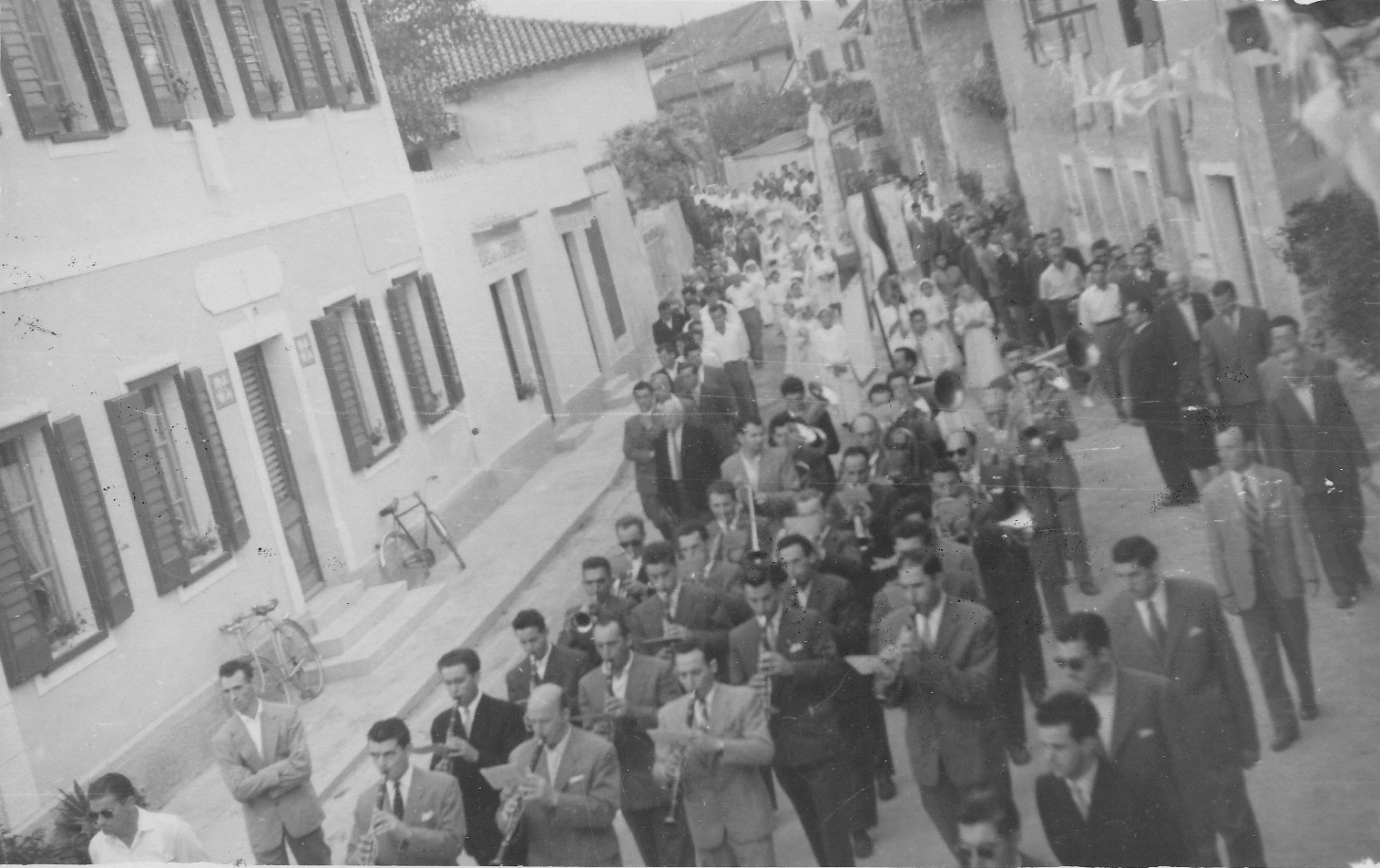 The band at the Madonna procession (1954)
And this is what Luigi Farfoglia recalls (translated from the local Bisiac dialect):
Hard times. Right after the war you didn’t know what to do: if you played for the Communists they’d give you dirty looks, if you played for the Christian Democrats they’d give you dirty looks. You didn’t know what to do. The Town Hall wanted us as the Municipal Band but we always held our ground, staying neutral and playing for everyone. Yes, we had our tough moments too, but we have to say that through all of it we always stayed together, on our feet, and we’re still here.
The idea everyone shared was that — and this one needs no translation — no te pol missiar la musica cu la politica … you can’t mix music with politics. Love of the first brings people together; love of the second can tear them apart.
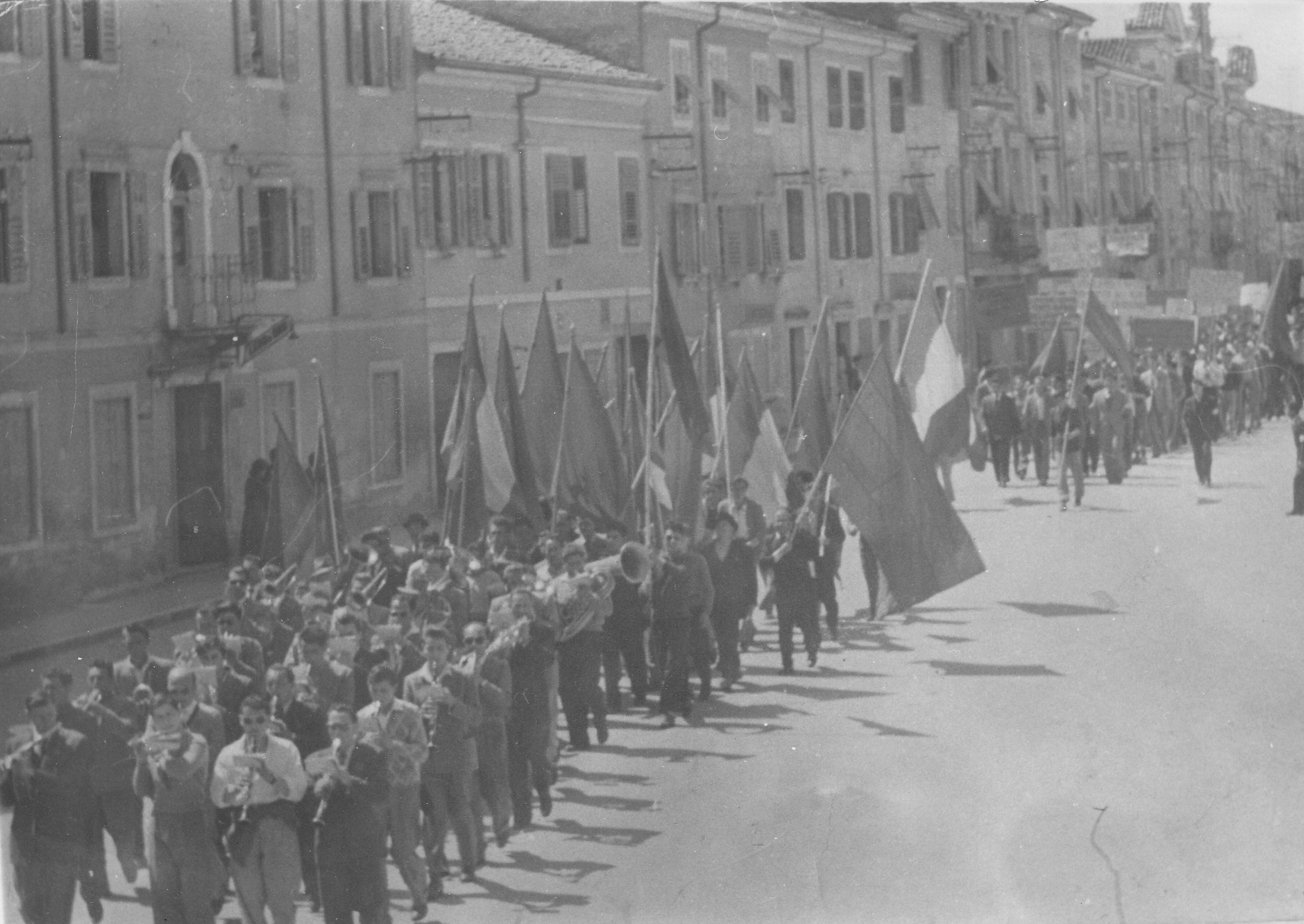 The band at the May Day parade (undated)
In the minutes of the meeting held on Christmas Eve, 1945, at the Gregorin home — attended by president Egidio Spanghero, the vice-president, and two board members — the first item reads:
… Giovanni Tomasella, currently hospitalized, will receive the sum of 1,000 lire (one thousand) as assistance for his illness.
Solidarity and friendship were what mattered, while politics — though everyone was free to think what they liked — was kept firmly outside the door. And so the band went on playing at events of every kind and stripe, religious and secular, Feste dell’Unità (Communist) and Feste dell’Amicizia (Christian Democrat), and even at a rally of the Liberal Party. That even carries no ideological connotation — it’s just that, objectively speaking, it was a bit hard to find Liberals in the local population at the time.
While the Madonna procession in Turriaco is held for the Nativity of Mary, in Pieris — a town famous for having given the world, in fairly quick succession, Fabio Cappello and one of the two versions of tiramisù officially recognized by the Italian Academy of Cuisine — it’s held in honor of the Madonna della Salute. A photograph (of too low a quality to be reproduced) shows the two town bands performing together on November 21, 1946. The rosters are thin, but unity, as always, is strength.
Things were getting back on track, though restarting the machine was no easy task. The economic miracle was still years away. For now, people worked — as they always had. They worked, but what they earned was always little, too little. Keeping a family afloat was barely possible, and there was little left over for the band.
In March 1948, a public subscription drive was launched to raise some funds. Today it would be called a fundraiser or crowdfunding. Back then those terms didn’t exist, which was a mercy. The opening of the appeal — pardon, the notice — addressed to the generosity of the people of Turriaco, reads like something from a manual, and brings to mind those proclamations that used to begin with the unfailing To My Peoples!, proof that, buried in the collective unconscious, the memory of the double-headed eagle was still very much alive.
To all our fellow townspeople!
In recent months, the Society has been compelled to carry out several costly repairs to its various instruments. To cover these expenses, the Society organized a fundraising evening some time ago, but unfortunately it did not meet its goal.
We therefore ask you — considering that this Society is the only one still standing in the entire Monfalcone area (and this is a source of pride for the whole village) — to please contribute even a small monetary donation, so that the Society may avoid dissolution.
That the instruments were in a sorry state is easy to believe. None of the players owned their own instrument — everyone played whatever the band provided. Some sense of the quality involved can be gleaned from accounts recorded in Cosolo’s manuscript.
The clarinet belonging to Valerio Furioso was so completely worn out it produced more air than notes. To get it to work, a low-tech but effective solution was employed: the clarinet was submerged in the albio — the stone or concrete basin below the hand pump where non-drinking water was collected — so that the pads would swell and get a bit of grip again.
Another instrument that tested its player’s patience was the liron, the double bass. Even in good working order, keeping a double bass in tune is no simple matter. When a peg wasn’t doing its job properly — as was often the case — the tuning went out not just on the corresponding string but, in a domino effect, on all the others as well.
In any case, the marketing campaign based on local pride — however unlikely it would have been to win approval from today’s trendy agencies — clearly worked. A few people donated as much as 5,000 lire, showing both extraordinary generosity and, evidently, a certain financial comfort (though absence of misery might be more accurate — two negatives together read poorly). The parish priest, Father Eugenio, who was certainly not a wealthy man, donated 2,000 lire. The total collected came to 13,200 lire, largely from a large number of small donations. In the final accounting, the treasurer Egidio Spanghero noted a shortfall of 100 lire. We prefer to think that someone had simply forgotten to issue a receipt, or that there was an arithmetic error somewhere.
Whatever the case, the band slowly got back on its feet. It rebuilt and strengthened its ties with the village, reviving old traditions and starting new ones. The band was now a reliable, established presence at every important community event: the Corpus Domini and Madonna processions (goes without saying), but also national holidays, the May Day parade, serenades to the village on New Year’s and Easter mornings, and the Christmas concert. The band also started venturing further afield — not just to nearby towns, but gradually going a bit farther.
Most of these trips were made on whatever transport could be arranged, but they went just the same. The old-timers still vividly remember a concert in Aiello del Friuli, reached after a two-hour journey on a farm cart: players seated along the edges, instruments inside, with the liron in the middle, nestled in straw.
Under Maestro Candotti’s direction, the band’s overall quality improved considerably. In 1952, it entered the Interprovincial Band Competition in Gemona del Friuli and came home with second prize. That same year, 1952, also saw the death in Turriaco of the old maestro Rodolfo Clemente.
In 1958, Maestro Candotti moved to Grado and stepped down as director. His successor was Maestro Nereo Cosolo — a Turriaco native through and through, a trumpet player and Candotti’s assistant, who had in the meantime earned his conducting qualifications at the Venice Conservatory. That same year, the Society’s leadership was renewed. After ten years as president, Albano Cecchini stepped down and was replaced by the young Silvio Gualtiero Cosolo, cousin of Maestro Nereo. The band’s story had turned a page.
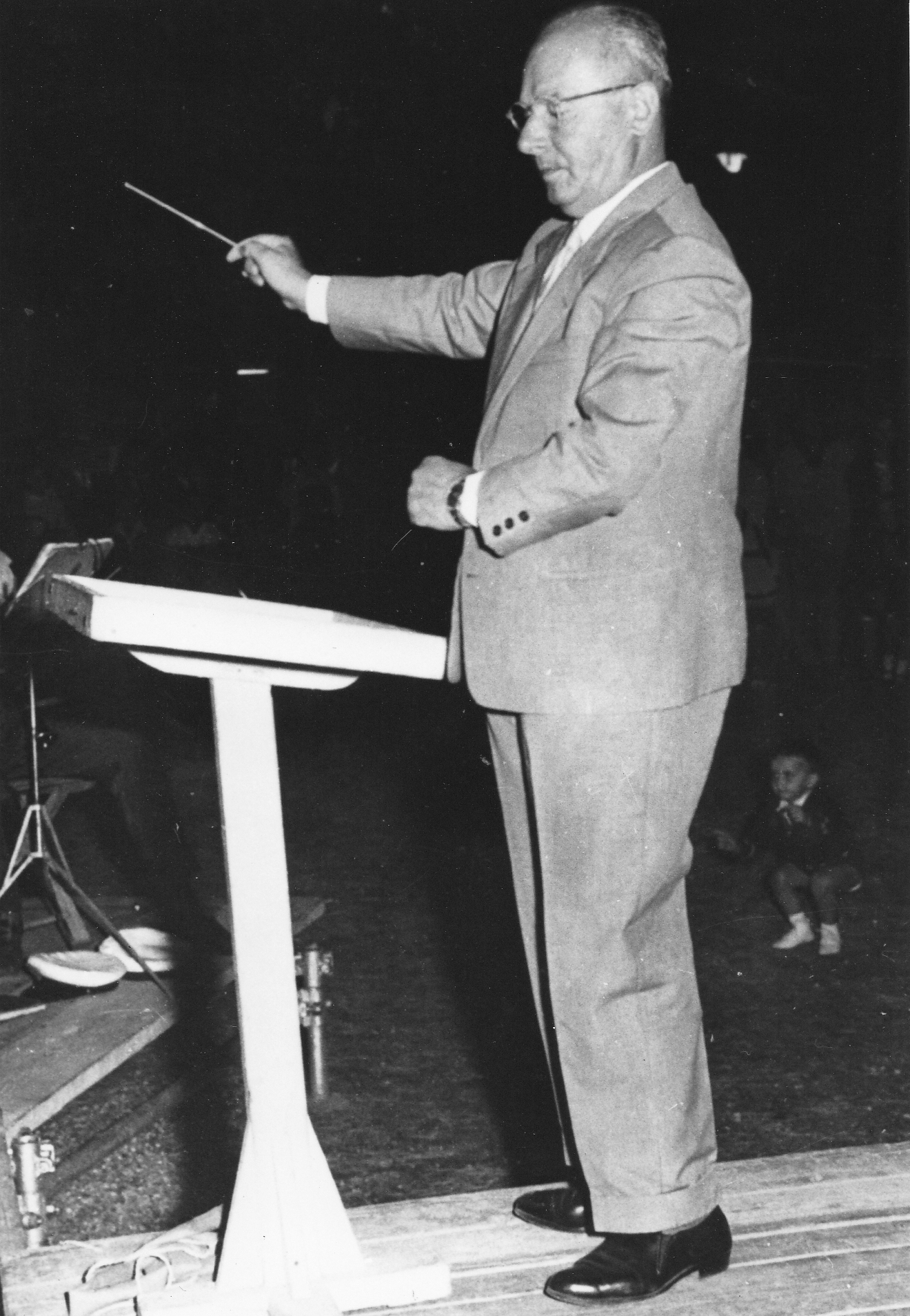 A fine portrait of Maestro Candotti
The new president — whom everyone call Silvio, but whom we’ll call Gualtiero here to avoid confusion with the late maestro Silvio Cosolo, in whose memory he had been named — set clear and ambitious goals at the start of his tenure.
First, the band’s roster needed to be refreshed and expanded. Years of retirements and the inevitable passing of the older players had reduced it to a skeleton crew. At the assembly of July 22, 1958, where the leadership was renewed, Cosolo was elected with eight votes out of ten members present. At full strength — loosely speaking — the band could count on about fifteen players. That was far too few to handle even modest orchestral demands with any dignity.
Second, the instruments needed to be modernized. Many were worn out and barely usable. Third, something had to be done about the band’s public image — because how the outside world perceived the band inevitably reflected how the players themselves felt about it.
The first problem could only be solved over the medium and long term. Maestro Nereo Cosolo began giving private lessons to young people who wanted to learn to play and eventually join the band. The second problem required an immediate solution.
After a careful survey and a thorough inventory, the instruments were divided into two groups: those that could be repaired, and those that simply had to go. They contacted Guido Bardelli, owner of a well-regarded music instrument shop in Trieste. After securing assurances of installment payment terms, they reached an agreement for the necessary repairs and purchases. About twenty days after the meeting with Bardelli, the instruments — new and refurbished alike — were ready for delivery to the players.
The attempt to give the band what would today be called a new look took shape in the hard-fought acquisition of the now-legendary peaked caps — an undertaking that, in Cosolo’s autobiographical memoirs, takes on almost epic proportions.
For starters, there were the grumblers to contend with. Some members argued that with the treasury so drearily empty, there was absolutely no sense in spending money on frills. The leadership took the opposite view: improving the band’s outward appearance was a priority, not a luxury. One particularly effective argument in the debate was that no other band in the region had the cap yet. After considerable debate and controversy, the caps were purchased, and on Liberation Day — April 25, 1961 — the Turriaco bandsmen proudly took the stage with something on their heads.
The increased prestige that came with the caps led to a rise in the number of services — paid performances requested of the band — whose proceeds helped ease, at least somewhat, the perennial financial strain.
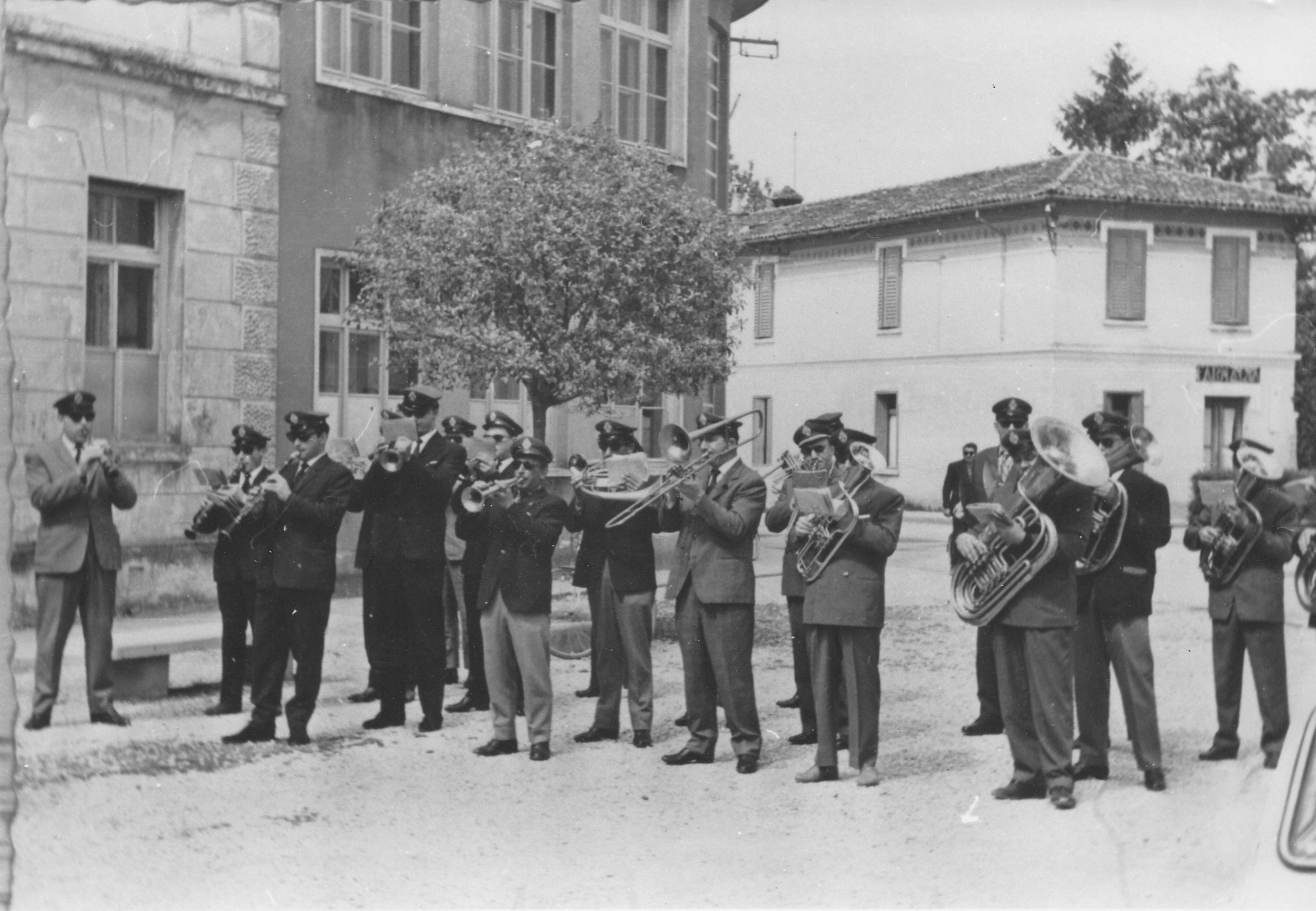 First performance with the new caps
As everyone knows, appetite grows with eating. After the band had been playing in caps for a while, someone began to think that doing so in a sharp uniform would add even more luster. Unfortunately, the finances — still weighed down by the debt to the Bardelli firm — made that idea impossible to pursue. For a while, it seemed destined to stay in the realm of dreams.
Several strategies were tried to make it even remotely feasible. First, the fundraising effort was made systematic and standardized: dozens of grant applications were sent to the municipality, the province, the region, and various public bodies and banks, while parishes and clubs were flooded with offers of parades and performances — that is, services.
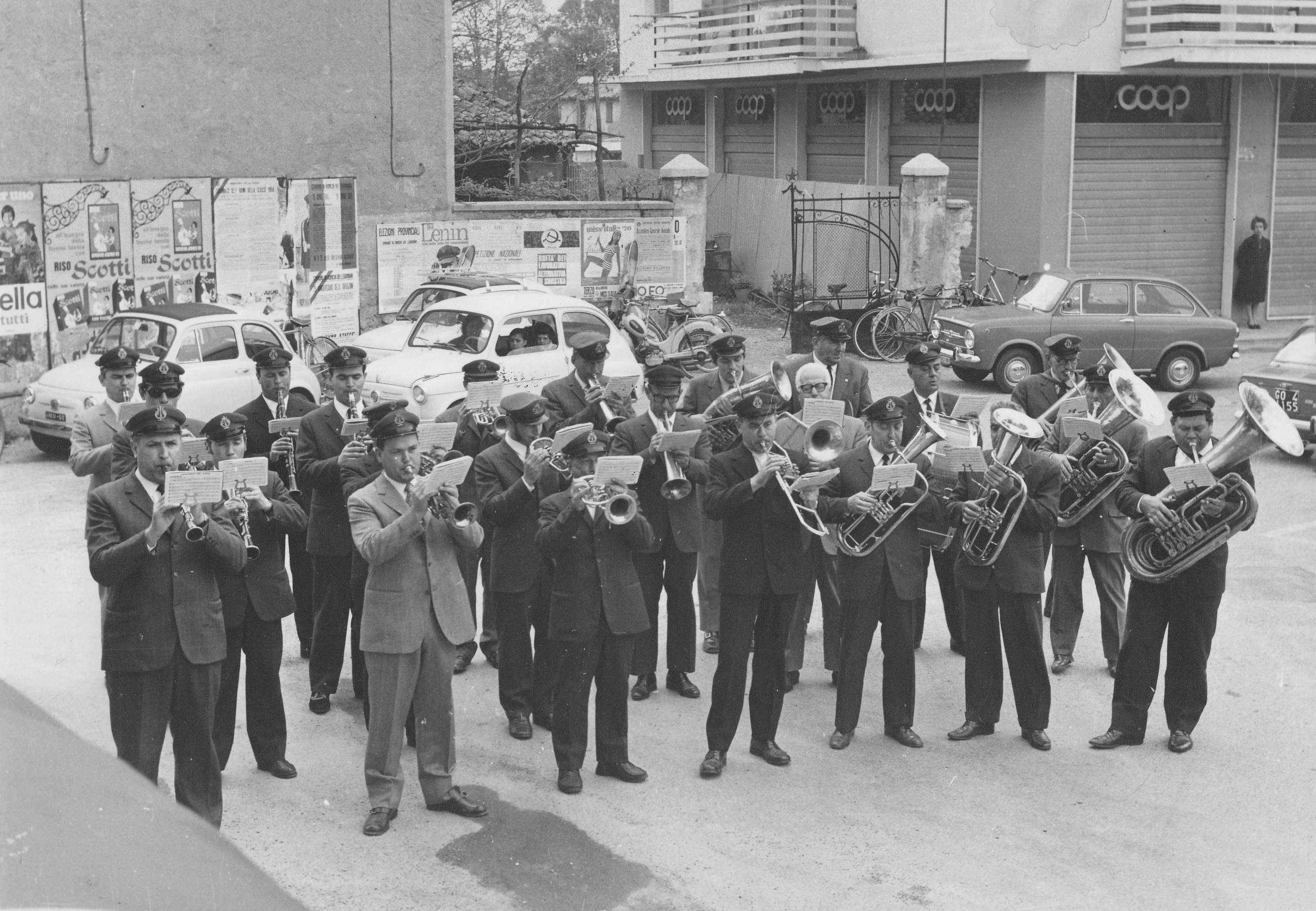 Last performance with the caps (and still no uniform)
Second, the band turned to self-financing. The most successful of these initiatives was the Veglione della Polka — a dance evening that started as a New Year’s celebration and was later extended to other occasions. It was held at the ENAL hall.
Nobody talks about ENAL anymore. At most, younger people know the Enalotto lottery (or, for the really young ones, the SuperEnalotto). Technically, ENAL stood for Ente Nazionale Assistenza Lavoratori — the National Workers’ Welfare Organization — but to everyone it simply meant the local dopolavoro, or after-work club: a prime example of synecdoche applied to everyday life. From the end of World War I to the late 1970s, the dopolavoro was, alongside the parish church and apart from the party headquarters, the other hub of social life in many of our towns.
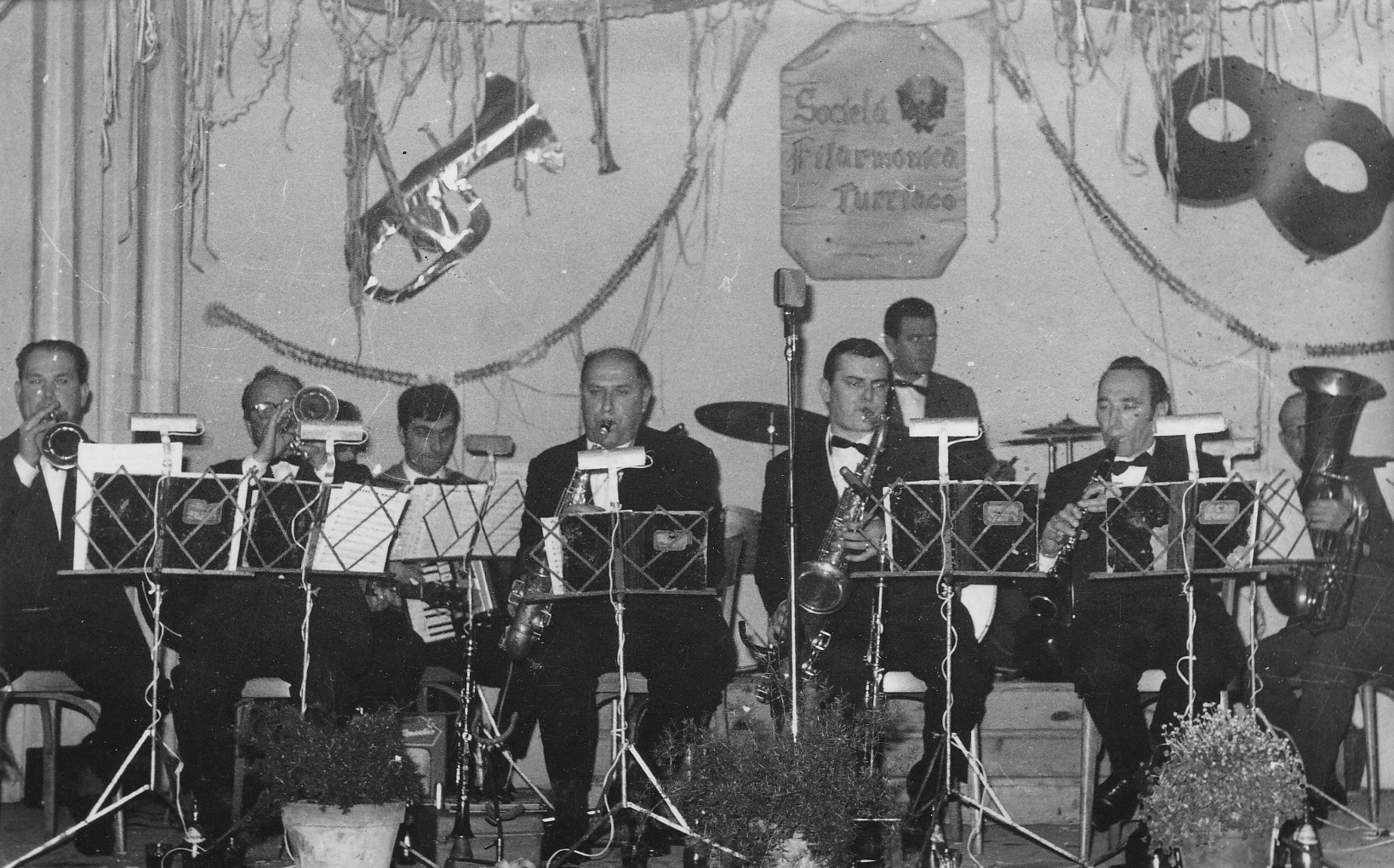 Veglione della Polka
The idea behind the Veglione was to revive the music of bygone days — right in the middle of the rock era. The sheet music for polkas, mazurkas, waltzes, and one-steps was drawn directly from the booklets dating back to the time when Turriaco had its two tavolaz dance orchestras. One happy side effect was the rediscovery of several Silvio Cosolo compositions that had fallen into oblivion. The dance evenings tried to recreate the atmosphere of the past, and they succeeded beautifully. The invitations — delivered personally to the town’s authorities and notable figures — specified that dark attire would be appreciated. Floral gifts were presented to the ladies, while a waltz competition and a raffle offered attractive prizes. The financial return, however, was modest, and the new uniform would have to wait for better times.
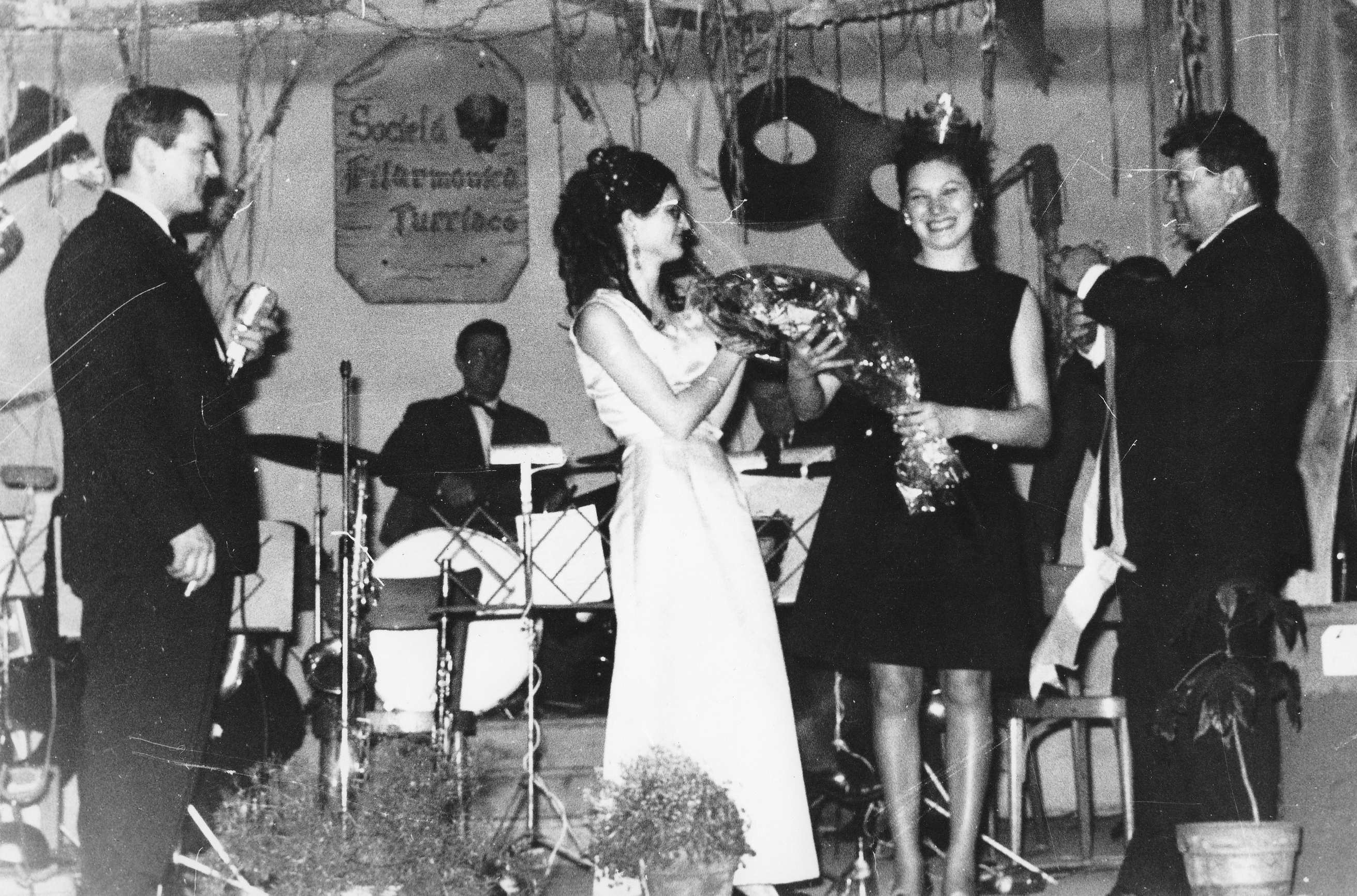 Crowning the Miss Veglione
Better times came with a very specific occasion: the band’s centennial. As the anniversary approached, President Gualtiero Cosolo called a meeting of the board and laid out his plans for the celebration.
Top priority: the band needed to make its appearance. A new uniform was essential —
… it was necessary to purchase the uniform, which would surely give the band a new identity, just as the adoption of the cap had done in its day.
Second, the centerpiece concert — performed not only for the general public but also for prominent invited guests who, it was hoped, would play a decisive role in securing future funding — had to be of the highest quality. It had to impress even those accustomed to hearing music in a proper concert hall.
Last but not least: a commemorative booklet was needed to document the key events in the band’s history.
The program sounded appealing, but the prospect of taking on a new debt for the uniforms alarmed the older board members, who (needless to say) made their opposition known. After spirited debate, the leadership argued that the project would only succeed if carried through in full — and won the necessary approval. The meeting adjourned, and President Cosolo rolled up his sleeves — metaphorically and otherwise — and the organizational machine swung into action.
The months leading up to the centennial were hectic. The tension was palpable. Nothing like this had ever been done before; there was no precedent to follow; everything had to be invented from scratch. The whole event had to leave a mark — or it would be nothing but wasted time.
The uniform supplier was the Fraizzoli & C. manufacturing company, owned by Ivanoe Fraizzoli, who at the time was president of the Milanese Inter football team. The trusted local go-between was the Virgolin firm, which ran a clothing store well known throughout the Monfalcone area. On the day set for measurements, the first players through the door were the very ones who had expressed the most reservations about the whole venture.
From the invoices of the time, we know the total cost came to 1,389,851 lire — a considerable sum by any standard. It should be said, though, that the result was outstanding, and that — best of all — the price included the new caps as well.
The concert, for which the band had been rehearsing with meticulous care, was divided into two parts and included a dozen pieces that formed a well-balanced program with something for every taste. It opened with a march by the late Silvio Cosolo, and featured two others composed by Maestro Nereo. There were operatic pieces (Norma and Nabucco) and operetta (The Merry Widow), Gounod’s Ave Maria, some inevitable works by or inspired by von Suppé, and more. Try to guess: what piece did the concert end with? Yes, you got it!
The commemorative booklet was written with contributions from two maestros: the band’s own Nereo Cosolo and the schoolteacher Silvio Domini, Honorary Inspector of Antiquities and Monuments and a deep student of local history. Formally dedicated to the speech that President Cosolo would deliver on the occasion, it traced the most significant moments in the Philharmonic’s history — caps and all.
The Honorary Committee included the highest authorities available locally: the president and vice-president of the regional government, the prefect, the provincial president, the regional finance commissioner, the mayor of Turriaco — who was, incidentally, another Cosolo, Giorgio — and Maestro Domini. The event received official endorsements from the region, the province, the municipality, the prefecture, and the Pro Loco, as well as the warmly welcomed support of the Gorizia Savings Bank, the Trieste Savings Bank, and the Friuli Bank. Press and television were contacted, and the obligatory interviews were duly given. In short, everything was done to the letter.
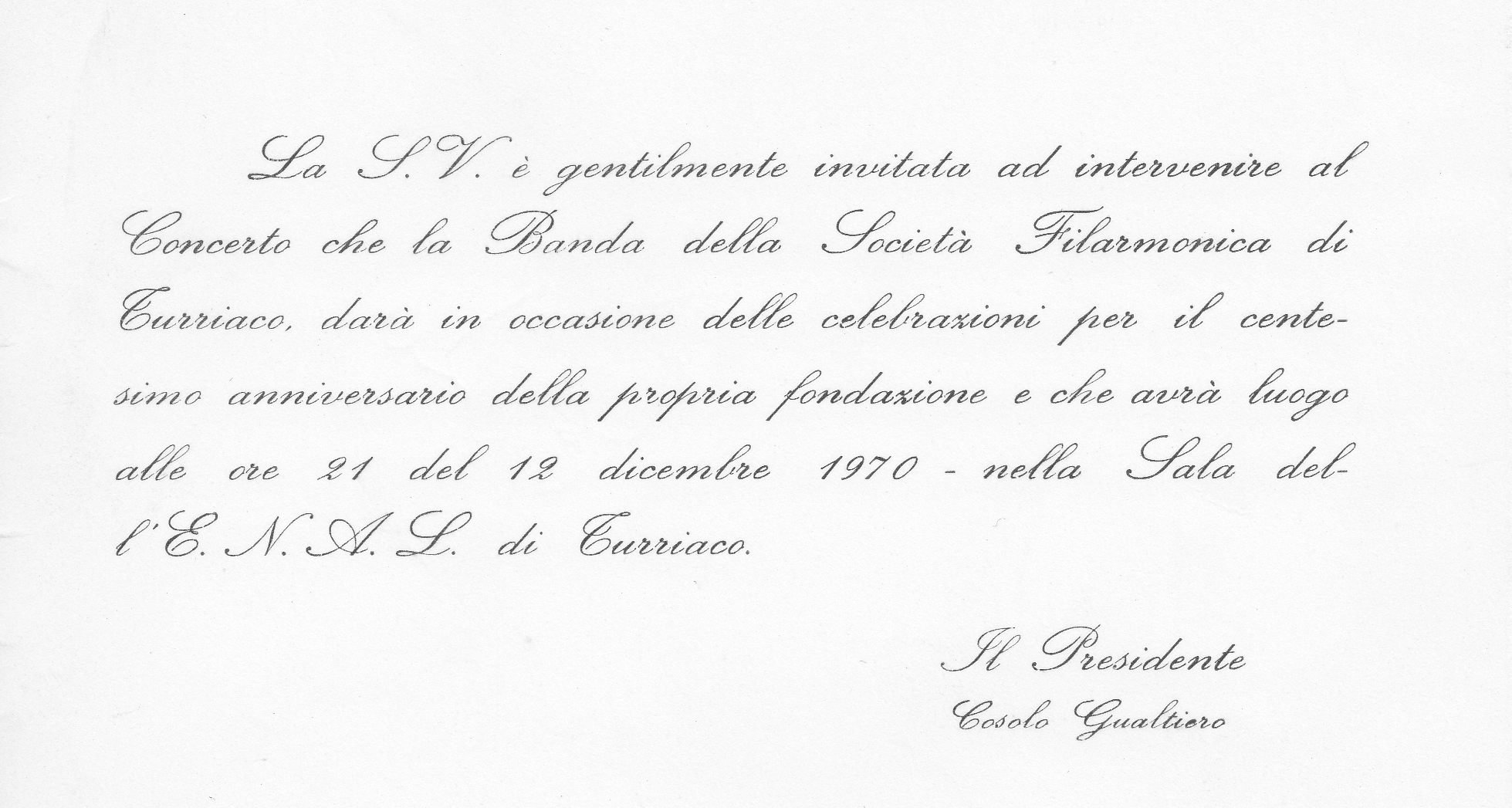 Official invitation to the Centennial celebrations
On the evening of December 12, 1970, as the crowd and invited guests streamed into the center of town, the band stood in formation — resplendent in its brand-new uniforms — outside the ENAL hall. Maestro Cosolo struck up Borgosesia, a stirring march, and the short parade to the square began. All along the route, the band was met by a festive, applauding crowd. The tension that had been building for months dissolved in an instant. Playing the clarinet while your eyes are filling with tears is not easy — but that evening, someone managed it.
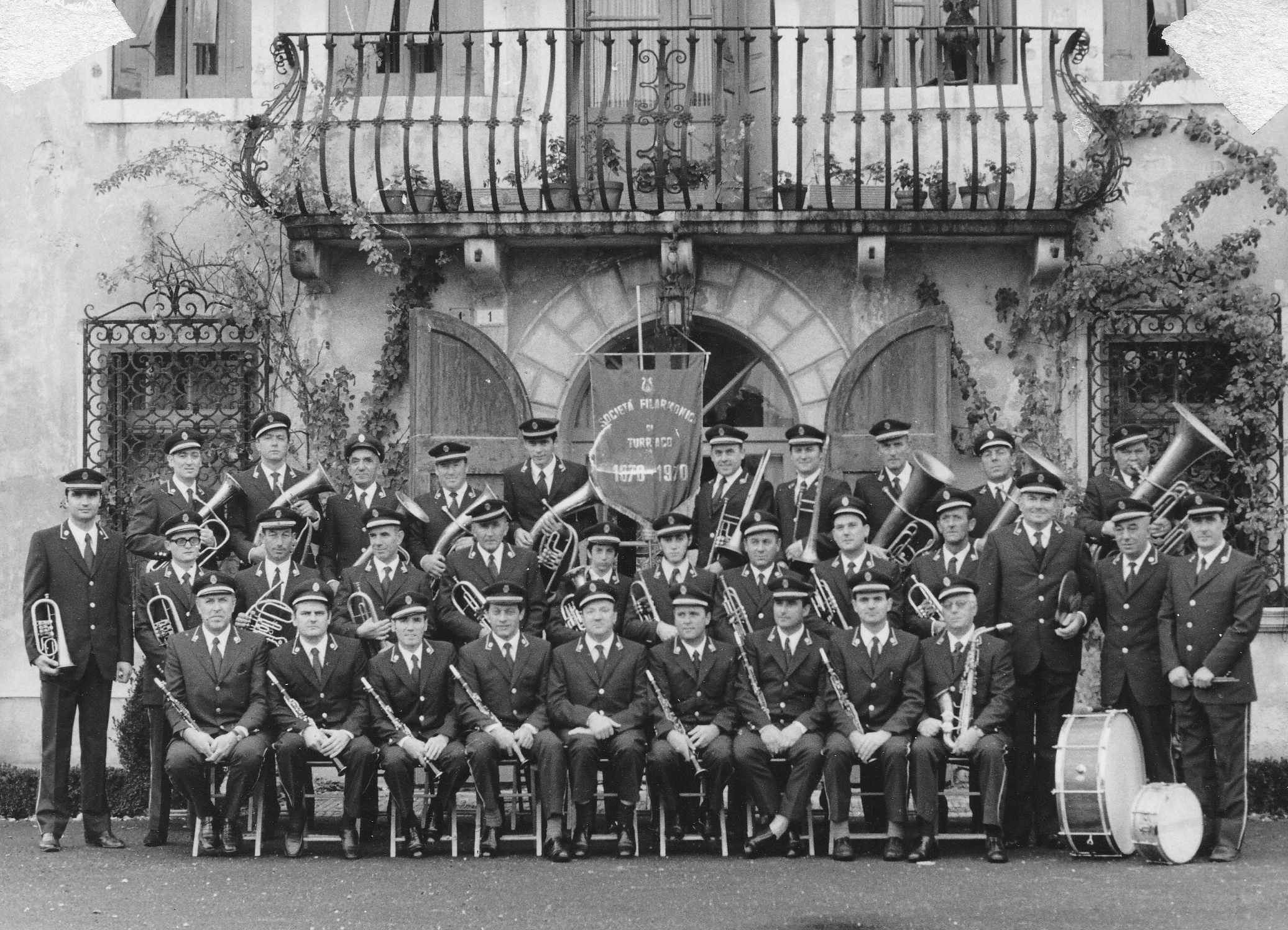 Centennial commemorative photo
The centennial celebrations marked a turning point in the life of the Philharmonic Society. A decade or so of Cosolo’s presidency had transformed a group on the verge of extinction into a vital, enthusiastic organization with a genuine love of music to share. A key part of that transformation was Maestro Nereo Cosolo, who had grown up musically within the band and was leading it with passion and skill.
The band was making a name for itself beyond the province, and the press was taking notice. Under the headline The Turriaco Band Makes Its Mark, the local paper commented on the Philharmonic’s activities:
With the concert performed last Sunday in Lignano Sabbiadoro at the invitation of the Tourism Authority, following earlier performances in various towns throughout Friuli V.G., the 1971 touring season of the Turriaco Philharmonic Association has come to a close. Everywhere, the welcome has been warm and the response enthusiastic, with large audiences applauding every performance with genuine fervor.
The versatility of the programs — ranging from symphonic repertoire to opera and operetta — speaks to the undeniable abilities of the players, both technically, at a very high level, and in terms of the refined interpretation they achieve under the direction of Maestro Nereo Cosolo.
Recently, the Philharmonic celebrated its centennial through the tireless efforts of its president, Gualtiero Cosolo, organizing cultural and artistic events attended by prominent authorities and large audiences. Turriaco is a town that belongs among those with a tradition worth preserving — one that regards art, in all its forms, as a vital lifeblood.
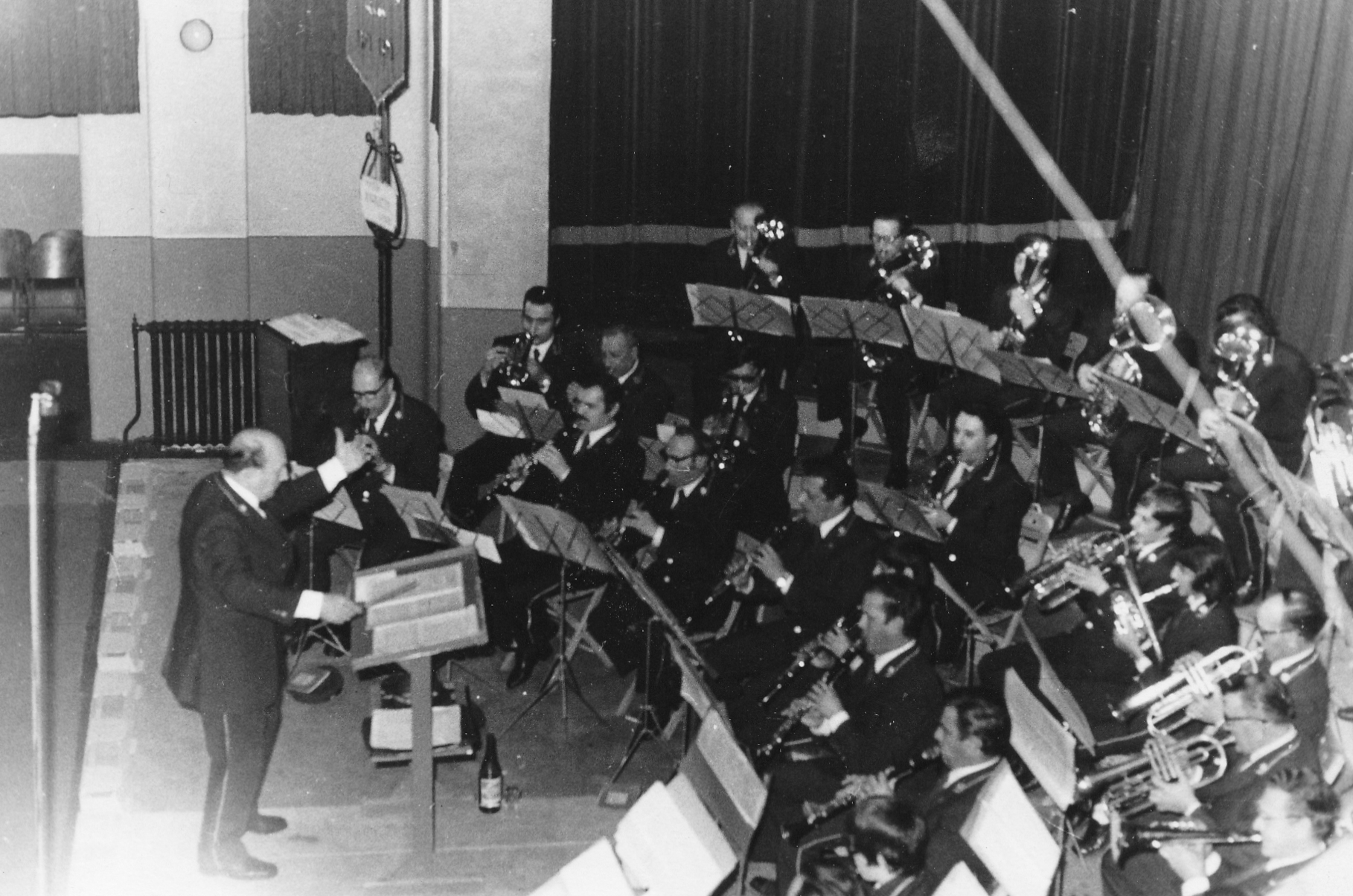 Maestro Nereo Cosolo leading the Philharmonic
Another headline: The Turriaco Band: From Vivaldi to Beethoven — an article commenting on the 1975 elections that renewed the board. After listing the newly elected officers (if it ain’t broke, don’t fix it: president Gualtiero Cosolo, vice-president Albano Cecchini, secretary Egidio Spanghero, maestro Nereo Cosolo, and several board members, including, for the first time, a representative of the younger players), and touching on the new repertoire the band was developing, the article concluded:
Another noteworthy feature of the group is that, despite operating in a small town, it has managed to sustain itself independently for over a century — without receiving funding from any public or private body.
It is a society of people who devote themselves to music as a hobby — unlike many other bands located in larger centers, which enjoy grants and support from various public institutions that allow them to acquire new instruments, maintain dedicated rehearsal spaces, and so on. All the more admirable, then, is the determination of these people who are, at one and the same time, musicians, members, and administrators of their own society.
Finances were no longer the overriding concern, and the band could breathe a little easier and widen its horizons. Out-of-town performances, once sporadic, became a regular feature of society life. Listing every performance and every trip would make for a very dull catalogue of names and dates. Better to focus on the ones that, in hindsight, stand out as the most significant examples of the band’s activity in this period.
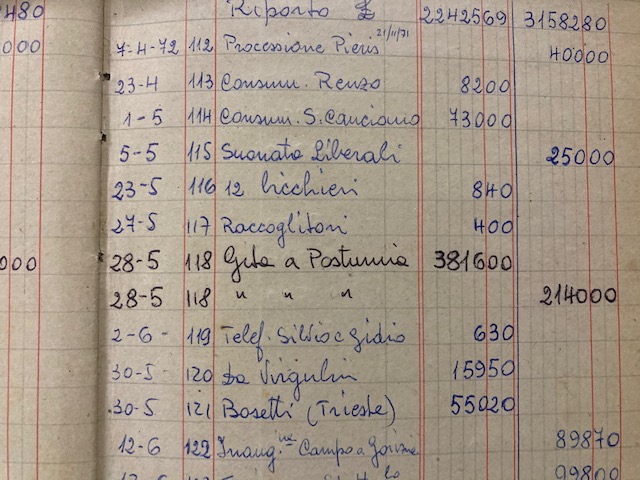 An example of the meticulous bookkeeping
Naturally, concerts come first. Beyond the traditional Christmas Concert — which remains a fixed date in Turriaco’s calendar to this day — the band performed on special occasions and simply to make itself known and appreciated. Joint performances at concerts, festivals, and gatherings strengthened ties with bands from the surrounding area and the wider region. The Turriaco band played alongside its neighbors from Monfalcone, Ronchi, Pieris, and Fiumicello; it was invited to the commemorations of major anniversaries, such as those in Madrisio di Fagagna and Santa Croce near Trieste; and through a shared love of music, it built bonds of friendship and camaraderie with these and many other groups too numerous to list.
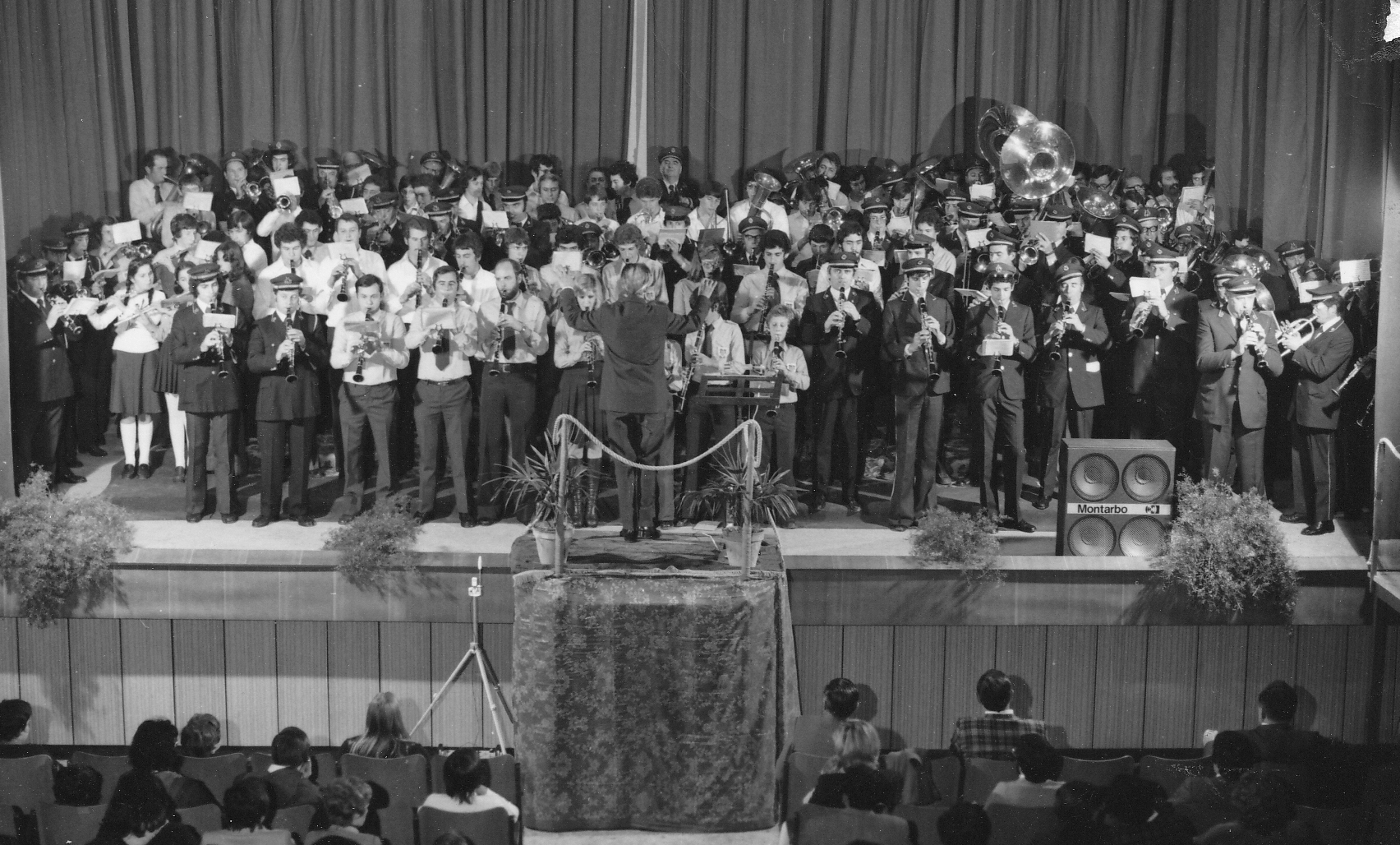 Fiumicello Band Rally (1975)
One event stands out above all: the grand Concertòn — the “Big Concert,” as it’s known in dialect — held in 1980 alongside the Banda S. Michele of Monfalcone, directed by Maestro Piero Poclen, a man of exceptional warmth, charm, and generosity whose memory is still alive in the area.
As guests of the Monfalcone band, the Turriaco players were happy to let the hosts take center stage, but they earned their full share of applause — most notably for a fantasy on Norma, which the local critic singled out for special praise, and for their part in the rousing finale of the Radetzky March (old habits die hard), performed under dual baton: first Cosolo, then Poclen.
Travel wasn’t only for concerts. There were also excursions and pleasure trips — though these invariably included a performance. Crossing the border into Yugoslavia on a trip to Postojna, the band played inside the Concert Hall, a vast cave capable of holding up to 10,000 people and with superb acoustics.
Another destination was Venice. In addition to feeding the pigeons, the band performed in St. Mark’s Square to the delight of bystanders. A trip to Venice needs no justification. Slightly harder to explain is a 1982 trip to Cibiana di Cadore, in the Belluno area.
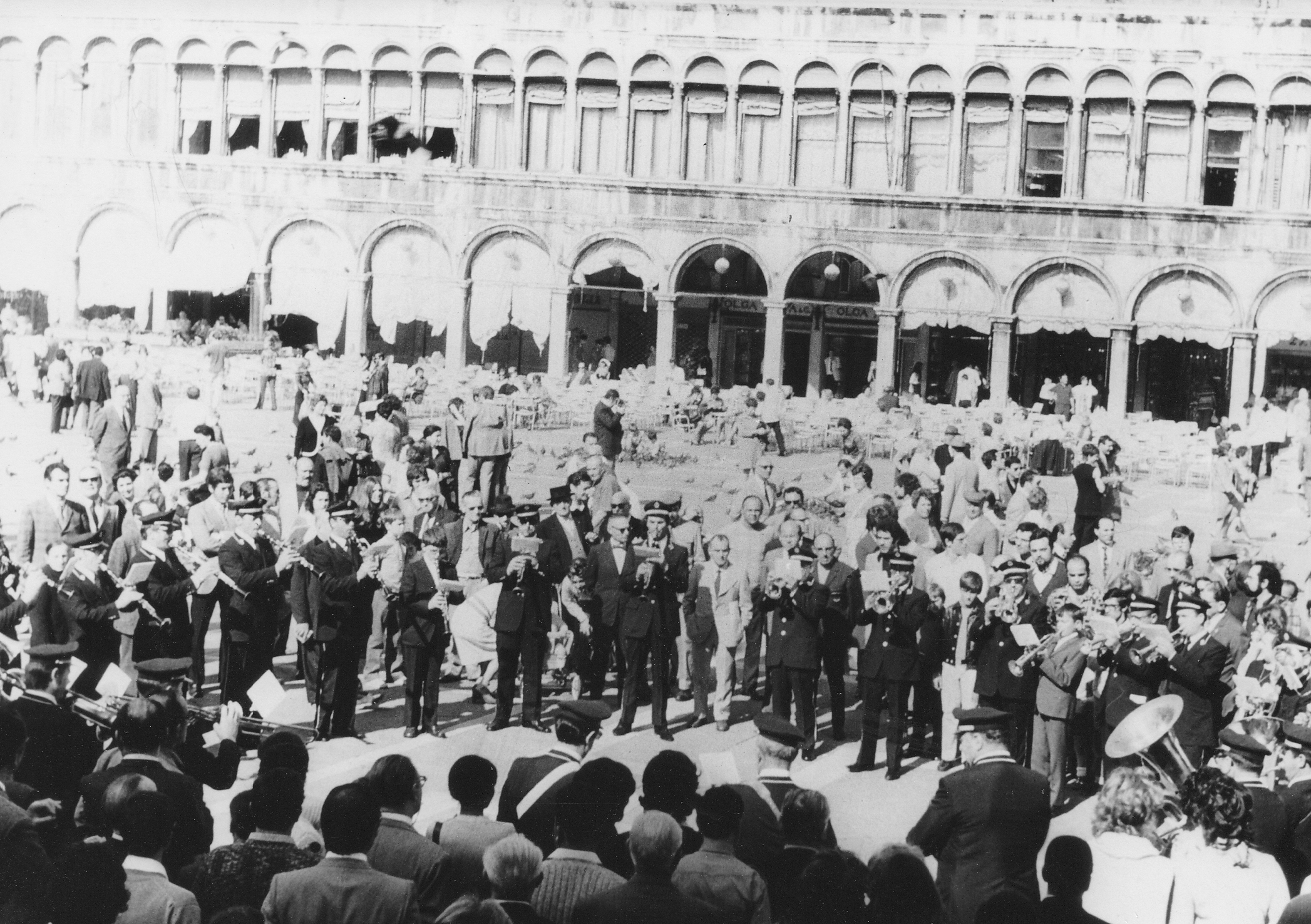 The band in Venice
Cibiana has just over 300 inhabitants, which makes it hard to see, at first glance, why anyone would go there. The answer is that Cibiana is also known as the village of murals — large-scale frescoes painted on the stone walls of its houses, forming an open-air museum with contributions from Italian and foreign artists. What people remember most clearly, though, is not the murals. That evening, after the concert, everyone crammed in front of the bar’s television to watch Italy beat Germany 3–1 (scorers, in order: Rossi, Tardelli, Altobelli) and become world champions for the third time.
Somewhere between concerts and pleasure trips, there were also appearances at festivals and events: the Gorizia International Folk Competition, the Muggia Carnival, and the national Festa dell’Unità in Bologna.
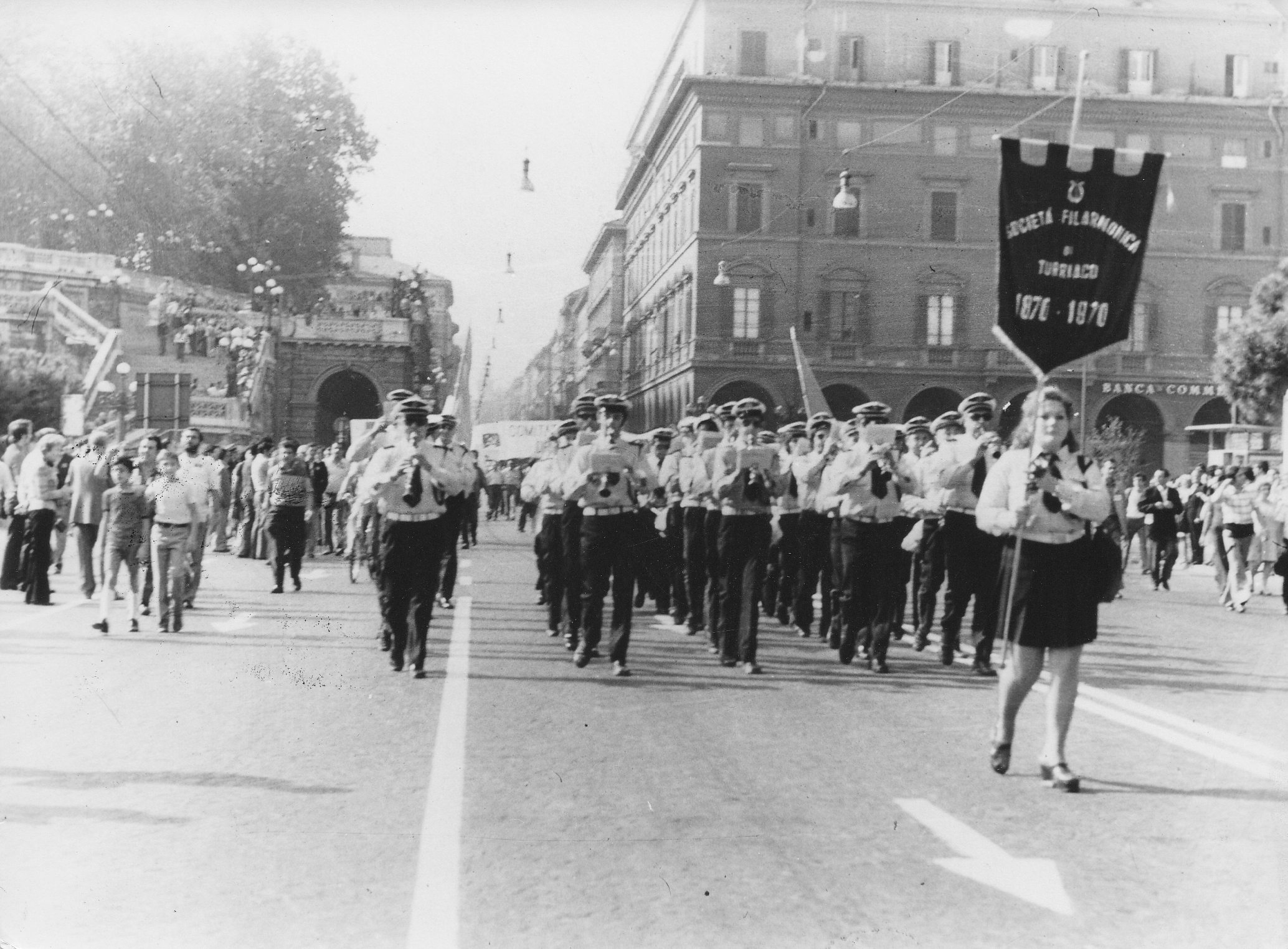 The band in Bologna
A special opportunity arose in 1985, when the band appeared as a featured guest on a Telefriuli broadcast — a well-known local television station — giving it exposure not just to live audiences but to viewers at home.
In the second half of August 1980, the band also celebrated its 110th anniversary. The experience gained ten years earlier proved invaluable: once you’ve done it once, even the most daunting tasks become more manageable. The program was, as usual, rich and varied. The festivities opened with remarks from local officials, the unveiling of a commemorative plaque, the inauguration of a retrospective photo exhibition, and a concert by the Conelli orchestra from Monfalcone, directed by Maestro Pino Vatta.
The following day featured a performance by the Giuseppe Verdi band of Trieste, directed by Maestro Azzopardo. (Make a note of that name — it will come up again shortly.) The grand finale on the last day of the celebrations brought a parade and a concert featuring, alongside the Turriaco Philharmonic, the bands of Fiumicello, Ronchi, Aurisina, and the Nova Gorica band — the Yugoslav counterpart of Gorizia.
Without question, though, the most important initiative of this period was the founding of the Music School. Maestro Nereo Cosolo had long been giving private lessons to aspiring players and had set up, on his own initiative, a small private school where he was the sole teacher. Admirable as it was, the arrangement had obvious weaknesses. The most critical was that with one person teaching everything, the instruction was often uneven. Another drawback was that while many students enrolled, very few stuck with it long enough to actually join the band.
A free-tuition school with specialist teachers for each instrument could be the answer. As usual, the proposal was met with initial skepticism — which, by now, should surprise no one. Once again, the leadership held firm and pressed ahead. Flyers and announcements went out inviting the parents of school-age children to a meeting where the idea was presented. Within a few days, more than 25 students had signed up. Lessons began a few weeks later with three qualified teachers: one for brass, one for clarinet, and one for flute. The date was November 8, 1983.
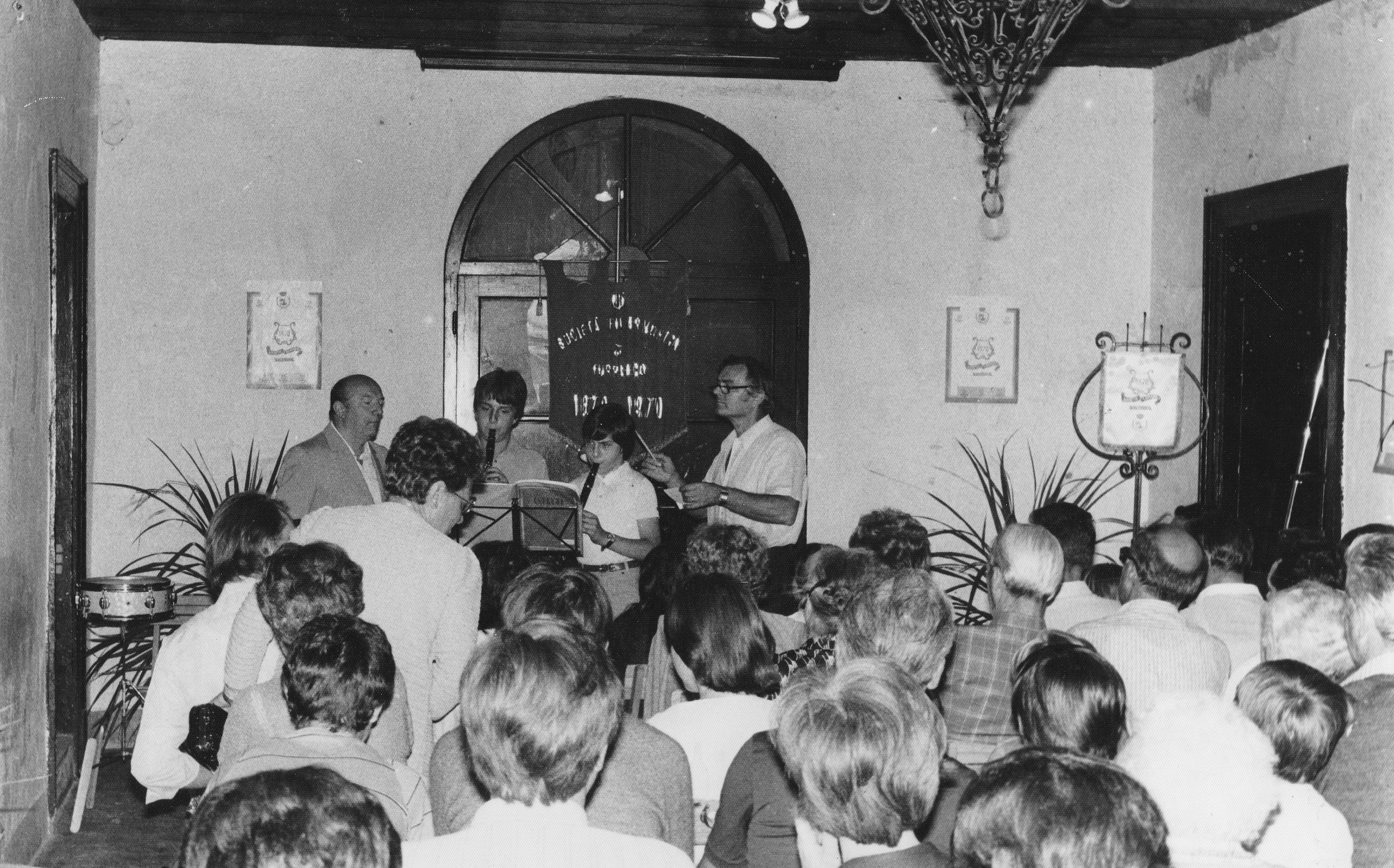 Maestro, President, and a large audience at the Music School’s first recital
All good, then? Not quite. The new school effectively competed with Maestro Nereo Cosolo’s private teaching activity — which, as one might imagine, created friction between the maestro and society president Gualtiero Cosolo. The working relationship that had carried the Philharmonic to its finest achievements could no longer function smoothly, and the situation gradually deteriorated. The deadlock was broken by Gualtiero Cosolo himself: after 27 years as president, he resigned — to be succeeded by Giuseppe Buttignon — and for a time stepped back from the life of the society. Nereo Cosolo remained as director, and the new Music School began its life. The era of the two Cosolos, who had revived the Philharmonic through dedication and passion, was over.
By the mid-1980s, the band’s ambitions were growing — and, fortunately for us, its activities were becoming much better documented.
Among the most memorable initiatives of this period, the trip to Klagenfurt, in Carinthia, stands out above all others. The occasion was an exchange with the local Postkapelle — the postal workers’ band — with whom contacts had been developing for some time.
That morning (it was May 16, 1987) the weather looked unpromising. Despite the ungodly hour — participants were asked to gather at a quarter to six in the morning — the streets of Turriaco were buzzing. Buzzing doesn’t quite capture it: the whole village was caught up in a mood of excitement and anticipation. Nine coaches were lined up to take the band and its supporters to Austria. Practically a quarter of the population was heading off.
The day’s program was packed — perhaps a little too packed. Practical and financial constraints had compressed into a single day a series of activities that would ideally have spread over more time.
Upon arrival, after an official welcome from the mayor, the players would parade alongside their Postkapelle colleagues through the city center to the Neuer Platz — Klagenfurt’s main square — for a joint concert by the two bands. After lunch, there would be a short tour of the city and a visit to the Minimundus, the miniature world that is one of the area’s main tourist attractions. Then on to the Wörther See and the lakeside town of Velden for another concert. Back to Klagenfurt for the customary reception with the Austrian band and their families. Return to Turriaco — naturally — late that evening.
From the chronicle of that day:
The two ensembles, as tradition calls for, performed several pieces together, to warm applause from a very large audience of locals and Austrians.
The mayor of Klagenfurt and the mayor of Turriaco both spoke of the importance of these spontaneous exchanges between neighboring peoples — encounters that carry real messages of fraternity and peace. And nothing seals such encounters more beautifully or more universally than music, which with its universal language bridges every difference in tongue.
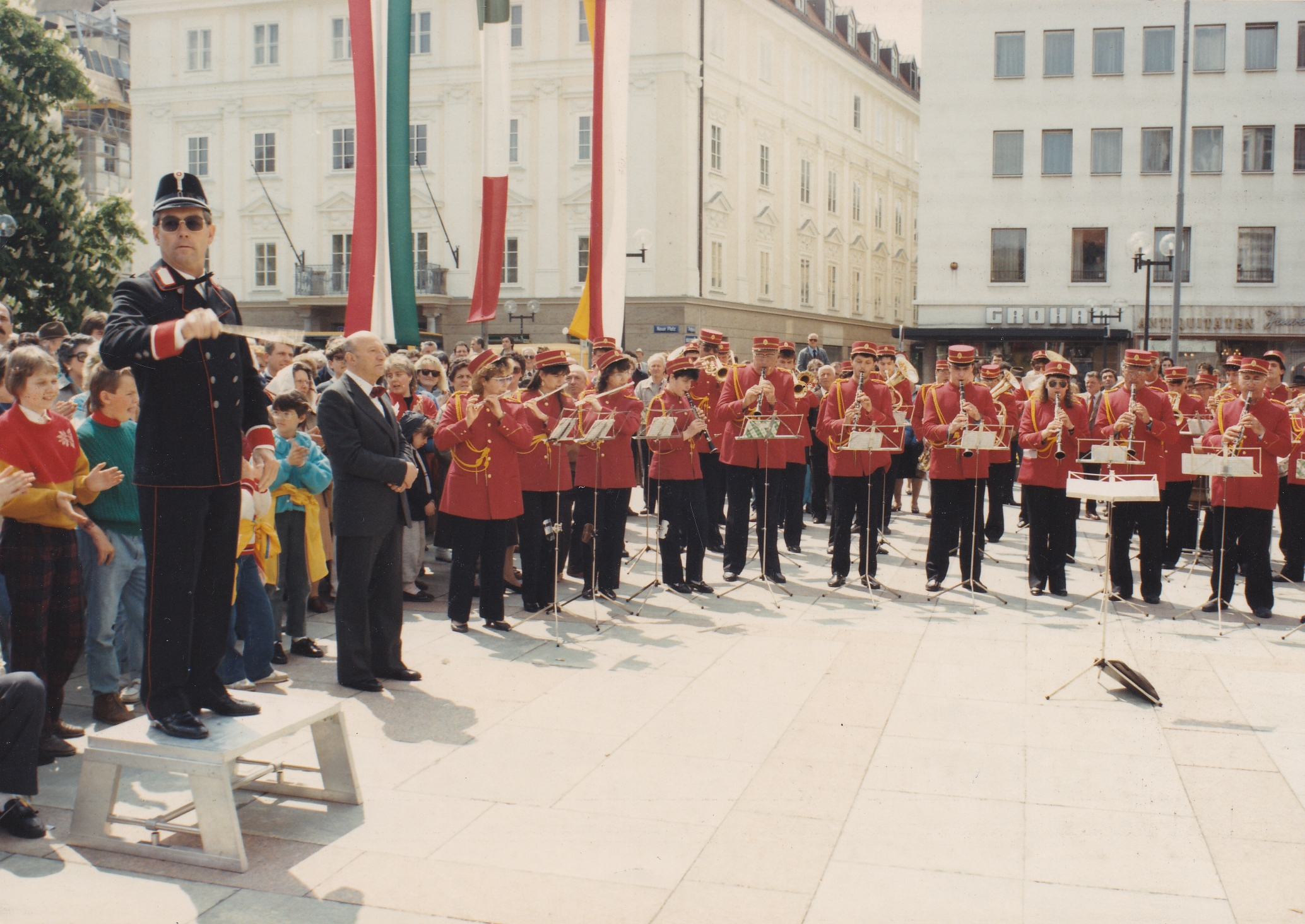 Concert in the main square in Klagenfurt
In 1987, Turriaco also saw another significant event: the inauguration of the Civic Center — the building where the Philharmonic Society is now based. This seems like a good moment to open a small parenthesis and tell a story within the story: the long, wandering journey the Society went through before it finally found a permanent home.
When we talk about a band’s headquarters, we don’t just mean the offices where the board meets or paperwork gets done. For a band, headquarters is first and foremost the place where rehearsals happen — and, optionally, where toasts are raised afterward without the inconvenience of walking to the bar. The bond between a band and its rehearsal space runs deep. These things tend toward the conservative: everyone knows their spot, it’s always the same spot, and any change causes a minor trauma. If you’re used to having the tuba on your left, suddenly finding yourself next to a flute produces a kind of disorientation. (This is a personal observation.) Imagine, then, what it takes to uproot the whole group and move it to an entirely different location.
Over the past century, the Turriaco Philharmonic has changed homes many times. Here’s the list.
After the First World War, the rehearsal room was on the upper floor of the building that now, after renovation, houses the Cooperative Credit Bank. Around the mid-1930s, rehearsals moved to the Spanghero osteria on Via Garibaldi, and later to the Dopolavoro on Via Oberdan. (On the Spanghero osteria, known to everyone as Dal Peon: one could write a story within a story within a story. It has been in the hands of the same family, generation after generation — feeding locals and visitors alike — since 1767, when a certain Valentino Spangher is recorded as an innkeeper in Turriaco.)
During the Second World War, the band suspended all activity, as we know. Once peace was restored, the players made do rehearsing among the planks and sawdust of a lumberyard on Via Oberdan, since demolished.
As soon as something better became available, the band moved on — finding hospitality first at the Communist Party headquarters, then on Via Roma, then at the ENAL, then back at the Spanghero osteria, and finally, to dispel any lingering doubt about the Society’s political neutrality, in the hall of the former parish cinema next to the rectory.
As if that weren’t enough, temporary arrangements were also made at two private homes: the home of Carlo Calligaris on Via Garibaldi and the home of then-president Albano Cecchini.
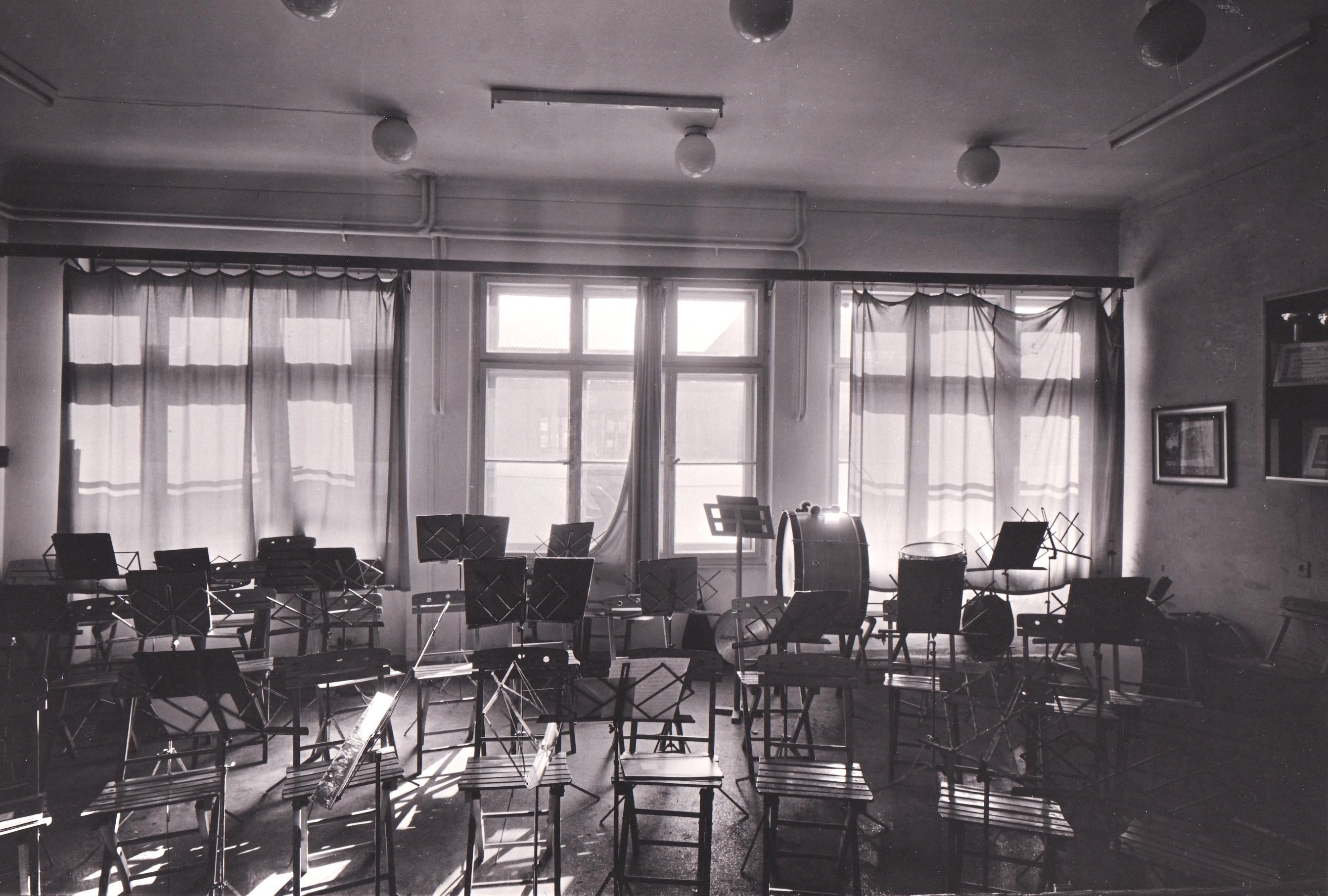 The current rehearsal room
Finally, in the 1970s, with help from the municipal authorities, the band’s nomadic existence came to an end. In the first half of the decade, rehearsals were held on the first floor of the former retirement home, before moving to the first floor of the former middle school on Piazza Libertà. That building began renovation in 1985, to be transformed into the Civic Center that would house the town’s clubs and associations. (For the record: during the renovation, the band was hosted at the ARCI — formerly the ENAL — on Via Garibaldi.)
After two years of construction, the building — completely modernized inside and out — was ready for inauguration. It was a significant moment for the entire community, and it was celebrated in style. The inauguration coincided with the first edition of what would become the annual Festa in Piazza, which has grown richer in content and wider in appeal every year.
The guest that year was the Civic Band of San Lazzaro di Savena. According to the accounts, two refreshment stands were set up — one run by the local Blood Donors Association and one by the Bocce Club — while the tombola lottery was organized by the Organ Donors Association. (And with this mention, we have disposed, once and for all, of the question of refreshments at band events. As everyone knows, one of the perks of playing in a band is that you never go hungry or thirsty.)
The following year, on September 25, the Postkapelle of Klagenfurt arrived for the Festa in Piazza, returning the visit the Turriaco band had made the year before. The Carinthians brought a sizeable contingent of family and supporters.
The Carinthian ensemble arrived in Turriaco in the afternoon, having earlier visited the Gorizia wine country, attended the harvest of the “Wine of Peace” in Cormòns, and entertained the farmers with a few pieces.
In the square, they played first alongside the Turriaco Philharmonic — the two bands together numbering over a hundred performers — and then, in the late evening, gave their own concert proper, followed by thousands of people who had filled the square.
Among the officials present, the accounts mention regional council member Mario Brancati, the noted Austrian musician Heinrich Oberotner, the president of the Friuli Venezia Giulia band associations Giovanni Melchior, and — of course — the mayor of Turriaco, this time Duilio Petean, and the mayor of Klagenfurt, Mr. Gutenberg. The accounts do not record the content of the respective speeches by the regional council member, the Austrian mayor, and the local mayor — but we can safely imagine it.
The concert with the Postkapelle was one of the last occasions on which Maestro Nereo Cosolo conducted his band. At the Christmas Concert a few months later came the farewell ceremony — after thirty years at the podium, and for reasons of health — with the customary presentation of tributes, a flood of memories and emotion, and, above all, the introduction of the new director: Maestro Lidiano Azzopardo.
A percussion instructor at the Tartini Conservatory in Trieste, a member of the orchestra of the Teatro Verdi in the same city — where he had played under the batons of Celibidache, Bernstein, and Schippers, among others — engaged as solo timpanist by the New York City Ballet for three extended five-month tours of the major European capitals (including London, with a concert at the Royal Albert Hall later recorded for Decca), author of instructional works including The Timpani and The Modern School of Percussion, and, for good measure, director of the Giuseppe Verdi civic band of Trieste: by all accounts, Azzopardo turned the band inside out.
With all due respect to the conductors who came before and after him — and probably to those who will come in the future — this was the first time the Philharmonic had been directed by someone who thought, felt, and made music at a professional level, and who was capable of instilling that same mentality in the people he led.
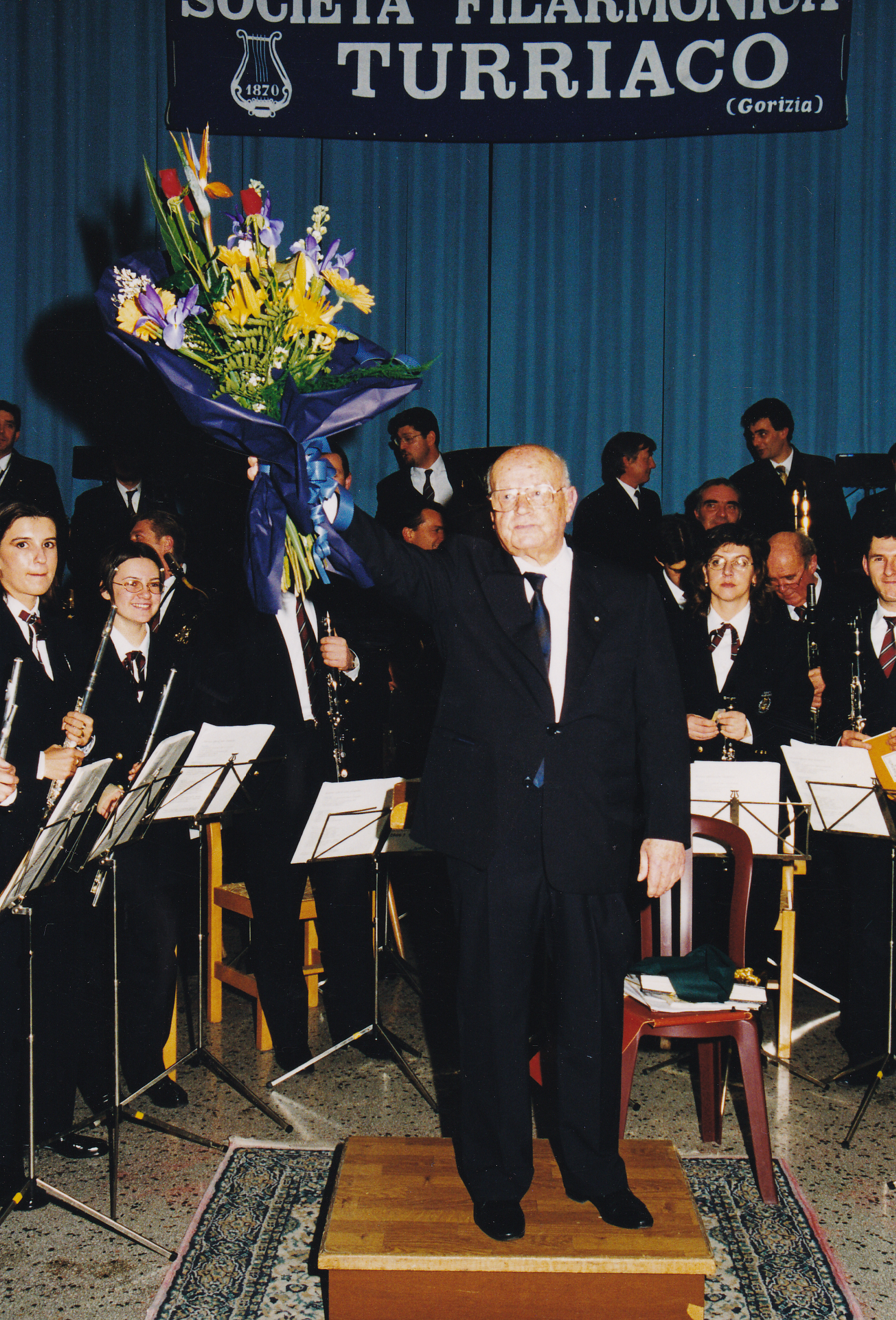 Maestro Lidiano Azzopardo
A man of somewhat gruff manner, plain-spoken and direct, Azzopardo was unyielding on musical matters. During rehearsals he demanded complete silence. When a mistake occurred, he could — from memory alone — not only correct whoever had erred, but play back for them exactly how the other parts sounded. Everyone still remembers the day a score belonging to one of the band’s veteran “senators” went flying out the window — a clear signal that, for Azzopardo, there were no sacred cows or untouchable figures.
Under his direction the band had some thrilling experiences. One was serving as a training ensemble for conducting courses organized by ANBIMA — the Associazione Nazionale delle Bande Italiane Musicali Autonome. After a period of theoretical study, the aspiring conductors took turns at the podium for practical sessions. Playing the same piece under different batons gave everyone a much clearer sense of what a bandmaster actually does.
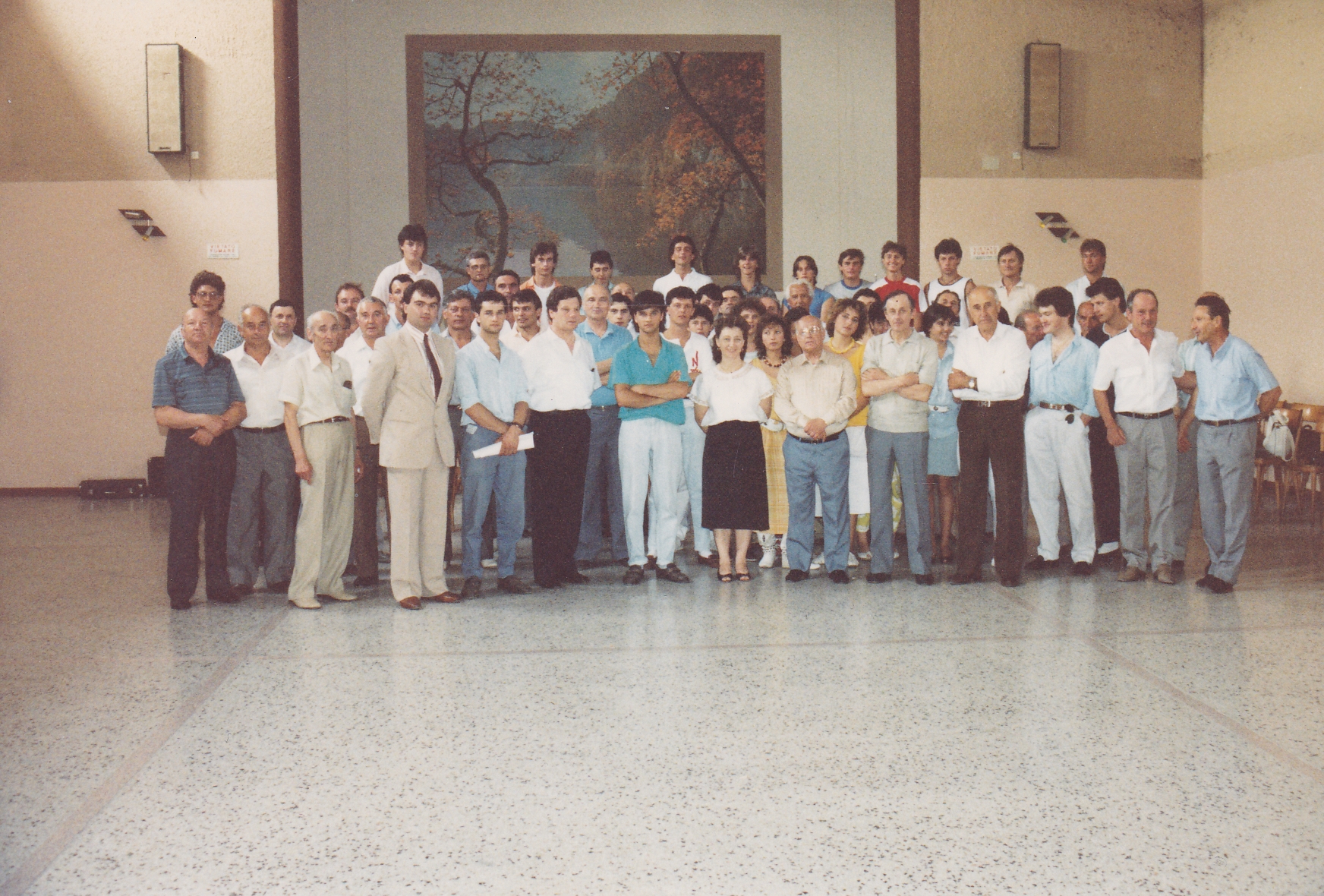 Participants in the ANBIMA course (Maestro Azzopardo is in the front row, sixth from the right)
Alongside the thrilling experiences, of course, there were the ordinary ones. In June 1989, the Philharmonic took part in the 4th Città di Schio Band Festival alongside the local Schio band and the Bressanone band. A glance at the program already reveals the new director’s influence: the Turriaco band performed a selection from My Fair Lady. The musical was making its first appearance in the band’s repertoire, joining the marches, concert marches, operatic fantasies, and the like that form the traditional menu of any self-respecting band. (Don’t worry — Al Cavallino Bianco: (White Horse Inn) was also on the program. Trieste, where the maestro came from, is, after all, the home of the international operetta festival.)
The following year, 1990, was an important one: the Society’s 120th anniversary. The organization was in fine health, and President Giuseppe Buttignon — known to everyone as Bepi, and to close friends as Carriola — had every right to be proud of what had been built. Directed by one of the finest conductors available, with a roster of more than 50 players and a music school ensuring continuity and artistic growth, the Philharmonic had every reason to celebrate. This time things were done on a grand scale, with celebrations lasting four full days.
Alongside the musical program, a series of interesting side events was organized: panels on environmental themes, an international volleyball tournament, the opening of a painting exhibition, and the presentation of a commemorative booklet for the anniversary. To design the booklet’s cover, the local elementary school classes were invited to take part in a drawing contest on the theme of The Band. The participating students were honored at the presentation.
The musical portion of the festivities opened on Thursday the 13th with a Philharmonic concert. On Friday, September 14, the fanfare of the 3rd Carabinieri Battalion Lombardia, based in Milan, gave its performance. One might wonder how a carabinieri fanfare ends up in Turriaco all the way from Milan. It happens because someone in the band had done his military service there as an auxiliary carabiniere and made a fine group of friends. It happens because among those friends was someone who served as a career carabiniere and knew still more friends in turn. In short: networking. And networking often proves invaluable.
One footnote on the musical program, which ran to about a dozen pieces. The Radetzky March was included, but — contrary to what one might expect — it wasn’t the closing number. The concert ended with La fedelissima, the formal march of the Carabinieri Corps, followed by the Italian national anthem.
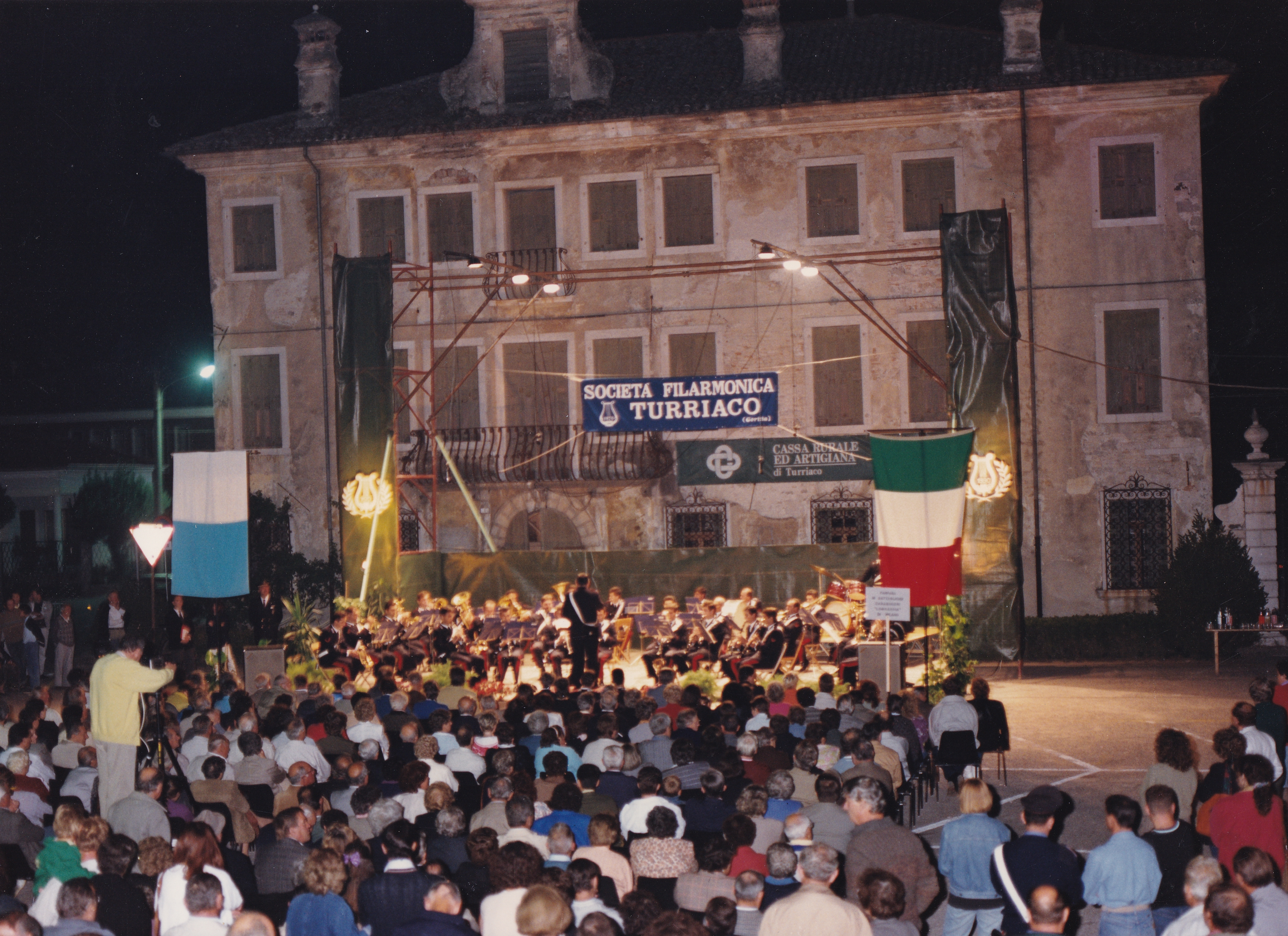 The fanfare of the 3rd Carabinieri Battalion “Lombardia” in Turriaco
Saturday brought the welcome return of the Postkapelle from Klagenfurt. On Sunday the 16th came the kermesse: a parade through the village streets and short concerts by the bands of Monfalcone, Cervignano, and Pradamano, with the Turriaco band as host. The whole thing closed with a concert directed by Maestro Azzopardo — this time in his capacity as director of the Giuseppe Verdi civic band of Trieste. For the first time, the concerts were held not in the main square but in the open space in front of the historic Villa Priuli.
One more milestone from 1990: for the first time, a woman joined the Philharmonic’s board of directors. Her name was Lara Furioso. Welcome — if somewhat overdue — to the other half of the sky.
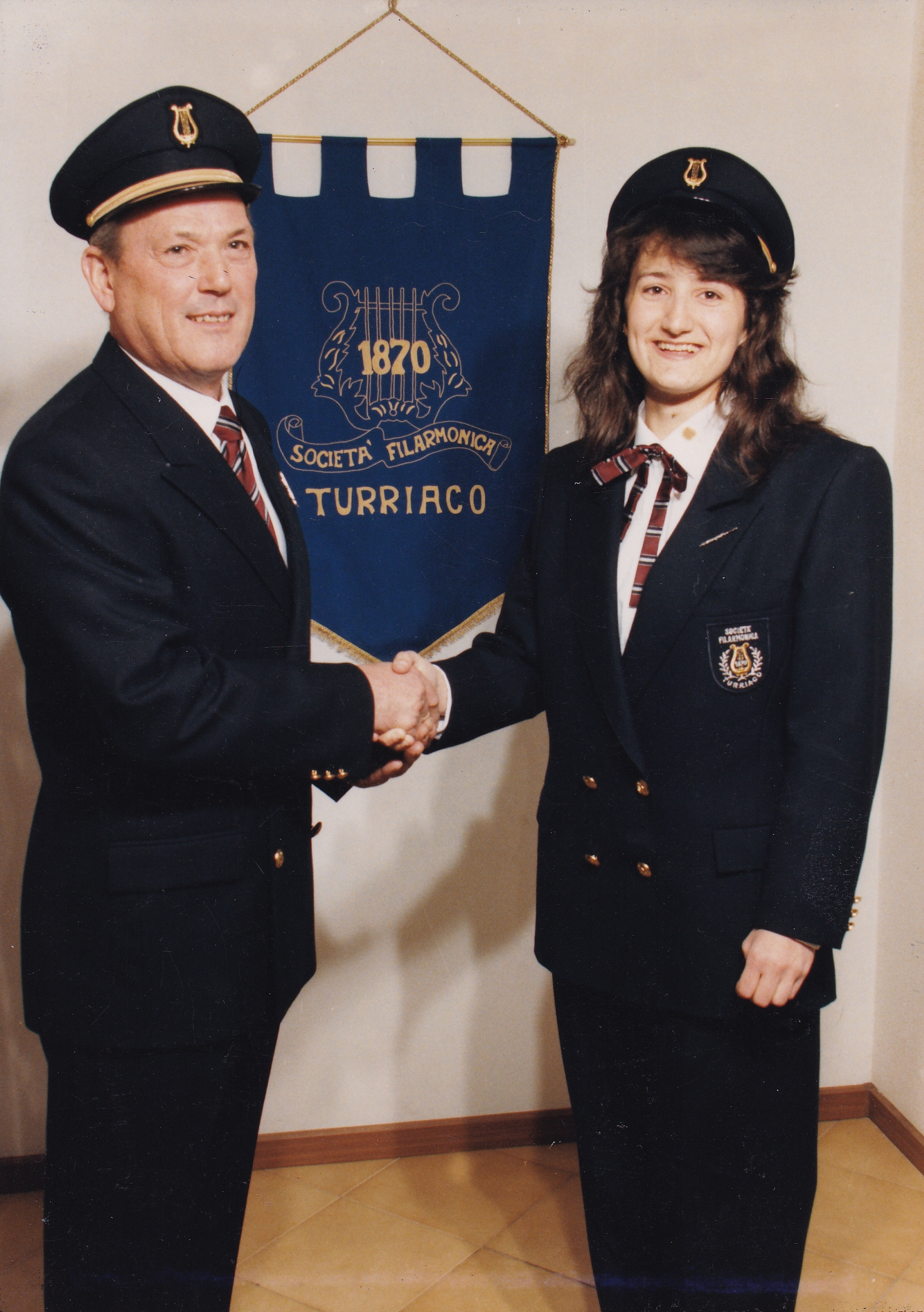 Lara Furioso with President Buttignon
And this gives us the occasion to address a small but real problem the Philharmonic had to solve as female members began — first tentatively, then with growing confidence — joining the band: the question of the uniform.
One could write an entire volume on the relationship between a band and its uniform. The uniform is, obviously, the first thing people notice when a band comes by. And uniforms come in all varieties: stiff or colorful, military or folk-inspired, winter or summer — and so on. We’ve already given ample evidence of the uniform’s importance in the Philharmonic’s history. Here we want only to pay tribute to the man who for many years was the Society’s uniform manager, Giuliano Brumat, and — above all — to his wife, Leda Cragnolin. She recalls:
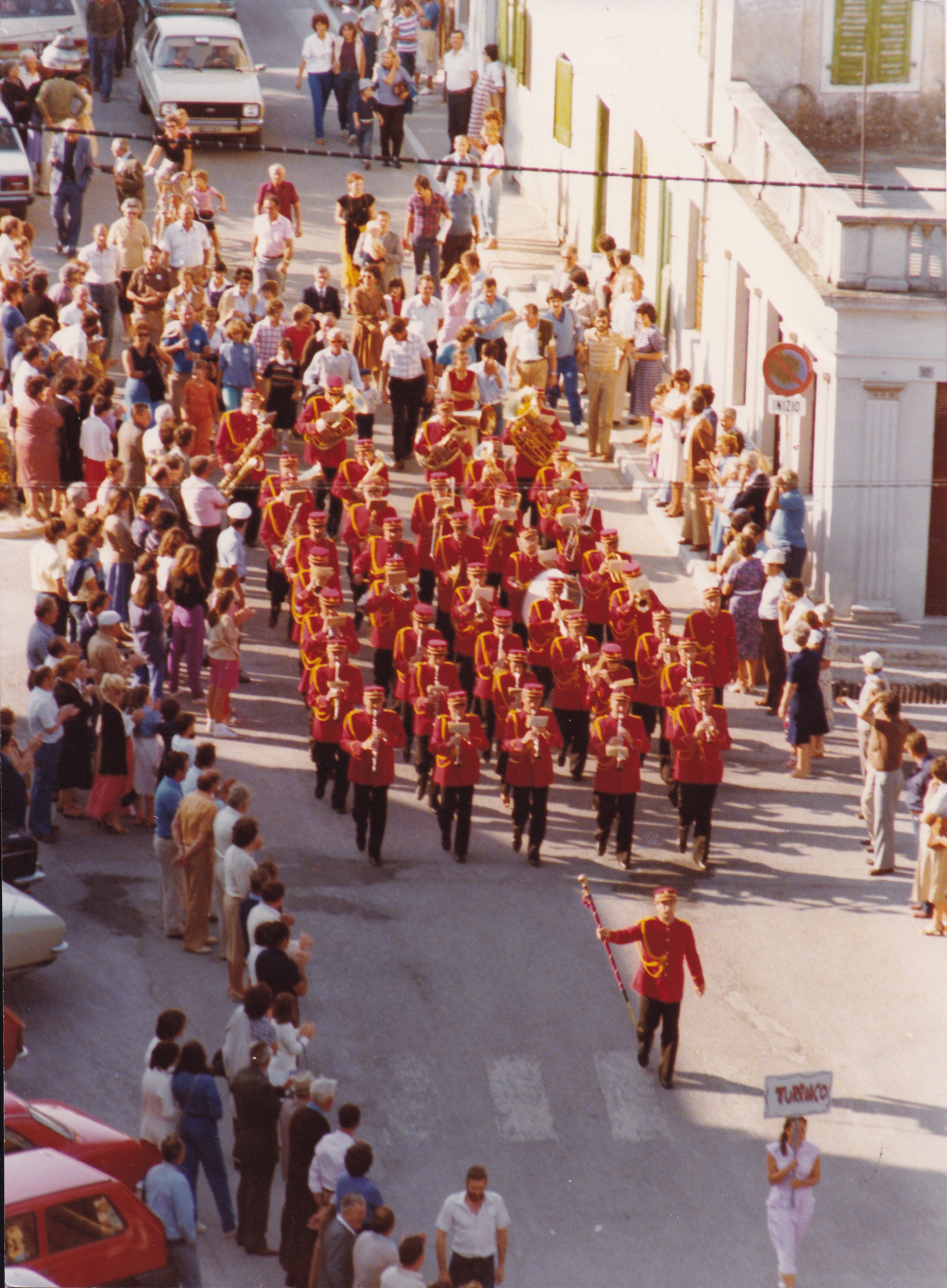 The band in folk uniforms
My job was to alter the band’s uniforms for new members, or for those whose uniform no longer fit as time went by.
There was certainly no shortage of work, since for a certain period the wardrobe included three different uniforms: winter, summer, and folk.
An important moment in the band’s history came in the mid-1980s, when women began joining the group.
Until then, the group had been all male, so when the first girl arrived, there was a bit of scrambling. “Now what do we do?” At that point I armed myself with patience and went to the Virgolin shop, where I asked the owner and friend Fausto if he could help us. I brought in a uniform, and together we found a fabric of the same color to make the new women’s uniforms. Then, with the invaluable help of Meri — who also worked as a seamstress in Turriaco — we managed to dress the new female members properly.
For a while, my basement became the changing room for the new recruits, and we often had to come up with creative solutions to allow them some privacy — something that, as a rule, didn’t quite materialize. There were a few awkward moments and a lot of laughing, but the work was great fun.
Whether work or fun, the result of what Leda and Meri accomplished together speaks for itself — as you can see from the photograph below.
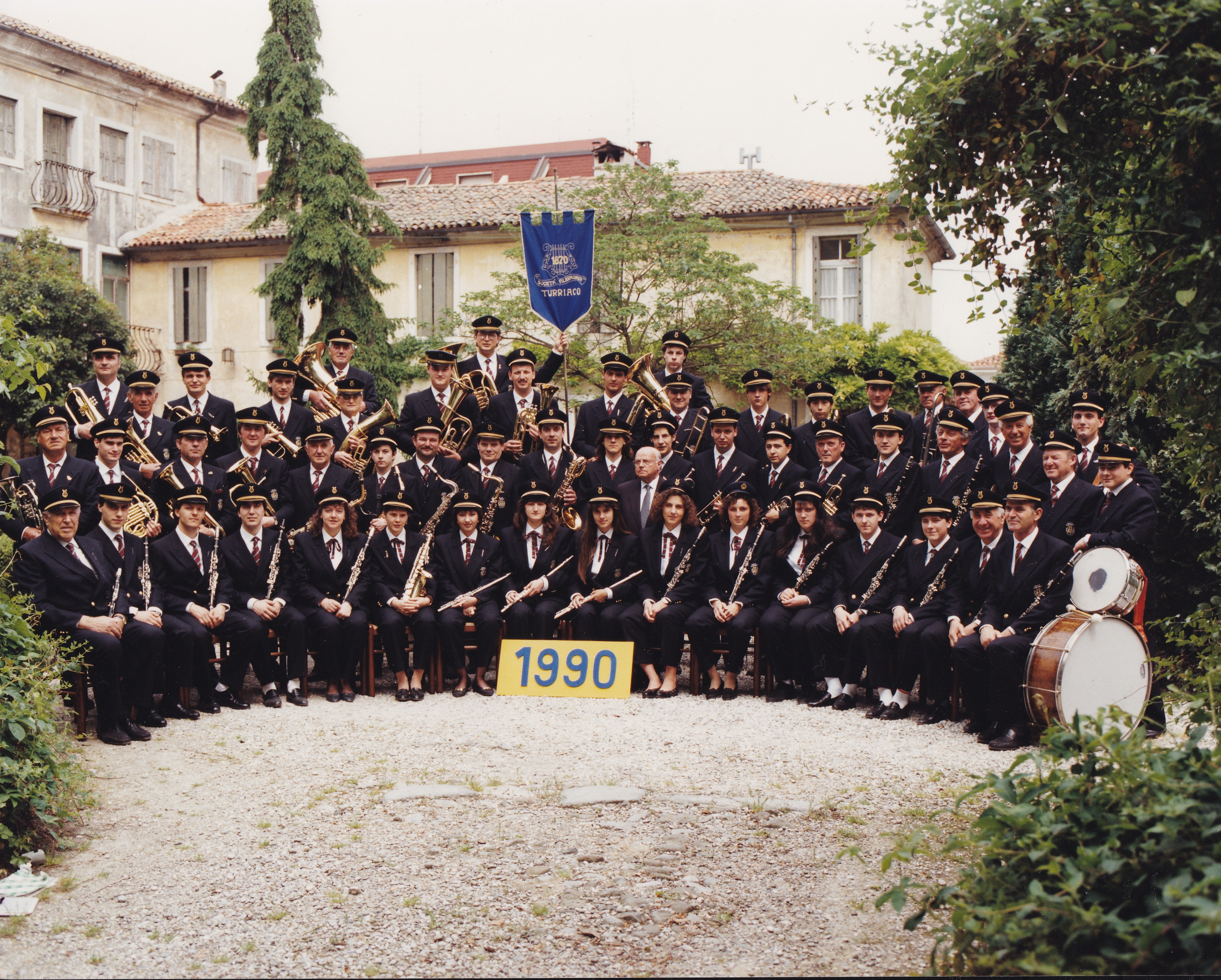 A splendid band in a splendid uniform
The summer of 1991 got off to a particularly turbulent start in the border regions. On June 25, Slovenia declared independence from Yugoslavia. The declaration triggered what became known as the Ten-Day War � a clash between the Slovenian Territorial Defense Force and the Yugoslav People’s Army, which was determined to retake control. The fighting was asymmetric, built on guerrilla tactics and ambushes rather than open battles. There were casualties. A few stray bullets crossed the border and hit the bar at the Casa Rossa plaza, the main border crossing in the Gorizia area. Some locals reported seeing a MiG-21 fly over their own terraces. For once, diplomatic intervention managed to smother the fire before it spread and did serious damage.
A couple of months later, things had apparently returned to normal. That year, the Festa in Piazza � billed as a three-day event celebrating culture, good cheer, and the finest popular traditions � was organized with impressive thoroughness. For starters, nearly the entire town took part. The list of participants included: the Municipal Administration, the Department of Culture, the Philharmonic Society, the Organ Donors Association, the Volunteer Blood Donors Association, the Amateur Soccer Club, the Youth Center, the ARCI, the Don Eugenio Brandl Cultural and Recreational Club, the Libertas Sports Club, the Bocce Club, the Turriaco Tennis Club, the Isonzo Turriaco Sports Union, and the Club Diamante Friuli Venezia Giulia � all under the patronage of the Cassa Rurale e Artigiana di Turriaco.
The local paper ran the headline The Piazza Party Explodes, and next to the main article, a short piece complained that closing the town’s main roads had nearly cut Turriaco off during the nighttime hours. Not only had the regional transit consortium not been notified of the detours the buses would need to take, but every possible alternative route had been blocked, redirecting traffic onto muddy, impassable country lanes.
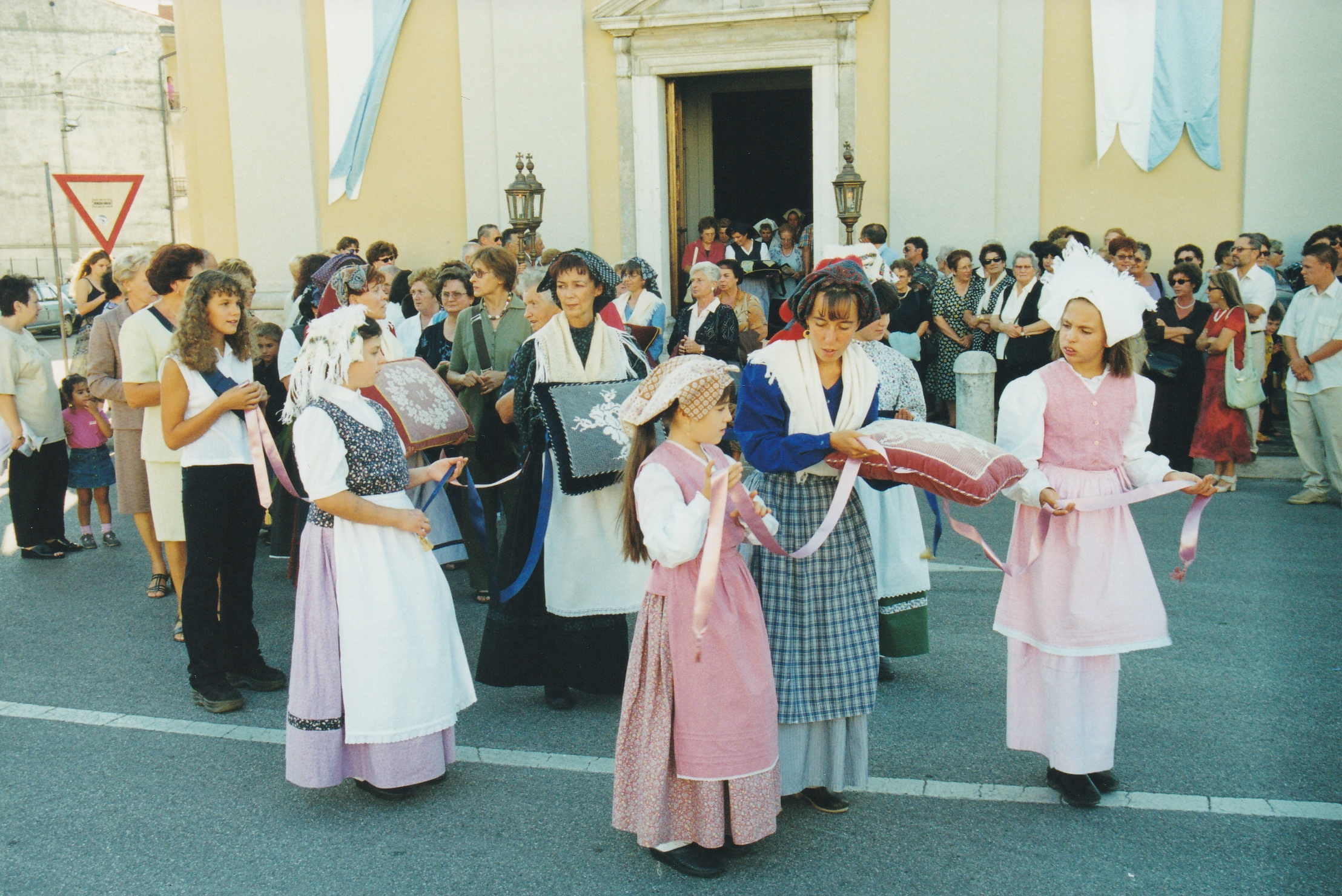 Traditional Bisiac costumes
Whether those muddy lanes affected the parade of Bisiac costumes � painstakingly reconstructed through careful historical research � is not recorded. They certainly couldn’t have disadvantaged the Bisiac diction group’s performance. (That was a joke.)
The closing concert, conducted by Maestro Azzopardo, was steeped in musical pedigree. Alongside the Philharmonic, it featured the band La prime l�s 1812 from Bertiolo (no, that’s not Bisiac � it’s Friulian for the first light, with the u held long, almost doubled), whose earliest written records date back to the year so proudly displayed in its name, and the band from Povoletto, founded in 1875. These three bands would meet again the following year at the First Regional Band Competition, held at the Bertiolo Municipal Auditorium. Joining them, noblesse oblige, was the Philharmonic of Maniago, founded in 1855.
Amid all those concerts, tours, and routine celebrations, 1992 brought something that could genuinely be called exceptional. From April 30 to May 3, Pope John Paul II made a pastoral visit to Friuli Venezia Giulia. The last time a pope had come to the region was in 1972, when Paul VI made a quick stop in Udine for the National Eucharistic Congress. This time, the pope visited all four dioceses and began his journey at the Basilica of Santa Maria Assunta, the ancient cathedral of the Patriarchate of Aquileia.
The organizational effort was enormous, involving associations, institutions, clubs, and anyone who could contribute to the event’s success. Worth mentioning here is the role of the parish choirs, coordinated by Don Stanislao Jericio, who for the occasion composed � in a single burst of inspiration � a sweeping Tu es Petrus of welcome that people still remember with admiration. Equally notable was the participation of the bands, including Turriaco’s, which greeted the pontiff in the plaza in front of the basilica and, despite bouts of rain throughout the day, did their best to stay in tune.
While we’re on the subject of out-of-the-ordinary events (pun intended), 1992 also saw the band take part in the world’s longest toast � held in Corm�ns, with the Wine of Peace. A brief explanation is in order.
In Corm�ns, near the local winery, lies the Vigna del mondo (Vineyard of the World) � a plot of land where, following a project involving Italian and foreign universities, over 850 grape varieties from every corner of the planet have been planted. About forty years ago, someone had a brilliant idea: make a wine from these vines, aptly named the Wine of Peace, bottle it with labels created by renowned artists (which have since become genuine collector’s items), and send it to every head of state in the world.
To mark the naming of the street in front of the winery as Via Vino della Pace, organizers set up a toast stretching three and a half kilometers � the length of the entire street � with hundreds of people raising their glasses simultaneously, all under the watchful eyes of Guinness World Records inspectors and an overhead helicopter. Among those raising their glasses were the members of the Philharmonic, who would return to Corm�ns several times in the following years for the grape harvest ceremony.
One last note, to answer a question everyone asks: What does a wine made from all those different grapes actually taste like? Fair question. Since new varieties were added to the vineyard every year, the wine was never the same twice. After a few years of reflection (and no production), since 2017 the wine has been made exclusively from native varieties. The symbolism remains intact, but the quality has improved considerably. On that last point, we’ll let the experts speak:
Golden yellow in color, bright and intense. All of Friuli is in there � malvasia, ribolla, and friulano � joined by an international note from the pinot bianco and chardonnay.
On the nose: orange peel, citron, peach, and pineapple above all. Fresh, savory, with just the right acidity, it lingers on the palate with notes of tropical fruit.
Reading a description like that and then learning that the current record for the longest toast relay is held by 1,300 participants who � in Bangkok, on December 12, 2019 � raised their glasses full of… Coca-Cola, is enough to bring on a genuine fit of depression.
In 1993, another renovation and another important ceremony called for the Philharmonic’s presence. This time, it was the reopening of the parish church of San Rocco. Built, like many churches in the area, between the late 17th and early 18th centuries, it was erected alongside a Renaissance chapel that was later demolished. Consecrated on June 28, 1746, it underwent a thorough renovation in the early 1800s that gave it its current appearance. By the late 20th century it had fallen into disrepair, and in 1985 a lengthy general restoration began � too lengthy, in the opinion of local residents, who made their complaints well known. Eight years later, it was finally complete.
 The Parish Church of San Rocco under restoration
The program for the occasion was an interesting blend of sacred and secular. On the sacred side: Il pane del cammino by Sequeri, Bizet’s Agnus Dei, the Hallelujah from Handel’s Messiah, Perosi’s La Trasfigurazione, and an original piece by Maestro Azzopardo himself, La notte santa. Alongside these, several secular works perfectly suited to the occasion: Mascagni’s Intermezzo from Cavalleria Rusticana, Handel’s Largo from Serse, and, to close, Beethoven’s Ode to Joy from the Ninth Symphony.
The Parish Church of San Rocco under restoration
The program for the occasion was an interesting blend of sacred and secular. On the sacred side: Il pane del cammino by Sequeri, Bizet’s Agnus Dei, the Hallelujah from Handel’s Messiah, Perosi’s La Trasfigurazione, and an original piece by Maestro Azzopardo himself, La notte santa. Alongside these, several secular works perfectly suited to the occasion: Mascagni’s Intermezzo from Cavalleria Rusticana, Handel’s Largo from Serse, and, to close, Beethoven’s Ode to Joy from the Ninth Symphony.
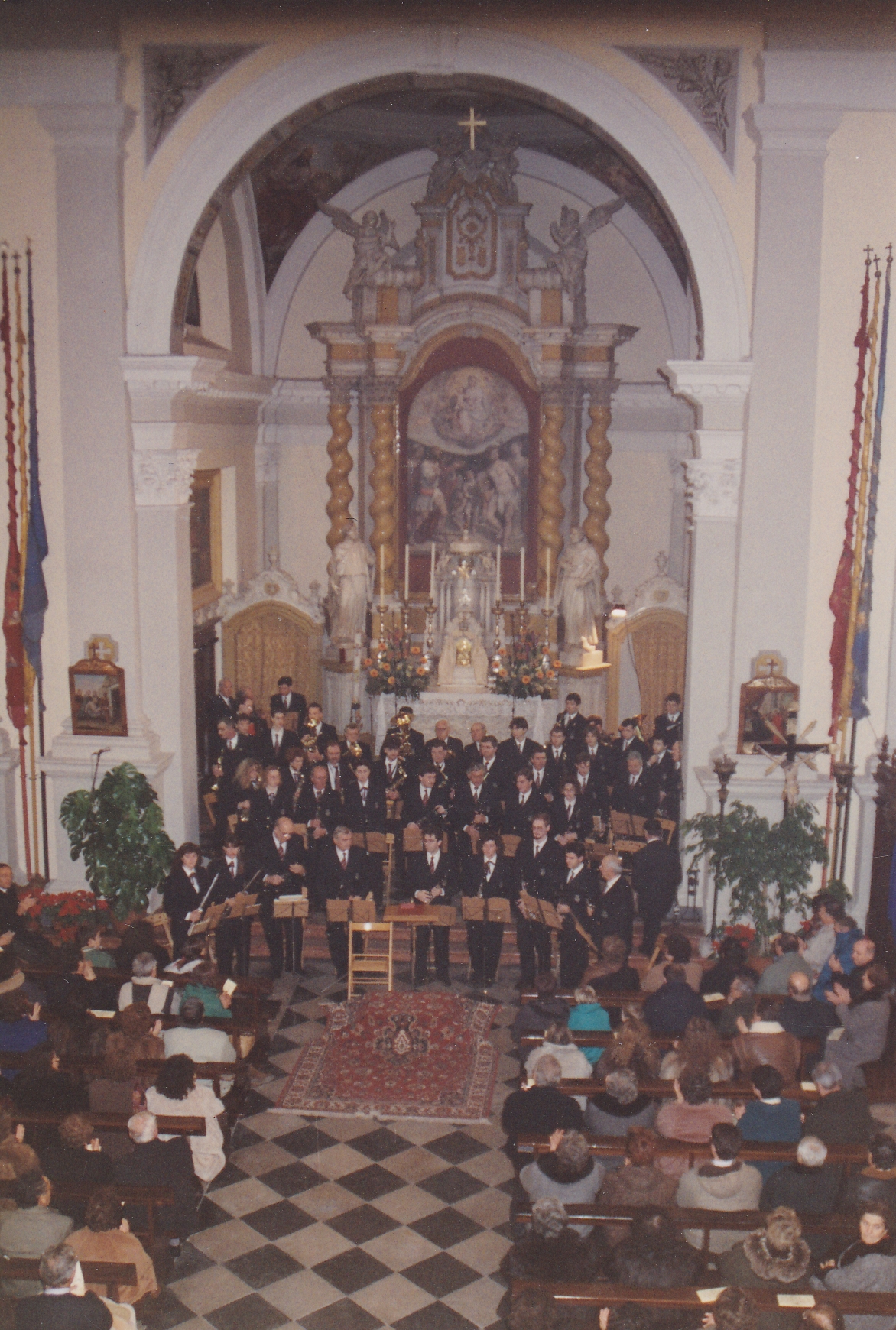 Concert for the reopening of the Parish Church
But 1993 also brought another interesting project: a visit to Turjak, in Slovenia. If you don’t know where Turjak is, don’t worry � we’ll get to its charms in a moment. The main reason for making the trip was that the destination is pronounced exactly like Turi�c, the Bisiac name for Turriaco (and, incidentally, Turjak is also what Slovenian speakers call the town).
The Slovenian Turjak is a small village in the municipality of Velike La�ce (don’t ask us how to pronounce that, at least not in writing), located about twelve miles from Ljubljana. It’s home to an interesting castle that has had a very eventful history. The building was completely destroyed and rebuilt three times � the last time on higher ground, which allowed it to withstand two subsequent Turkish sieges. Its most recent ordeal came during World War II, when it became the site of fierce fighting between Yugoslav partisans and the Chetnik troops who held it.
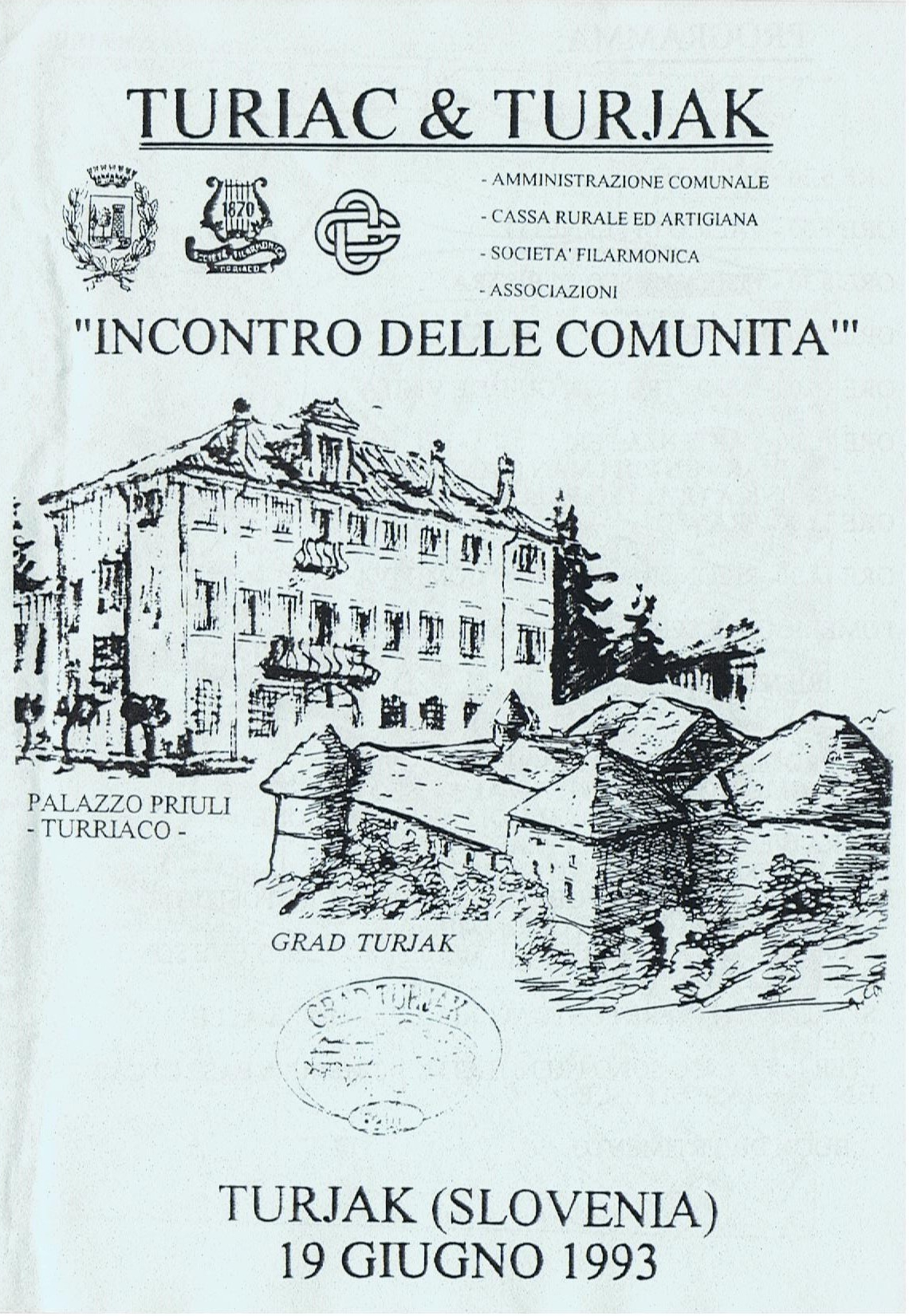 Travel brochure for the Turjak trip
It doesn’t take much imagination to picture what happened once the partisans seized the castle, which was half-destroyed yet again and had to be rebuilt � slowly, and after being nationalized, as was the fate of nearly everything in Yugoslavia. One unusual feature of the castle is that it contains two chapels: one Catholic and one Protestant. A passageway connects the Catholic chapel to the village below, which gives you some sense of the structure’s scale.
Since a tour of the castle didn’t fill an entire day, the itinerary was arranged to include a proper stop in Ljubljana (with its own castle) and a visit to a third castle � Bistra, home to Slovenia’s Museum of Technology, whose star exhibit (disclaimer: this is a purely personal opinion) is a collection of 15 cars used by the late President Tito.
Somehow, the group managed to stretch all of this until mid-afternoon, when they finally reached Turjak for the meeting with the local community, the band concert, and so on.
It was, all in all, a memorable experience that many still recall with affection. When they talk about it, though, almost no one calls it a trip to Slovenia.
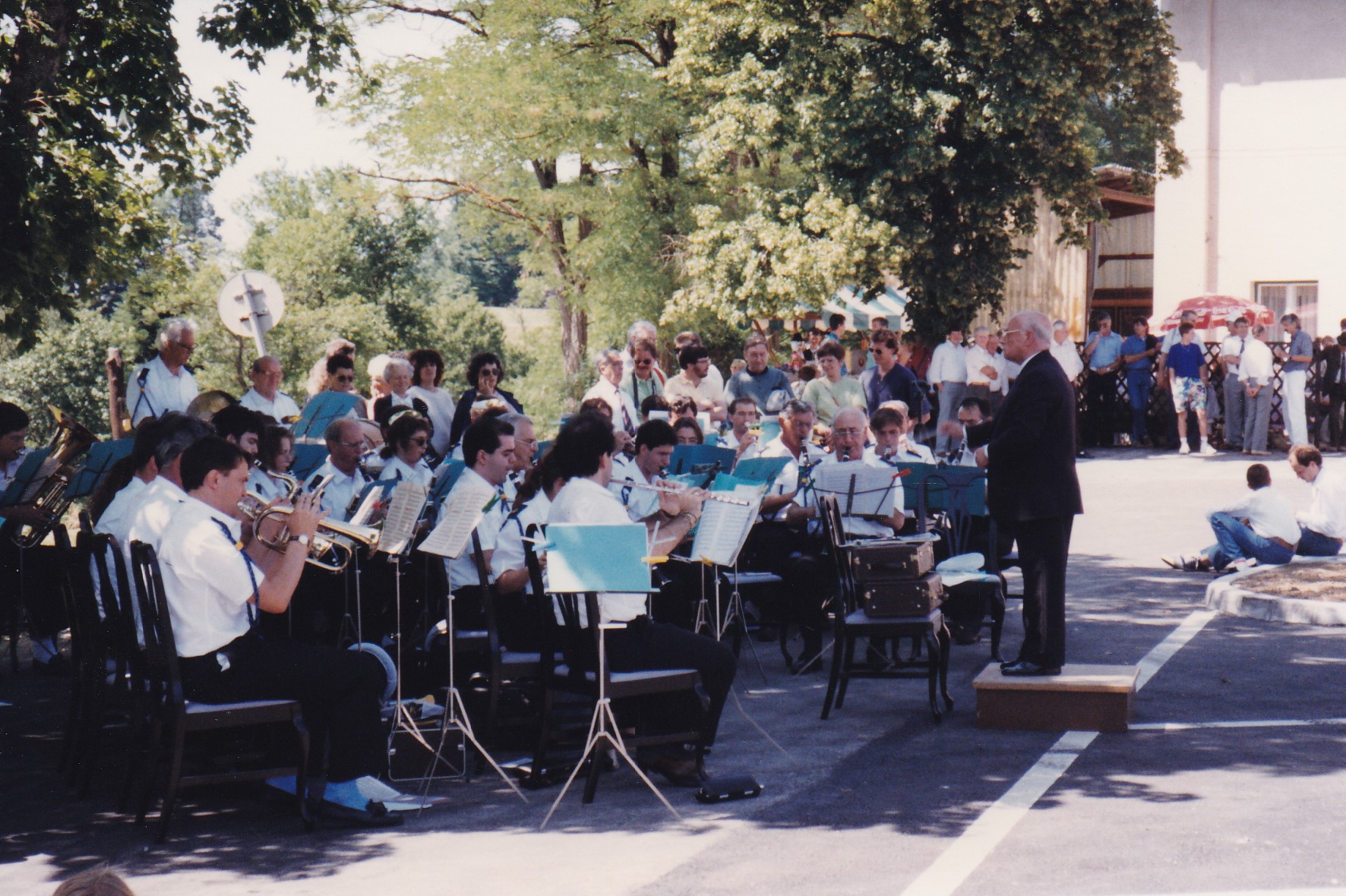 Concert at Turjak
The thing is, in these parts, crossing the border to the east always meant going to Yugo. The Yugoslav border was a very strange border. It literally cut the city of Gorizia in two, ran right along the edge of the Vallone highway � where taking a wrong turn meant accidentally leaving the country � and required showing a propustica (the c pronounced like the z in pizza), a special pass issued to residents of the provinces of Gorizia and Trieste that allowed crossing even at minor checkpoints, which were open only during the day.
With the propustica in hand, everyone turned into a smuggler: meat, gas, and cigarettes in Yugoslavia were simply unbeatable on price. The Yugoslav customs officers went through the motions of inspections, even though they knew that rummaging through car trunks would turn up at most a bottle of slivovitz � the plum brandy that pairs so well with gubana � or one too many cartons of cigarettes. The Italian side was equally relaxed about it. Despite being technically part of the Iron Curtain, this was considered the most open border in Europe: most of the time you crossed it in second gear, and the engine almost never knocked.
Another interesting trip took place in 1995.
No, we haven’t skipped a year. It’s just that 1994 is worth remembering for only two things (everything else was more or less routine). First, the Music School introduced an interesting new offering. In addition to the existing theory and solf�ge courses and the traditional wind instrument lessons, that year the school began offering an introductory music course for school-age children and a percussion course. It’s not hard to guess who pushed hardest for that last one. Second, during the traditional September celebrations, Maestro Lidiano Azzopardo was awarded honorary citizenship. It was, as the local paper put it:
A recognition of the artistic sensibility and professionalism of a musician who has devoted so much energy to the musical development of Turriaco.
And that, for 1994, is more or less everything. Oh, we almost forgot. That same year there was another trip to Carinthia, this time to Keutschach am See, a charming town in what is called the Valley of the Four Lakes, home to Neolithic pile-dwelling remains.
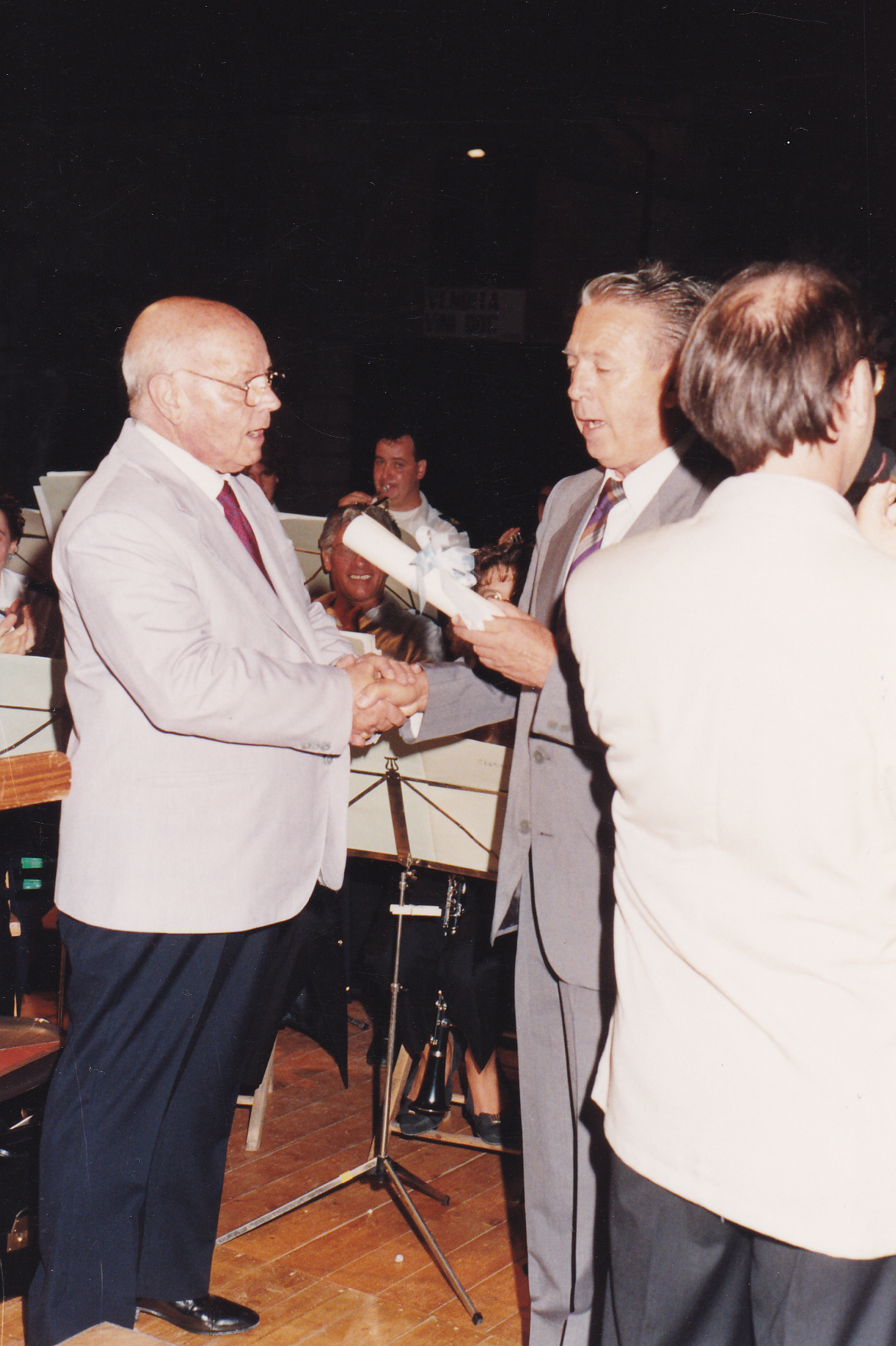 Honorary citizenship ceremony for Maestro Azzopardo
Back to 1995, and the threshing festival of Novellara.
Novellara is a town of about 15,000 people located roughly twelve miles from Reggio Emilia (or Reggio nell’Emilia, as purists insist). Were it located in some other country, it would probably earn three stars � maybe more � in the travel guides. The main draw is the complex formed by the handsome parish church of Santo Stefano and the even handsomer piazza surrounding it. The church, the piazza, and the long colonnaded walkway enclosing them were designed as a unified whole by Lelio Orsi, a painter and architect in the tradition of Correggio � one of the many brilliant figures produced by the Italian Renaissance.
Novellara also has four convents and an imposing fortress built by the Gonzagas, now home to the town hall. Inside, there’s a fine museum displaying magnificent tapestries and a collection of pharmacy vases � seventeen beautiful jars that, after being scattered across various corners of Europe, were tracked down and brought home (the eighteenth is in the museum in Limerick, Ireland, but hope is not entirely lost). The fortress also contains a delightful little theater and, last but not least, a municipal balsamic vinegar cellar, where the real thing � not the supermarket kind � ages in rows of small oak barrels.
The Philharmonic traveled to Novellara for the Batdura a l’antiga, a festival held on the second Sunday of July that faithfully reenacted the wheat harvest as it was done in the old days. The event reached its climax at sunset. After a long procession of floats, costumed figures, vintage farm tractors and equipment, a large threshing machine rolled into the center of town. Grain went in, the steam whistle blew, and out came the clean wheat, ready to be ground into flour at the mill. From there the flour was kneaded in the gramla � the wooden dough-mixer found in every traditional household � then baked in stone ovens. The resulting bread, along with pork cracklings, was distributed at booths set up throughout town.
The chronicles tell us that the Philharmonic performed at five in the afternoon, sharing the piazza with the band from Ponte dell’Olio (Piacenza), which arrived with majorettes in tow. The competition for the crowd’s attention was, obviously, no contest. That evening, the band took part in the grand parade before the threshing, joined by the Pontde dell’Olio band, the Gli Scariolanti group from Gavassa, and the Folklore Group from Correggio.
If this has made you want to attend the Batdura, we have to disappoint you. The festival has not been held for years � or so a helpful town hall official informed us, which is why we’ve been writing about it in the past tense. On the bright side, Novellara now hosts two new events (though neither takes place in summer). The first is the Sikh gathering for Vaisakhi, the festival that falls on April 13 or 14, depending on the calendar, marking both the start of the harvest season and the new solar year. It’s a deeply felt celebration that draws thousands of participants each year. (It’s worth noting that Novellara is home to the second-largest Sikh temple in Europe.) The second event is Nomadincontro, a fan gathering for the legendary Nomadi band, whose iconic frontman Augusto Daolio was born here; it’s held on the Sunday closest to his birthday (February 18). At the time of writing, the town’s mayor is the daughter of Beppe Carletti, co-founder of the Nomadi. Take your pick.
Also in 1995, the Postkapelle of Klagenfurt returned to Turriaco for the Friendship Festival. A suspicion was beginning to take hold: the Carinthians’ warm attachment to this corner of the world might have something to do with the quality of the local wine. We’ve collected numerous stories on the subject that, for obvious reasons, we’ll refrain from sharing. Journalistic duty does, however, compel us to mention the episode involving someone � let’s call him Hans and say he played the tuba � who, unable to pour another drop into an already full tank, found no better solution than to deliberately dump his last glass of wine (everyone swears it was white) over himself, just to smell it on the way home.
1996 opened with yet another trip to Austria, in the spirit of friendship and cultural exchange. The Philharmonic returned to Klagenfurt as guests of the Postkapelle, returning the visit the Austrian band had made the previous year. Beyond the scheduled joint performance, the Philharmonic was offered a chance to perform on a truly prestigious stage.
Conducted by Maestro Azzopardo, the band performed at the prestigious Konzerthaus in Klagenfurt, presenting a program centered on Italian opera, with some forays into musical theater. The audience responded with particular enthusiasm to the fantasy on Norma and the finale of the second act of Aida (the Triumphal March sequence), while also applauding warmly the selection of songs from Cats � one of the longest-running and highest-grossing musicals in history. The photos from that evening capture something in the musicians’ expressions: the awareness of where they were and what it meant.
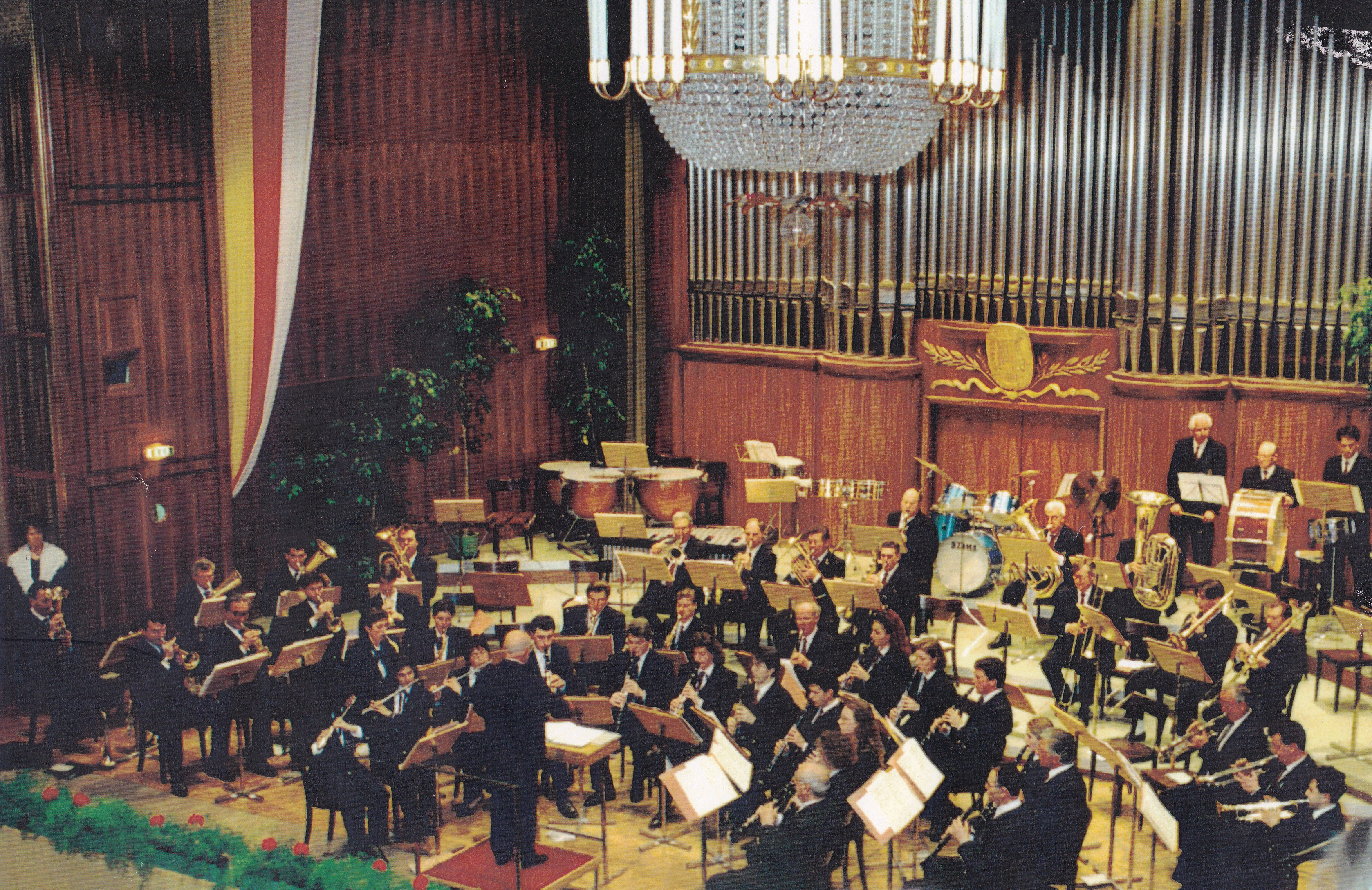
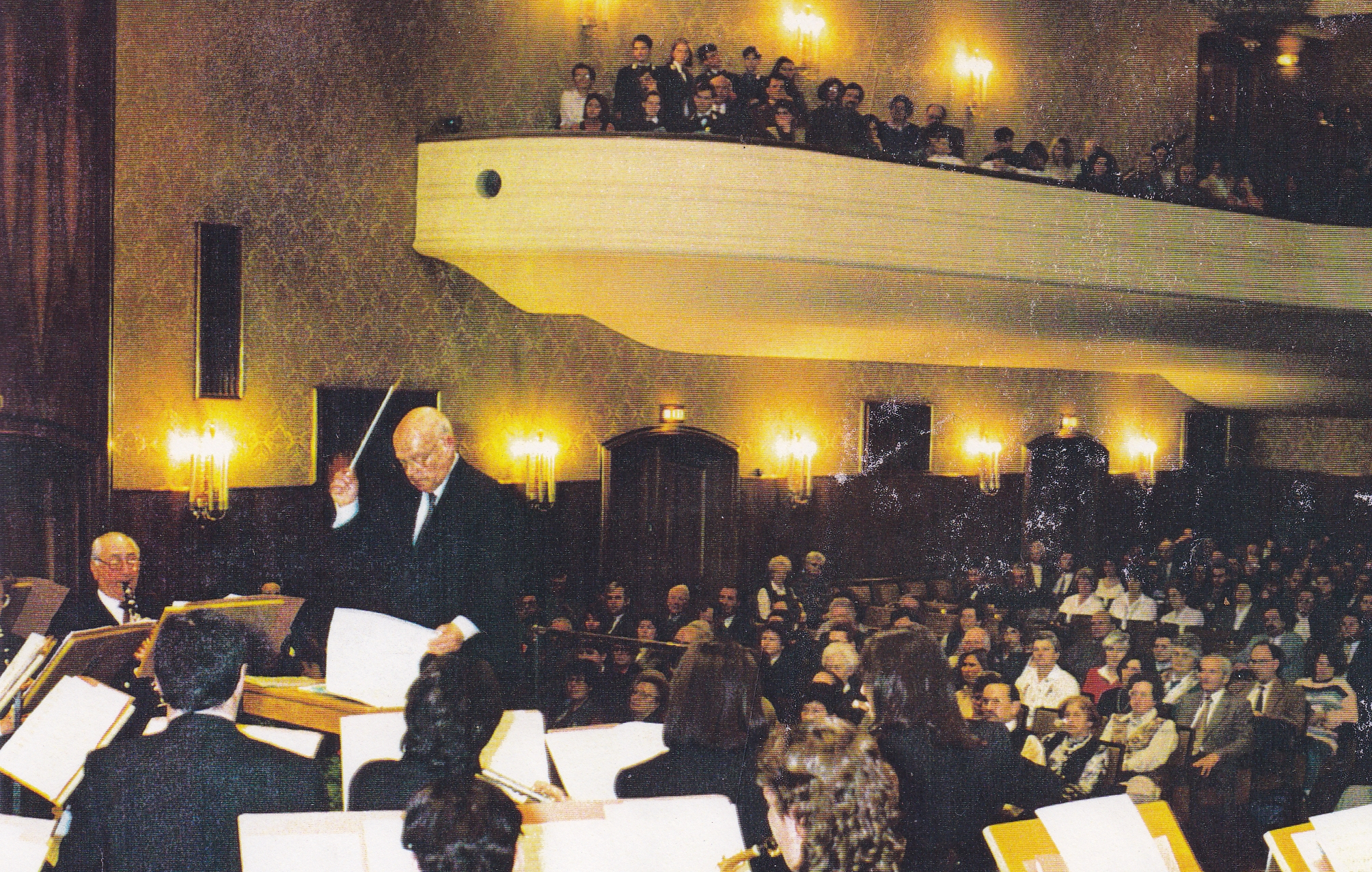 Two images from the concert at the Konzerthaus
Beyond the concert itself, people also remember the remarkable snowstorm that had blanketed the city � and the festive piconada that followed the performance. The word is local slang; literally translated into Italian it means pickaxe blow, but without context it gives little away. A piconada is the liberating session of playing that releases tension after a demanding performance � the musical equivalent of letting your hair down, an improvised jam on popular songs (sometimes a bit rowdy) that follows every serious concert. Think of it as the band’s version of rugby’s third half: everyone together, laughing, trading jokes and friendly insults, doing justice to the refreshments, and losing track of how many times the glass gets refilled. In fairness, in recent years the alcohol level at these gatherings has dropped considerably, thanks in no small part to the growing presence of women in the ensemble.
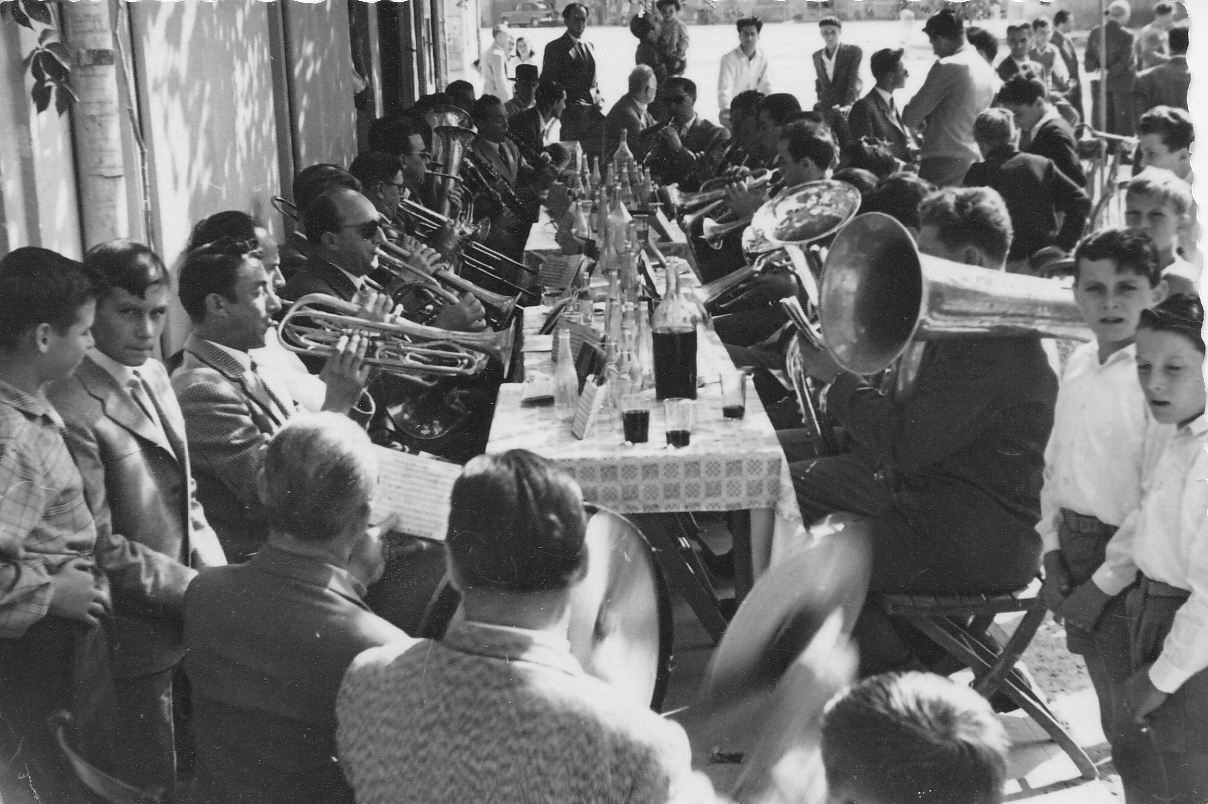 A piconada from another era
1996 also marked an anniversary that had nothing to do with the Philharmonic but involved one of its longest-standing partners. That year, the Banca di Credito Cooperativo di Turriaco � formerly the Cassa Rurale e Artigiana � celebrated its centennial. The Cassa was founded on December 6, 1896, in the presence of Monsignor Luigi Faidutti, a leading figure in the Christian social movement in the Isonzo region, by 74 members, each of whom had contributed four crowns. The institution’s core mission � what today we’d call its mission statement � was to provide small, low-interest loans to its members. Its first leadership included a director (Count Francesco Folco, a major landowner who also donated the land on which the headquarters was built), a deputy director (the curate Don Andrea Furlanin), and three council members: Benedetto Guanin, Luigi Clemente, and Pietro Bergamasco. In 1899, the Cassa joined a federation of 34 rural savings banks in the Gorizia area and Lower Friuli. The federation was dissolved in 1937, but the Turriaco Cassa, along with ten others, managed to survive.
Spanghero writes in his history:
One immediate consequence of the founding of the Cassa Rurale was the instant elimination of all of Turriaco’s loan sharks, who had long exploited the misfortunes of others to enrich themselves, while freeing the farmers � perpetually indebted � from ongoing exploitation. Since then, the Cassa Rurale di Turriaco has continued operating almost without interruption, weathering the difficulties caused by two wars fought on its very soil, and reaching us today in flourishing condition. This was possible largely thanks to Don Eugenio Brandl, a priest in Turriaco for 45 years from 1919 to 1964, who administered the Cassa free of charge and with great diligence, often simply to keep it alive.
To celebrate the centennial, a concert was held in Turriaco on Friday, July 19, 1996, and repeated the following day in Monfalcone. We’d like to say something interesting about these concerts, but the printed program offers little to go on, and the local paper’s coverage is, how shall we put it, purely factual. If pressed to highlight something, one might note Maestro Azzopardo’s continuing enthusiasm for Lloyd Webber musicals: after Cats the previous year, this time it was a fantasy from Jesus Christ Superstar.
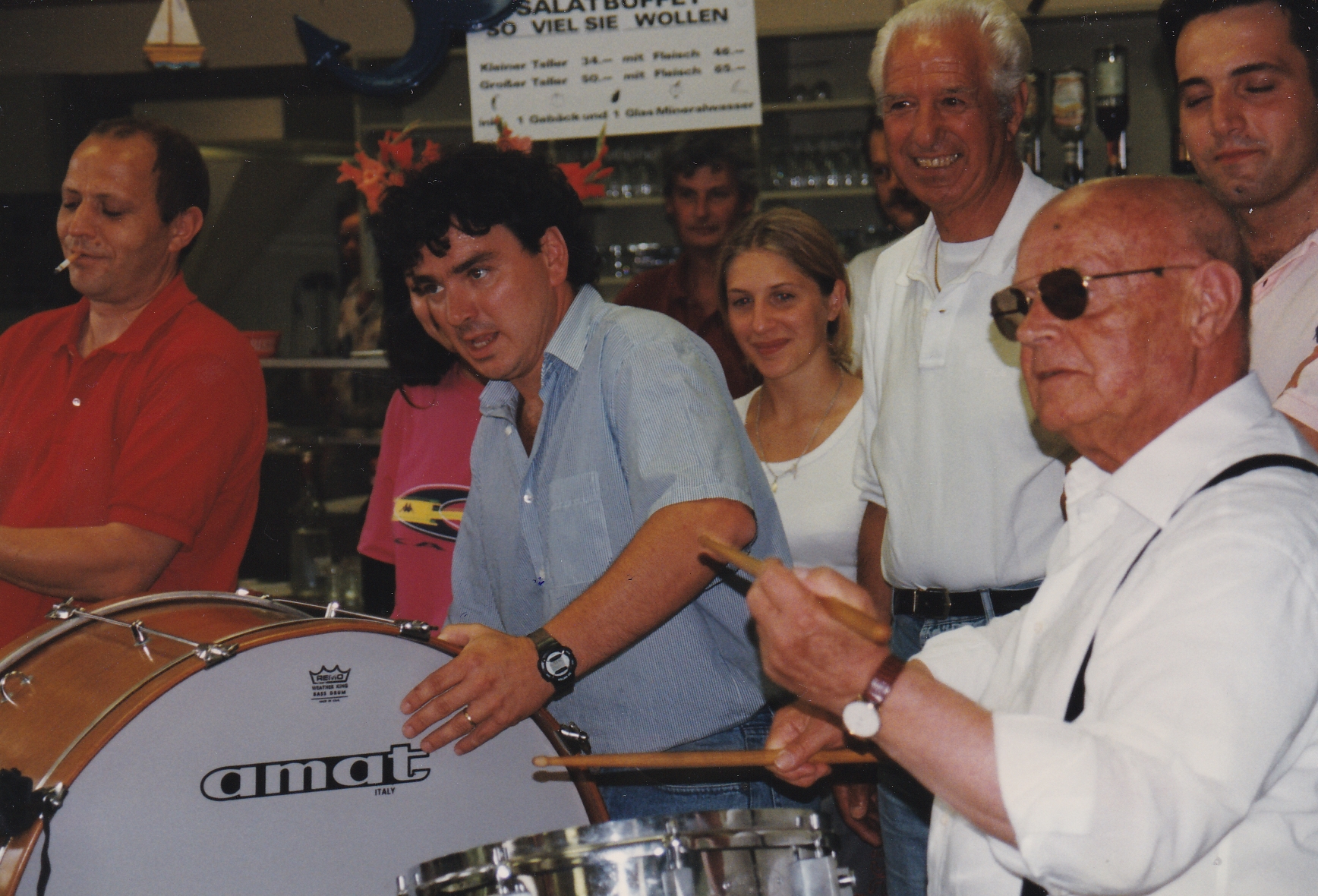 An Austrian piconada
The September Festa in Piazza that year leaned further into musical theater. The program included Singin’ in the Rain and Kiss Me, Kate. Also featured was an original march by Maestro Azzopardo with an unmistakable and evocative title: Klagenfurt.
1997 opened with a devastating loss for the Philharmonic. In March, Massimo Cocolet � one of its most talented members � died at only 31. He had joined the band in 1980, still very young, and had gone on to devote himself to the clarinet, his instrument of choice, while also developing a serious command of the saxophone. He had been appointed director of the band in Villesse and had taken on the role of music school director in his hometown, San Pier d’Isonzo, where he taught theory, solf�ge, clarinet, and saxophone. His sudden death left a profound void in everyone who had known him and had the chance to appreciate his warmth and human depth.
That same year brought another notable anniversary: the tenth anniversary of the friendship with the Postkapelle of Klagenfurt. The occasion called for an exchange of visits. In late July, the Carinthian band arrived in Turriaco and performed at one of the Summer Concerts organized in Piazza Libert�. In August, the Philharmonic returned the favor, performing in the main square of Klagenfurt.
Meanwhile, the Music School kept growing. It added a new instrument to its curriculum � the piano, which has little to do with the band but was in high demand from families. The end-of-year recital that year was dominated by piano pieces: solos, four-hand duets, and duos with flute, clarinet, and saxophone. What we particularly like to remember, though, is the performance of a brass quartet � trumpet, trombone, soprano flugelhorn, and alto flugelhorn � in which the young students, like Stadtpfeifer musicians in seventeenth-century Germany, brought three chorales from the Protestant tradition back to life.
The Christmas Concert � held each year on the Sunday before December 25 � is without doubt the most important event of the year for the Philharmonic and its audience. Being a long-standing tradition, it hasn’t demanded much attention in these pages. But the 1997 edition was special. With the mayor of Turriaco, the president of the Banca di Credito Cooperativo, and the president of the regional ANBIMA in attendance, three members � Ennio Bergamasco, Giuseppe Buttignon, and Silvio Gualtiero Cosolo � were honored for fifty years of service in the band.
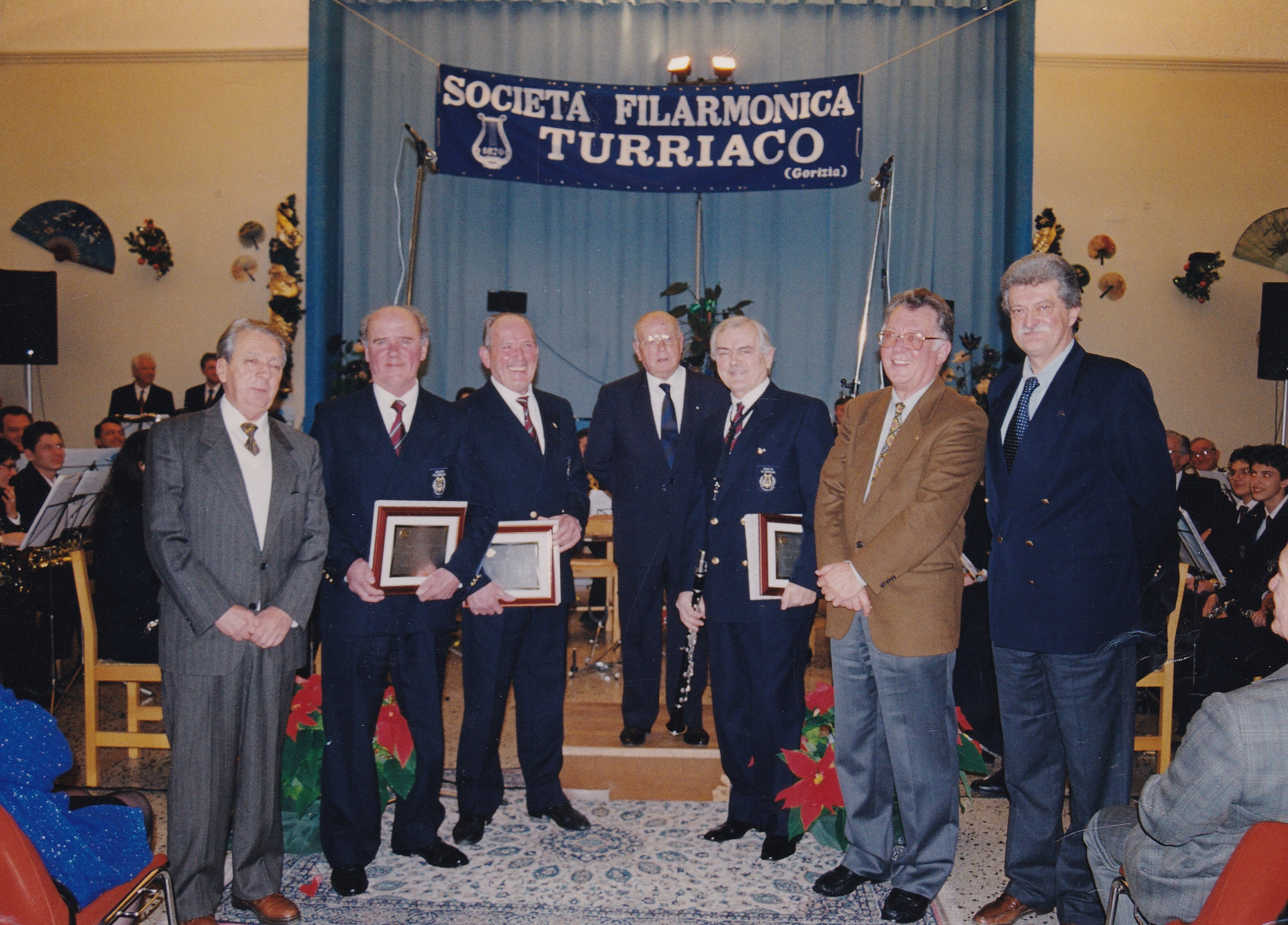 Ceremony honoring veterans with fifty years in the band
Now it’s 1998, and two years remain before the end of the second millennium. Looking back at the events of that period, it’s striking how quickly time passes. Let’s pick a few of the more notable ones.
On January 17, 1998, Paula Jones accused President Bill Clinton of sexual harassment. (OK, that one could have been skipped � let’s replace it with Pope John Paul II’s visit to Cuba that same month.)
In February, a U.S. military jet that had taken off from the Aviano base severed the cable of the Cermis gondola lift, killing 20 people.
In March, Titanic won 11 Oscars from 14 nominations, equaling the record previously set by Ben-Hur.
In April, after twenty years of design work and another ten of construction, Japan opened the world’s longest suspension bridge (just under 2.5 miles). Three years later, Berlusconi would put the Messina Strait bridge back on his political agenda.
In May, Ecofin met to approve the list of countries set to adopt the euro.
In June, the Philharmonic was a guest of the newly formed band in San Giorgio di Nogaro. That same month, Microsoft launched Windows 98.
In July, France won its first World Cup, defeating Brazil.
On August 1, the Philharmonic was back at the W�rthersee for a concert under a blazing sun. The next day, Pantani � who had already won the Giro d’Italia � won the Tour de France as well, completing a stunning double.
In September, two Stanford students named Larry Page and Sergey Brin founded a company with an unusual name: Google Inc.
In October, police arrested Chilean dictator Augusto Pinochet while he was undergoing medical treatment in Britain.
In November, the first module of the International Space Station was placed in orbit.
In December, Zinedine Zidane won the Ballon d’Or as the best player in Europe.
All of which is to say: for the Philharmonic, 1998 didn’t have a lot to offer.
1999, on the other hand, brought significant news. The most important, from our perspective, was a change in leadership. After ten years at the helm, Maestro Lidiano Azzopardo handed the baton to Flaviano Martinello, whose program, according to the local paper, was clear:
The new director’s primary objective will be “building a bridge between the most traditional band repertoire and more contemporary rhythms,” so as to meet the musical tastes and needs of all generations.
Martinello’s debut away from home came during a trip to St. Kanzian am Klopainersee, a Carinthian municipality on one of the warmest lakes in Europe. It was another in a long series of band exchanges � visits that also served as opportunities to share and show off each group’s historical, cultural, and artistic heritage. On this occasion, the band was accompanied by the Bisiac Traditional Costume Group, which, although it would not be formally established until the following year, had already been active for some time in preserving local folklore and tradition.
Another significant commitment that year, in collaboration with ANBIMA, was organizing a composition competition centered on the theme of the Isonzo River. The contest, open to composers from Friuli Venezia Giulia and Slovenia, aimed to make a cultural contribution to the appreciation of the river and the land it flows through.
If collaboration with the local elementary school had long been a given, that year the Philharmonic went even younger � reaching out to the kindergarten. Through a series of music animation activities, children were introduced to songs, games, and riddles that brought the instruments of the band to life. The bravest kids got to try the trumpet, saxophone, clarinet, drum, flute, and trombone; others went straight for the baton and tried their hand at conducting.
Another outreach initiative involved the Philharmonic in a concert series called The Day of the Bands. The project originated with ANBIMA, which wanted to promote this type of musical association and volunteer activity. By organizing concerts in towns without a band, the idea was to spark interest in music orientation courses and encourage the formation of new musical groups. As part of this series, the Turriaco band, alongside the Giuseppe Verdi band of Ronchi dei Legionari, performed at the parish hall of San Pier d’Isonzo.
The year closed, as always, with the traditional Christmas Concert, at which two members � Isidoro Tonetto and Giuseppe Donda � were honored for fifty years of service in the band.
And then came 2000. No one seriously feared � as people had around the year 1000 � that catastrophic events or the end of the world might be at hand. Still, when a year ends in three zeros, it invites a certain amount of reflection.
Looking back with hindsight, it’s clear that the Turriaco Philharmonic Society had changed a great deal over those two decades � and kept changing at a pace unlike anything in earlier times. The Philharmonic of the 1960s was not very different from the Philharmonic of the 1980s. Today’s, despite being made up of many of the same people, is simply not comparable to the one that existed twenty years ago.
In telling the final part of this story, we want to try to clarify � first of all for ourselves � what exactly those changes were, what drove them, and what the key turning points were.
Not everything changed, of course. Some values and principles have remained fixed and unshakeable, even if the ways in which they play out in daily life have taken different forms.
First and foremost: the love of music. This is non-negotiable. For anyone who plays in a band or an orchestra � or sings in a choir � music isn’t just something that makes life more pleasant. It’s essential. Like air and water. Without it, life becomes unlivable � or at the very least, far less worth living.
That said, it’s probably safe to say that no one today would insist on being buried in their uniform or with their instrument, and no newly elected president would dare to say that, if forced to choose between his wife and the band, he’d have no hesitation. But the fact remains: whatever keeps someone coming back for fifty-plus years � learning their part, showing up to rehearsal, and following the gestures of whichever director is in front of them � can only be a deep and genuine passion.
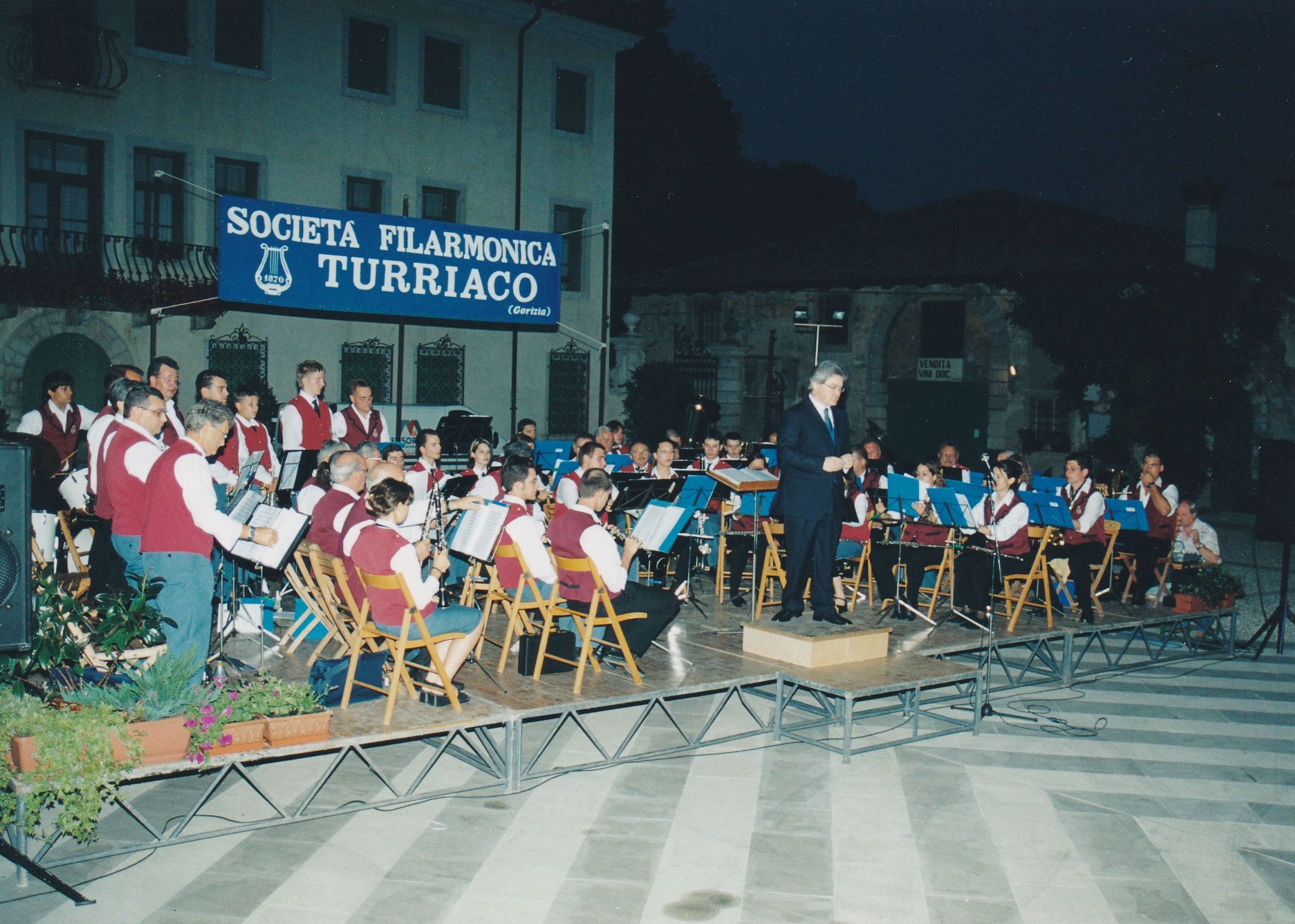 Maestro Martinello leading the Philharmonic
Second among the enduring values: the bond with the community, the people who live here, and the life of the place. Nobody stops to ask why they should take part in certain events or contribute to certain causes. Things get done because they need to be done � and because, frankly, they’ve always been done. The how gets debated regularly; the whether almost never does. The Philharmonic is an integral part of a community that stretches beyond the narrow borders of the municipality to encompass the province and the entire region. And to that community, the Philharmonic is proud to contribute in whatever ways are appropriate to it. That includes providing the soundtrack for ceremonies and events, and boosting the appeal of initiatives that the community deems important. If, say, participation in processions or rallies has scaled back over time, involvement in charitable and solidarity events has grown.
Third, and worth restating: the Society’s fundamental neutrality on political, religious, racial, and related questions � and on everything, including age, that might serve to divide or exclude. The era when the village was essentially split between red and white (with some shades in between but almost no black) is over. The time when political parties were powerful sources of identity and belonging is gone. Neutrality today means, above all, refusing to erect barriers based on what someone believes, what they practice or don’t practice, where they were born, or where they come from.
But properly understood, neutrality doesn’t just mean absence � absence of prejudice, exclusion, or discrimination. It also implies a proactive stance aimed at removing whatever gets in the way of people getting along. Leaving to national politics � capital-P Politics � the task of managing the large-scale problems of our time (economic and social inequality, migration, public health crises, and the rest), the Philharmonic, in its own small way, tries to build an environment where its members � locals and newcomers, young and old, men and women � can coexist with mutual respect, united by the desire to make music together, for their own joy and everyone else’s.
With those founding principles restated, it’s worth noting how, over time, new sensibilities and new needs have taken shape. Maestro Azzopardo had already made the point when stepping down from the musical directorship: bands had to choose between evolving and risking extinction. The very meaning of being a band had to be rethought and reshaped to fit a new social context and the needs � that is, the desires and expectations � of both the players and the audiences.
Some of these shifts are easy to identify. One of the most significant concerns the relationship between the band and its director. In the past, it wasn’t unusual for a band to be led by the same person for twenty or thirty years running. The reasons varied. Sometimes the band was essentially the director’s band � he had founded it and, not unreasonably, considered it his creation. In other cases, geography, availability, or finances made the current director the only realistic option. And in still others, a near-symbiotic relationship had developed � the band was happy with the director and the director was happy with the band � and no one saw any reason to change it.
In recent times, the perspective has shifted. The relationship between band and director is now seen as a medium-to-long-term engagement (though not an open-ended one), focused on carrying out a project and reaching specific goals. The band chooses a director who, by professional ability, shared vision, and common purpose, seems best suited to lead them at that particular moment. Once those goals have been achieved and a certain journey has been made together, the paths diverge � almost always by mutual agreement, with good relations maintained � and life goes on. Azzopardo was the first director to establish this way of thinking, and his successors, as we’ll see, have continued it.
Another shift over the years involves how band members relate to their belonging. In the words of a current member of the Board of Directors:
Once upon a time, people maybe had more fun; now things are done more seriously.
There are dozens � hundreds, really � of anecdotes about band members from past decades: the adventures and misadventures they lived through, the scrapes they got into, the stories that still make people laugh. Not all of them can be told. Many shouldn’t be. A few appear in these pages. As for the last twenty years, stories about the band are increasingly hard to come by. Put it this way: things have moved from a somewhat carefree � perhaps too carefree � way of doing things to one that is a little more measured and thoughtful (we’d never use the word professional). This shift shows up in several ways.
First, instrument study has become a far more serious matter. Several members have passed exams or earned diplomas � and more recently, degrees � from the Conservatory. Many others have attended, and continue to attend, the Music School. The idea that someone might play in the band without solid musical training is simply unthinkable today. To give one example: while the current percussionists are accomplished musicians capable of handling complex rhythms and polyrhythms, people still remember a time when someone � having trouble counting the measures of rest � would wait for the bass drum player next to them to wind up for a strike, then crash the cymbals at the same moment. The bass drum player, naturally, figured this out � and took a certain delight in throwing in the occasional fake-out.
Second, much more attention goes into choosing the repertoire. Marches are still a staple � a band without marches is unthinkable � but the musical palette has broadened considerably, ranging from classical to jazz, from rock to folk, with occasional ventures into world music. Above all, as we’ve already noted, the band now works by projects: an entire season may be organized around a single theme that excites both the director and the musicians.
Last but hardly least: the role of women and young people. Women now make up the majority of the woodwind section and are making inroads in percussion. The last male stronghold appears to be the brass section � though it may not be long before a woman is spotted blowing into a tuba.
As for young and sometimes very young players, attitudes have completely changed. Once upon a time, the Philharmonic had its capibanda � senior members who guarded their privileged positions carefully. New members had to put in their time at the bottom and endure treatment that today would be called hazing, plain and simple. Now it’s perfectly normal to find fifteen- and sixteen-year-olds playing first parts, and nobody bats an eye. With members ranging from 14 to well over 80, the band is in fact one of the best places around for genuine intergenerational dialogue. Younger members get the space and recognition they’ve earned, while the older ones can go on grumbling � confident that, in any case, their passion, their experience, and their years will always be respected.
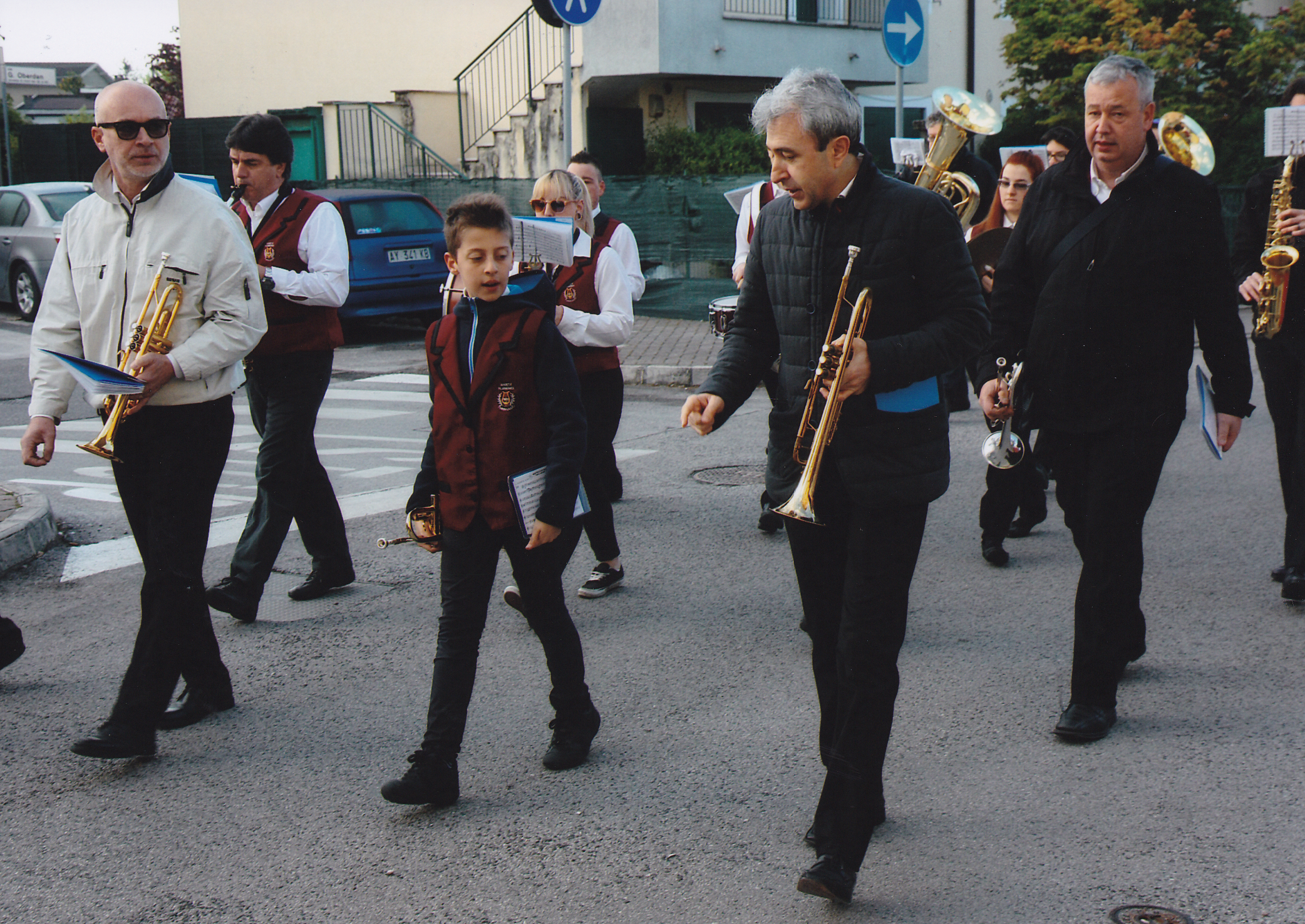 How I school the little one
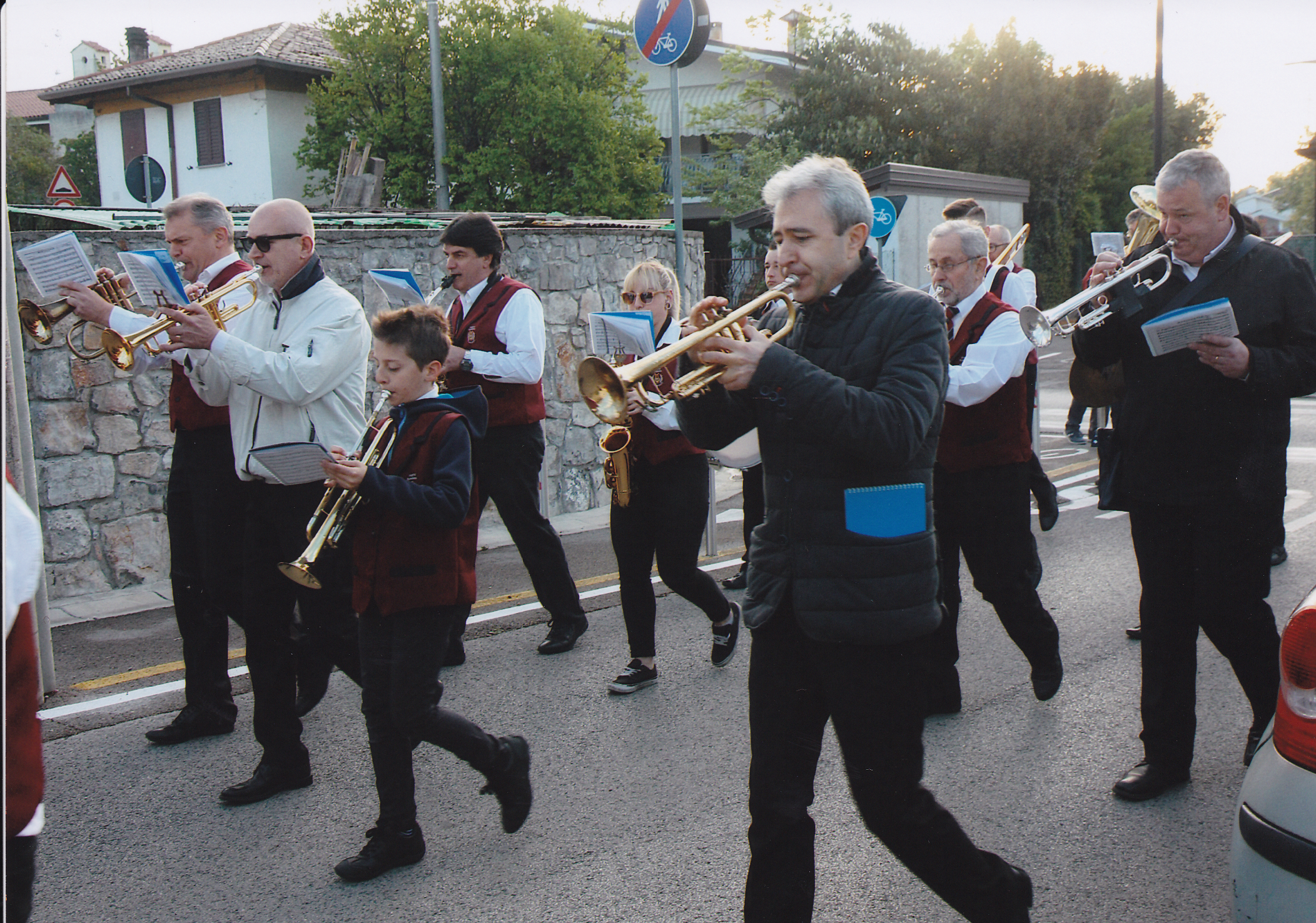 The schooled little one
With those transformations outlined in broad strokes, let’s look more closely at the most significant events of the period. We start with 2000.
That year marked the 130th anniversary of the Philharmonic’s founding. The occasion was celebrated on September 3, during the traditional Festa in Piazza � its fourteenth edition, organized as always by the Municipal Administration, the Pro Loco, local associations, and the Banca di Credito Cooperativo. Each year the festival revolves around a theme, and that year the theme was the band’s own anniversary. Things kicked off at ten in the morning with a Mass dedicated to all band members, past and present. At eleven, the exhibition La nostra banda (Our Band) opened, presenting an interesting survey of photographs along with a collection of sheet music, uniforms, and instruments from the band’s history. The honorary patron of the exhibition was Guglielma Szubert, great-granddaughter of the band’s first director.
The afternoon was devoted entirely to music: a parade through the streets of town followed by performances from the local band and visiting bands from Monfalcone, Corm�ns, and St. Kanzian in Carinthia. The grand finale at 8:30 p.m. featured a Philharmonic concert tracing the Society’s entire history through music.
The month before, the band had performed in Giassico � a charming little village on the banks of the Judrio river, in the municipality of Corm�ns � to celebrate the birthday of… Emperor Franz Joseph. Yes, you read that right. Around here, people were still celebrating the old Kaiser’s birthday.
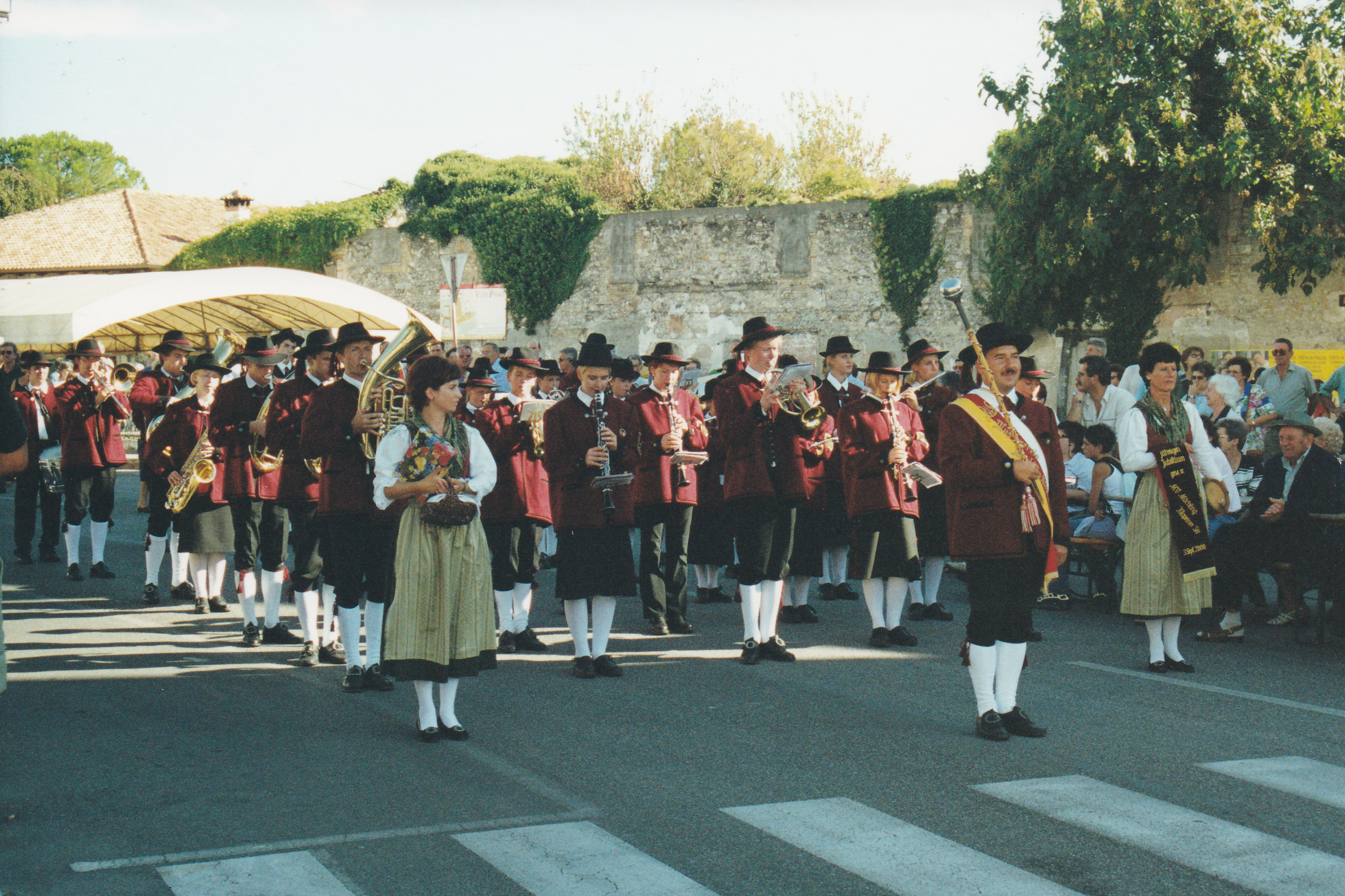 Austrian band in traditional costume
It had all started back in 1975 with the first edition of the Festival of the Peoples of Mitteleuropa, which began modestly and grew over time into an internationally recognized event. On the third Sunday of August, thousands of people would travel to Giassico from the countries that had once been part of the Habsburg Empire, drawn by a festival that opened with a Mass in six languages, followed by meetings, parades, music, songs, and dances from the folk traditions of Central Europe.
With portraits of the Emperor literally dominating every corner, costumed groups, the occasional nostalgic taking it all very seriously, impressive grills and rivers of beer � you could spend two happy days with a musical backdrop that wasn’t hard to imagine. It was the ideal occasion for the band to dust off its most traditional repertoire: the Imperial Anthem, the marches like the famous Wien bleibt Wien (Vienna Stays Vienna) � known locally as the one that goes Molighe el fil che svoli � and the equally beloved Alpenfest and Unter dem Doppeladler (Under the Double Eagle), the last of these composed by a Wagner � not that Wagner, but another one who shared the surname. His name was Franz Joseph Wagner, and beyond Tarvisio he’s celebrated as the Austrian king of marches. All of these pieces are still in the march book used for parades.
On the subject of Austro-Hungarian marches, one small technical note is in order. If you hear the same piece played by a local Italian band and by an Austrian Musikkapelle marching in lederhosen and feathered caps, you’ll notice that even though the notes are identical, the sound is different. Austrian bands tend to play at a slightly slower tempo, with a stronger rhythmic pulse and a different articulation. This style was also characteristic of the Turriaco band. The old band members had a word for it � incomprehensible and untranslatable: sticad�n. Old bandmaster Mario Tomasella described it this way in an interview:
We played everything shorter, everything more sticadin Meaning notes that should last two beats, we made them shorter.
It wasn’t quite a rubato (which is, trust us, nearly impossible to sustain while marching) � it was more of a light staccato, which, repeated constantly, could sometimes sound faintly manic. That sound has largely been lost, though occasional attempts are still made to recover it.
And here we are, almost caught up to the present day. We still have two decades left to cover — a stretch of time most of us have a hard time thinking of as “history.”
The year 2001 opens on a somber note. In early March, Lidiano Azzopardo passes away. The loss of the former conductor hits hard — not just the Filarmonica, but the entire community of Turriaco, which had always held him in great esteem and deep affection. Feelings that the maestro returned in full: he thought of Turriaco as something of a second home. A year later, the Filarmonica honored his memory with a concert built around pieces he had composed or conducted in his final years.
In 2003, the presidency changes hands. Giuseppe Buttignon steps down and Andrea Baldo is elected in his place. The new Board of Directors includes Vice President Mario Pressi; returning board members Valter Bertoz, Marco Cerni, Sergio Passon, Marina Canciani, Franco Nocent, Stefano Clemente, and Mauro Mattiazzi; and two new faces: Gabriele Zimolo and Irene Brumat.
At this point, a reflection is in order. If you take the time to look back at the names of those who have led the Società Filarmonica and check how long they served, you notice something interesting: the presidency, far from being a pro tempore appointment, looks more like a royal investiture — whoever receives it tends to hold it for a very long time. Gualtiero Cosolo served as president for 27 years; Giuseppe Buttignon for 18; and the same goes for the current president, Andrea Baldo.
The fact that a person is repeatedly confirmed in such a role — board elections are held every two years — can mean several things. First and foremost, it testifies to a complete absence of internal conflict and to the nonexistence of behind-the-scenes maneuvering for positions of power. Plots, conspiracies, and power grabs are entirely foreign to the spirit and history of the Filarmonica, and everyone agrees that’s how it should stay.
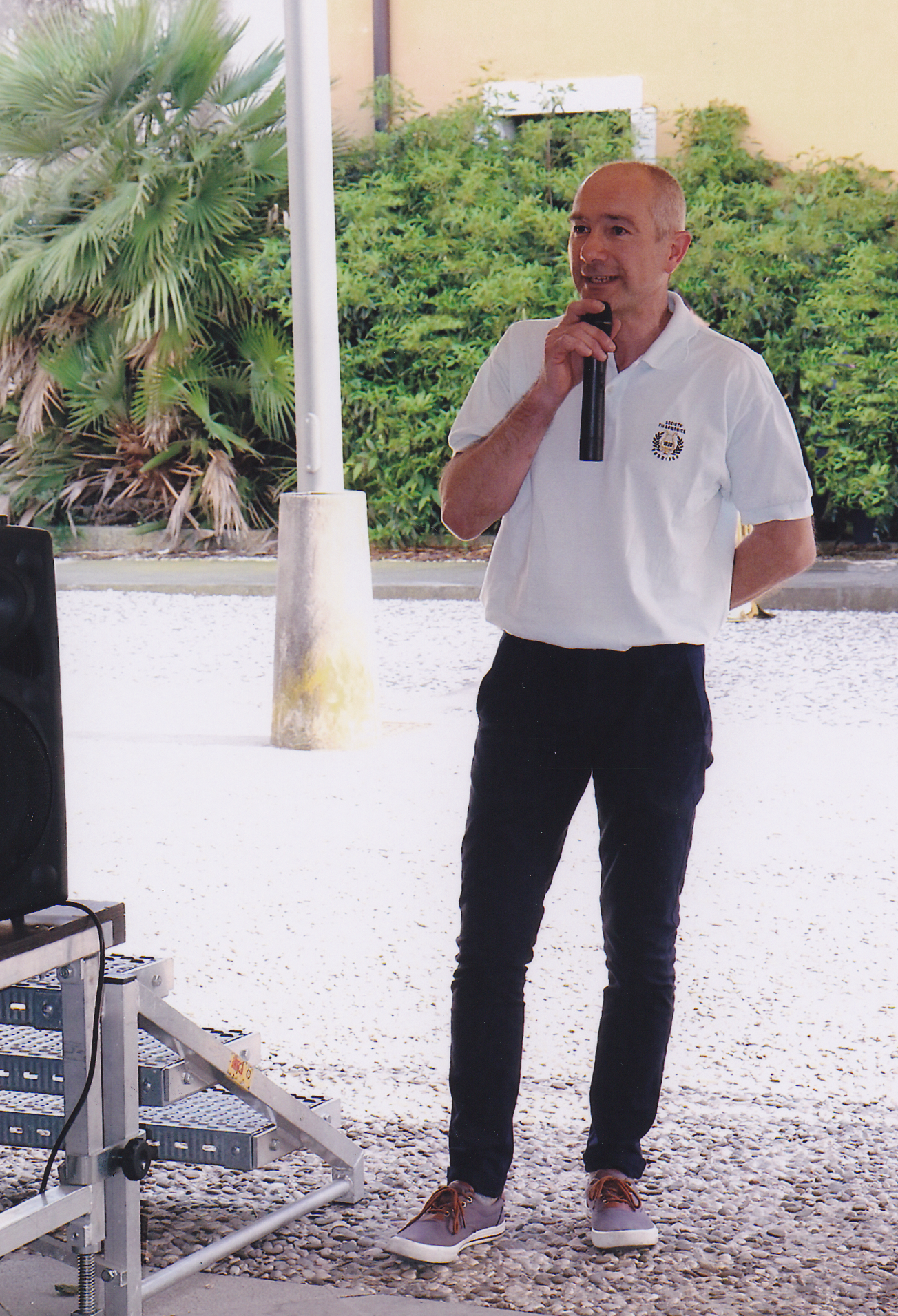 Andrea Baldo, current President
Whoever becomes President takes on responsibilities that have grown heavier over time. They do so out of pure dedication to the cause, since the position comes with no benefits — direct or indirect. On the flip side, this also means that once someone has shown they can fill the role with wisdom, balance, and effectiveness, the decision of when to step down is essentially theirs alone to make.
That year’s Christmas Concert introduced a feature that would be repeated every year going forward: the show opens with a performance by the Youth Band, made up of students from the music orientation courses coordinated by Marina Canciani. The Board of Directors and Maestro Martinello introduced the change to mark the 20th anniversary of the Filarmonica’s Music School. At the event, a commemorative plaque was presented to former president Buttignon in recognition of his service, and the new ceremonial banner — embroidered by Mrs. Sonia Beltrame — was officially unveiled.
In the new millennium, the Filarmonica keeps working to build and strengthen ties with bands from neighboring countries. In 2002, visits had been made to St. Kanzian in Austria and Tolmin in Slovenia. In 2004, another memorable trip took place to Carinthia — memorable above all for the lessons it offered. The destination this time was Bodensdorf, a pleasant little town on a pleasant little lake, the Ossiachersee. The memories of those who made the trip are rather hazy — and in a moment it will be easy to see why — but we managed to piece together some of what happened.
The trip had been preceded by a scouting mission carried out by a group of five — representatives of the Filarmonica, the Bisiachi Costume Group, and the local cooperative bank — who had made contact with the director of the local Raiffeisen Bank (which was sponsoring the event) and with the host band, celebrating its 55th anniversary that year.
That things were heading in a somewhat unusual direction became clear right away when the aforementioned director — one Reiner Furlan, whose last name says a lot — began offering everyone generous tastings of Schnapps at ten in the morning. These are the local fruit spirits served as a welcome gesture and during toasts. For those unfamiliar with German: Schnapps comes from schnappen, a verb that describes the typical way of drinking it — knocking back the whole glass in one shot. At first, everyone was busy debating the ideal serving temperature for an Obstler, identifying the characteristic celery notes of a Meisterwurz, and appreciating the bitter finish of an Enzian. After a couple of rounds, all such distinctions became, shall we say, considerably blurrier — and it’s not hard to imagine why.
What was less than admirable was not so much the behavior of the five envoys — when you’re in a dance, you dance — but the fact that when they returned home, not one of them mentioned any of it. When the main group set out a couple of days later, they were caught completely off guard.
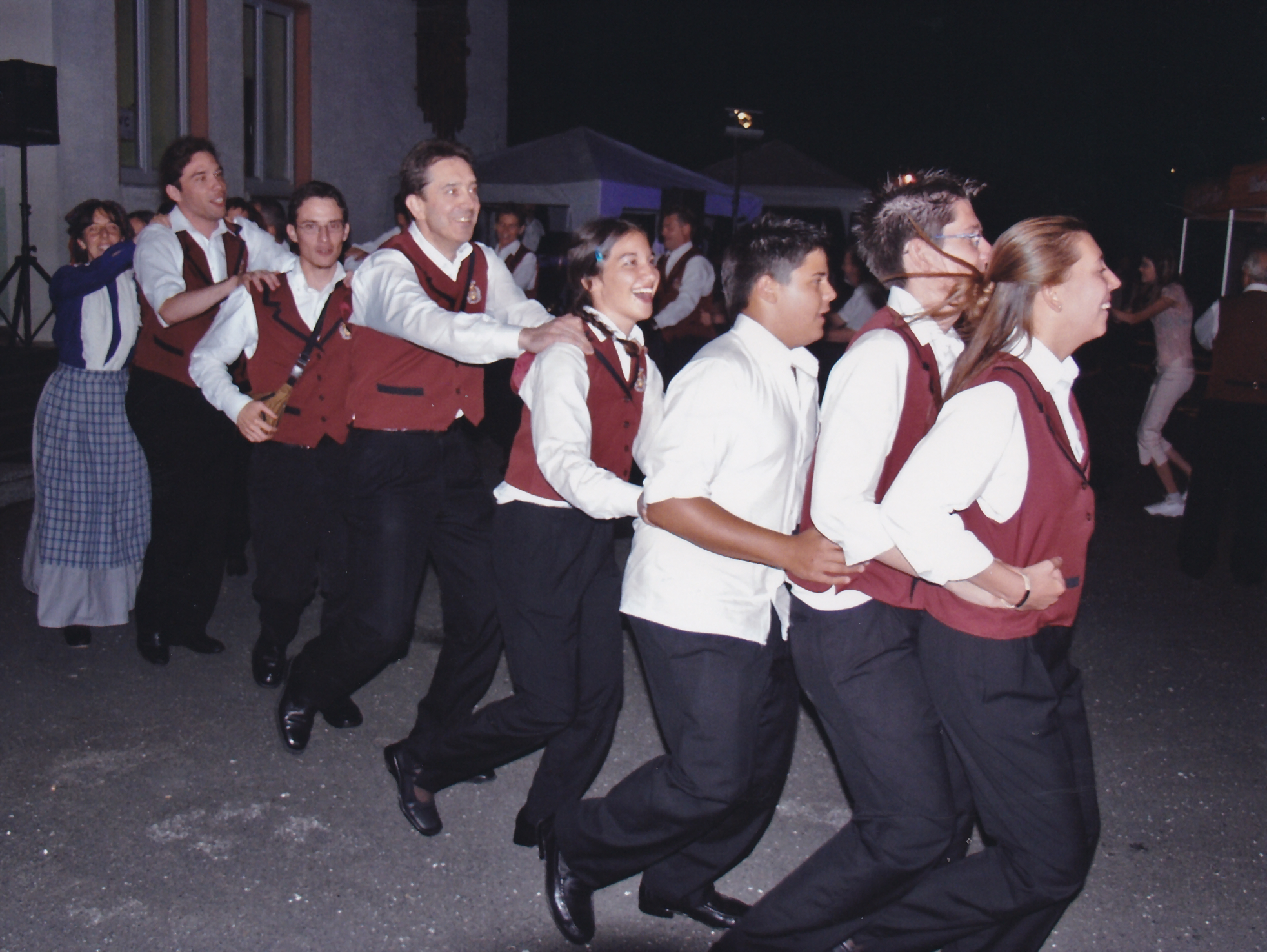 Bodensdorf: Spirits running high
The joint performance with the local band was preceded by a lengthy fraternal gathering during which the Prosits flowed freely. Everyone arrived at the concert already well-fueled, but the notes were mostly right, the tempos more or less on point, and the pieces made it to the end one way or another. What remains shrouded in mystery is the after-concert. What is known for certain: a group of musicians somehow ended up on stage improvising with the locals on pieces nobody had ever seen or heard; a considerable taxi operation was mounted to get those who couldn’t manage it on their own to bed; and more than a few, overcome by a sudden fit of modesty, chose to skip the village parade the following morning. The experience, though, proved invaluable the next time around.
That year also brought a new development: the public debut of the Turriaco Brass Ensemble, the band’s brass section. A brief digression is needed here — one that will be obvious to musicians but may be useful to non-experts reading these pages.
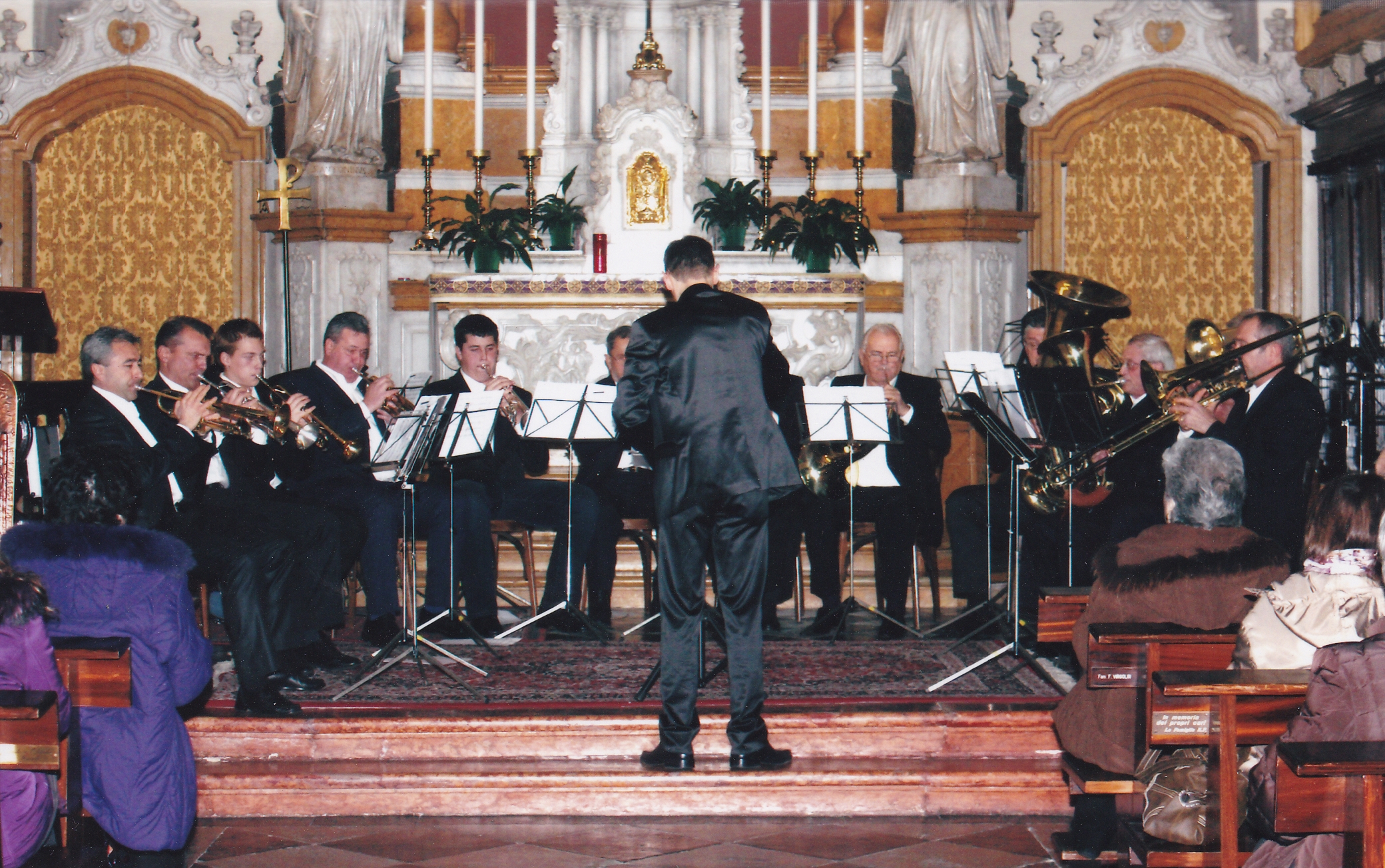 The Turriaco Brass Ensemble at the Church of St. Rocco
The instruments in a musical ensemble are divided into sections, or families. The main ones are strings, woodwinds, brass, and percussion. A band has no strings (except for the occasional double bass, which appears only in concert hall settings, never on the march). Percussion instruments are those that, as the name suggests, are struck with sticks or mallets (snare drum, bass drum, kit, but also xylophone, vibraphone, etc.), shaken (like a tambourine), or crashed together (like cymbals). So far, so straightforward. Then come the woodwinds and the brass.
You might think the distinction between woodwinds and brass is simple: if an instrument is made of wood (or today, plastic), it’s a woodwind; if it’s made of brass (or metal), it’s brass. If only it were that easy. The two families are actually distinguished by other criteria. Some of them are historical. Flutes, for instance, used to be made entirely of wood — both the recorder (also called the block flute or the sweet flute) and the transverse flute (what people today simply call “the flute”). The transverse flute is now made of metal but is still classified as a woodwind. The saxophone — or rather, the saxophones, since there are several types: soprano, alto, tenor, and baritone — is also counted as a woodwind, even though it has always been made of metal, having been invented fairly recently.
What makes the difference, then, is not the material but the way the instrument is played. In brass instruments, the sound is produced by the vibration of air passing through lips pressed against a mouthpiece. In woodwinds, the vibration comes either from blowing across a hole (flute and piccolo) or from setting a reed vibrating with the lips — a single reed in the case of the clarinet and saxophone, or a double reed in the case of the oboe and bassoon. The brass family includes the trumpet, trombone, French horn, tuba, and related instruments such as the euphonium and flugelhorns.
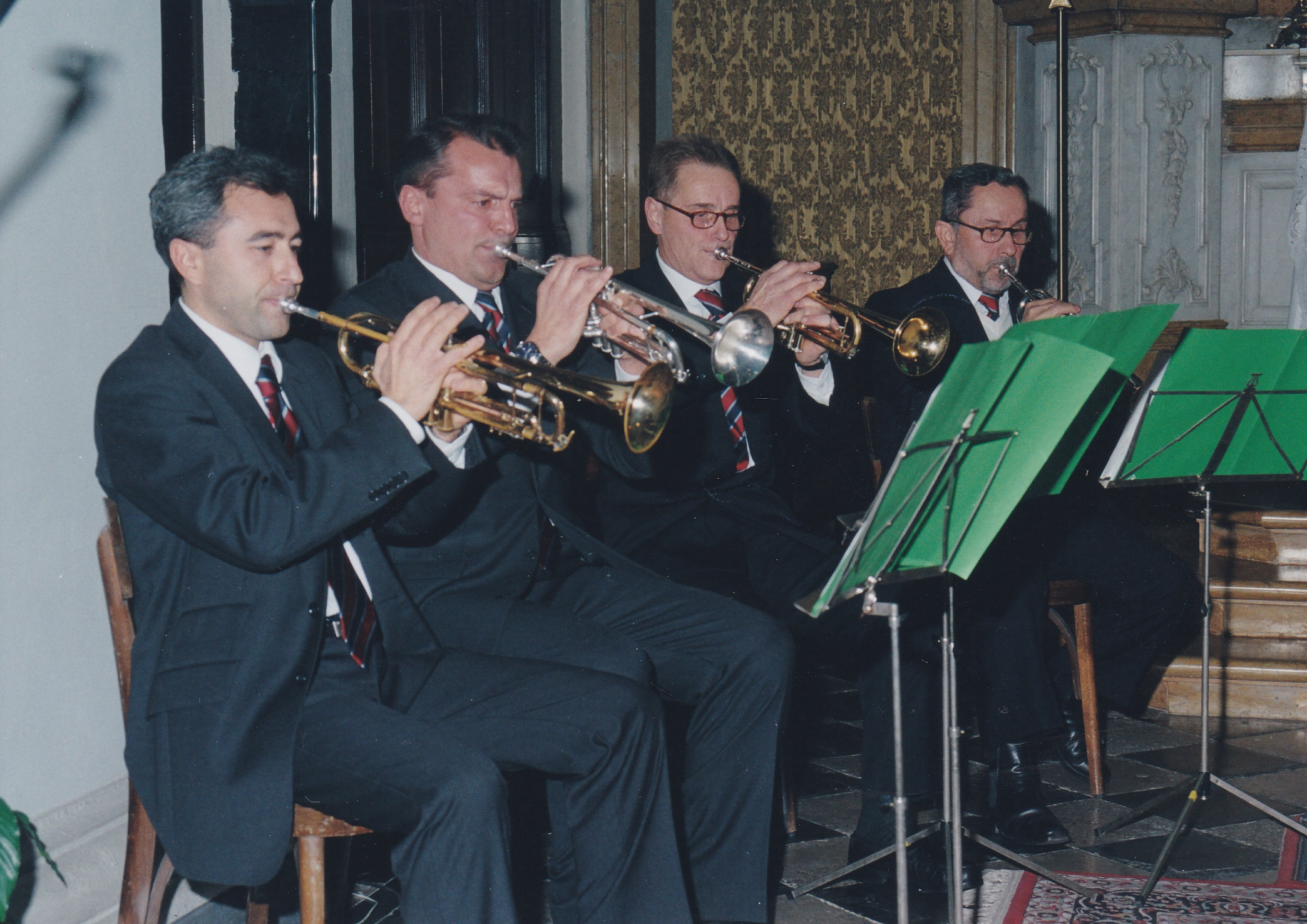 The trumpets
This is a family with a remarkably blended sound — almost as cohesive as the strings, and far more so than the woodwinds — as well as enormous versatility and expressive range.
Musicians in prestigious orchestras — the Berlin Philharmonic, the Vienna Philharmonic, or our own Santa Cecilia — often form smaller groups on the side, for personal enjoyment, a desire for variety, or to explore a repertoire outside the mainstream.
In similar fashion, and without being the Berliner or the Wiener, the Filarmonica had its own brass group for a time. The driving force was David Facini, a trumpet graduate of the Tomadini Conservatory in Udine and a teacher at the Music School, who convinced about a dozen current students, alumni, and longtime band members to try something new. The group performed for a couple of years at Christmas concerts and charity events and made for an interesting addition to the band’s activities.
At some point, someone had the idea of recording a CD. A home studio was set up — basic but functional — a sound engineer was found, microphones were positioned, and one Sunday morning the Ensemble gathered to record. By all accounts, it was a tough but rewarding session. For four hours, the pieces for the CD were played, listened to, replayed, and listened to again. Then, just as they were about to save everything to disk, the disaster struck: through some combination of distraction and bad luck, one of the members (everyone remembers exactly who it was) tripped on a power cable, cut the electricity, and wiped out every single take (backup batteries did not exist — or at least were not available — at the time). After a brief moment of despair — the audio of which has fortunately been lost — they started over from scratch, though with inevitably less enthusiasm. The CD was recorded all the same, but the result, everyone agreed, was no match for the original.
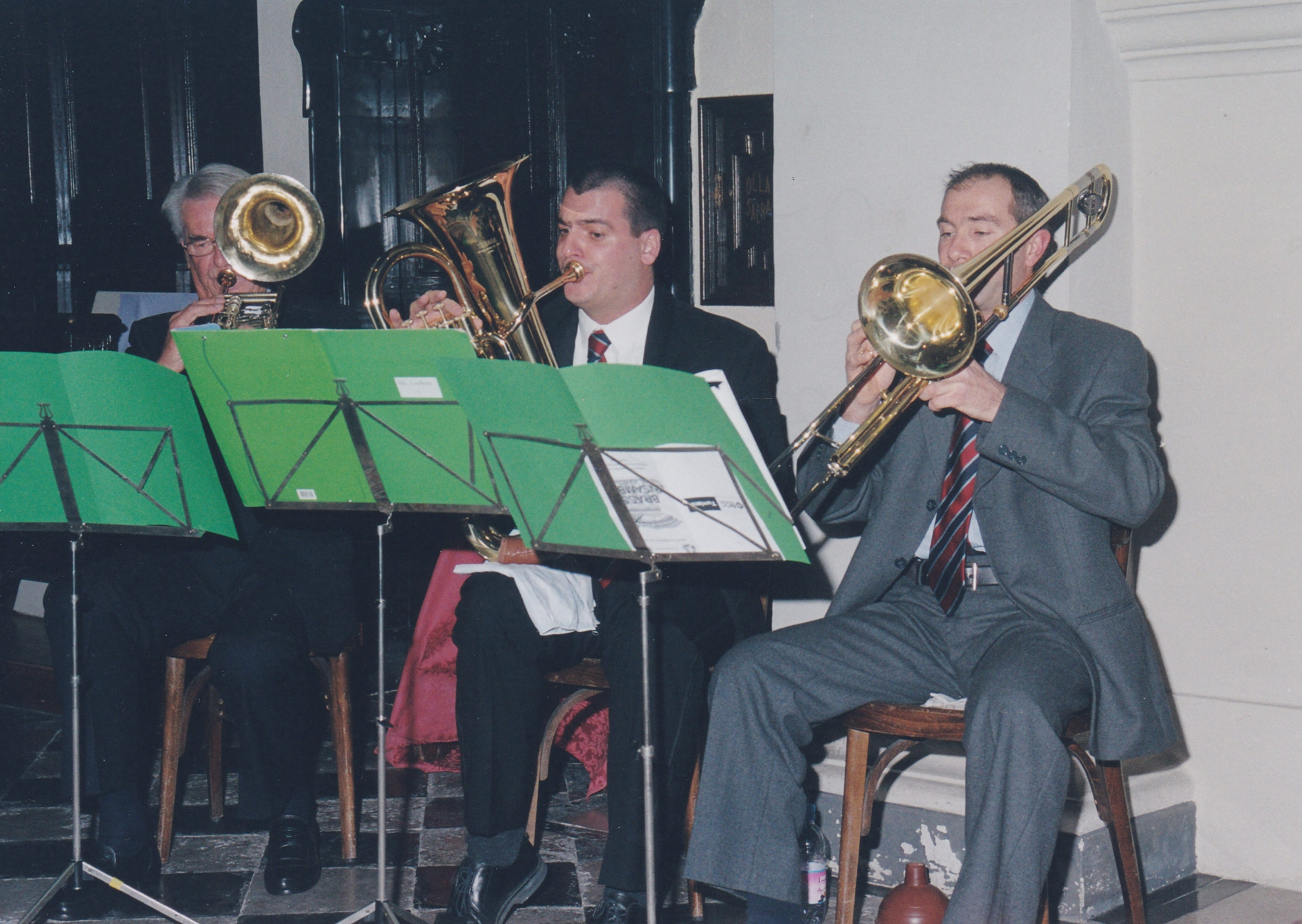 Trombones and euphoniums
As often happens, activities like this are inseparable from the people who drive them. When Facini moved on to other commitments, the Brass Ensemble folded — and that was a real shame.
In 2005, another sad event. After months of illness, former president Giuseppe Buttignon passes away. His life had been devoted to work, family, and the Filarmonica, of which he had been a member since 1947. A man of warm character, open spirit, and quick wit, Giuseppe had a talent for smoothing out conflicts and creating the atmosphere of friendship and cooperation that is essential to keeping any organization alive and thriving. The following year, the Filarmonica honored his memory with a moving concert that also featured choral groups from Begliano — the town where Buttignon had lived — and S. Pier d’Isonzo, where he had marched with the band in countless processions and performed in the parish hall many times. On that occasion, some of the older members who had long since left the Società picked up their instruments one more time to say goodbye to a friend.
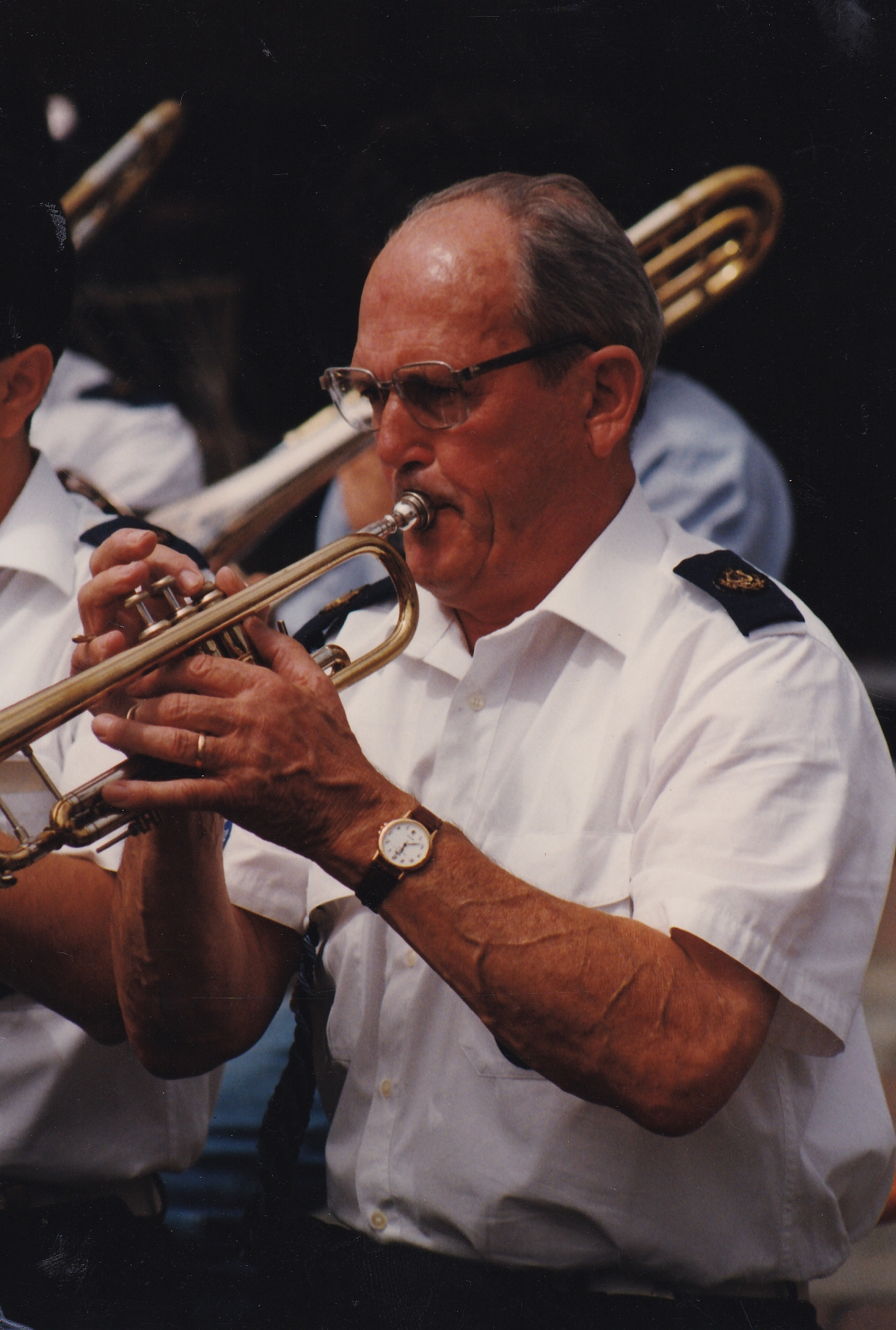 The late president Giuseppe Buttignon
The following year, 2006, the traditional Easter morning parade honored both tradition and innovation. Despite a threatening sky, the band set out on time to make its rounds through the village — waking people up and wishing them a happy Easter — a tradition that goes back a long way and that both musicians and residents take seriously. As usual, no one had eaten breakfast beforehand. The route, as always, included numerous stops at stands set up for the occasion, loaded with Easter treats of every kind. That year, though, the route was different. It was extended to include Via Benco and the southern bypass road, which had opened just a month earlier. When the town changes, the band changes with it.
The Christmas Concert that same year brought an interesting program note. Among the pieces conducted by Maestro Martinello was Alla czardas by G. Orsomando. Big deal, you say. Fair enough — but here’s the story. The piece had been the required selection for the Solo Clarinet and Band category at the Fourth Carlino Clarinet Competition, which the Filarmonica had taken part in the previous October. If you look it up (YouTube is invaluable for this), you’ll find it’s a virtuoso showcase that demands exceptional agility, technical command, and the ability to move fluidly across the full range of the instrument. The competition was won by Gabriele Zimolo, who had started his musical training with the Turriaco band and who continues to perform with it even after earning his clarinet diploma from the Tartini Conservatory in Trieste. In front of a large audience — including the mayor, the parish priest, the bank director, and the ANBIMA provincial president — Gabriele overcame his natural shyness and gave a full demonstration of his abilities.
In 2007, a change of conductor: after a decade with the Filarmonica, Flaviano Martinello leaves Turriaco to focus all his attention on the Carlino band, which he had been directing for some time. While the search for a new conductor is underway, Gabriele Zimolo takes over the band’s direction, including the traditional September Festa in Piazza concert. A week later, Maurizio Zaccaria arrives from Trieste — 41 years old, with a diploma in band scoring from the Verona Conservatory, trained in the school of Maestro Azzopardo. At his official welcome, the mayor, Alessandra Brumat, is there to greet him.
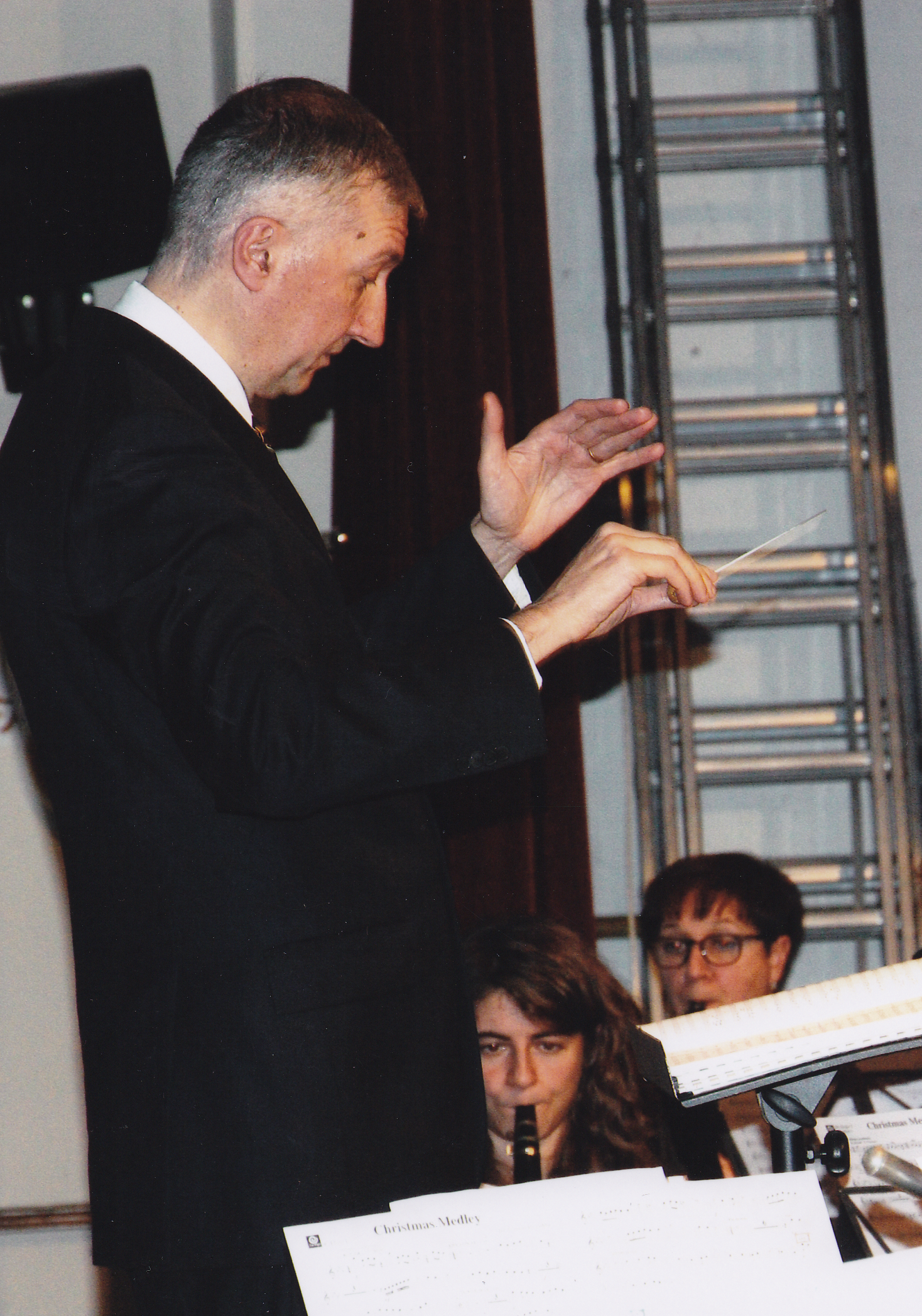 Maestro Maurizio Zaccaria
It was Zaccaria’s idea to work in cycles and projects — an approach the Filarmonica still follows today. He also pushed to strengthen the percussion section, both in terms of instruments and player training. On his initiative, a xylophone, a glockenspiel, and two timpani were purchased. And here again, a word of explanation for the non-musicians.
The percussion family breaks down into two types. The more familiar ones — bass drum, snare drum, cymbals — belong to the category of indefinite pitch percussion. In plain terms, these instruments produce a sound that can be generally higher or lower in register but doesn’t correspond to any specific note. Then there are the definite pitch percussion instruments, which produce clear, identifiable notes that can be sung or replicated on other instruments and used to build melodies.
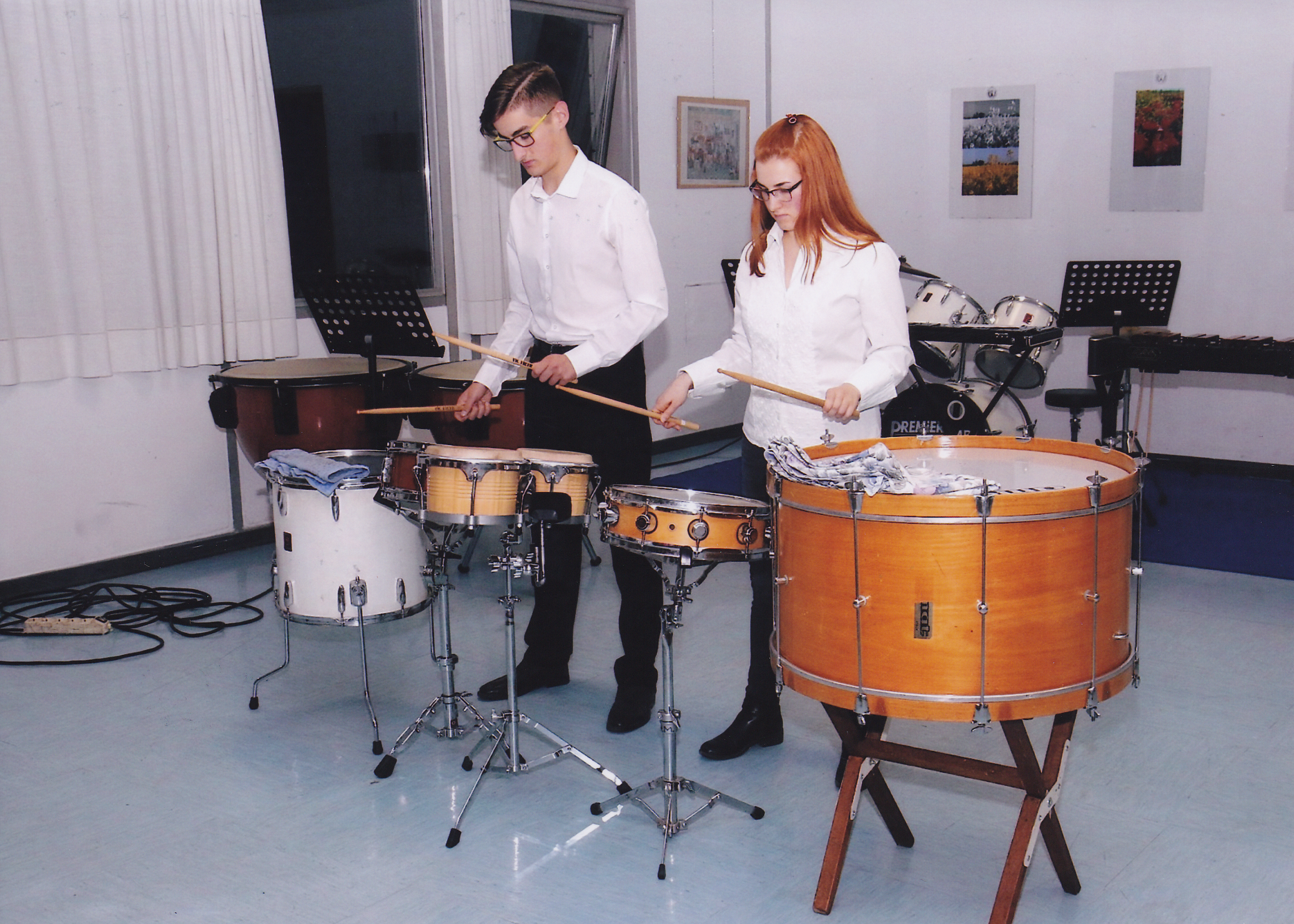 Young percussionists on their way up… (and they got there)
Xylophone and glockenspiel both belong to this second category. Both are made up of a series of bars arranged in two rows, like a piano keyboard: the lower row — corresponding to the white keys — produces the natural notes, while the upper row — corresponding to the black keys — produces the sharped and flatted ones. Both are played by striking the bars with mallets; skilled players use two mallets per hand. The difference between the two lies in the material: xylophone bars are made of wood, producing a clear but somewhat dry, woody sound; glockenspiel bars are metal, producing a bright, bell-like tone.
And then there are the timpani. Here, appearances are genuinely deceiving. They may look like drums from the outside, but timpani are definite pitch instruments. Their tuning can be adjusted — on modern timpani, via foot pedals — by changing the tension of the drumhead, which then produces notes of different pitches. They are rather complex instruments and rather expensive ones. Prices vary depending on brand, materials, diameter, and other technical features, but in any case they are, as people say, significant. And let’s not forget: you never buy just one — you need at least two, and larger ensembles often have three or four.
The debate over whether to buy the timpani was fairly heated, partly because the group was caught in a classic chicken-and-egg dilemma. Some argued it was pointless to buy them since no one knew how to play them; others countered that no one could learn to play them without having access to the instruments. (Strangely, this argument was never raised about the xylophone and glockenspiel — perhaps there was some hope of steering a piano student toward those instead.) Someone also pointed out that timpani could only be used in concert settings, since marching with them was clearly out of the question. How it ended is easy to guess. The timpani were eventually purchased and have been part of the instrument inventory ever since. Everyone is happy — with the single exception of those who, on every away trip, have to load and unload them from vans and trucks.
Year 2009. The Filarmonica establishes a sister-band relationship with the band of Ponte Buggianese, in the province of Pistoia. The first contacts were made thanks to the good offices of Cristina, President Andrea Baldo’s wife, who is originally from that area. The idea of building ties with a Tuscan band was received with enthusiasm, and preparations for the trip — which was also planned to include visits to Torre del Lago Puccini and Pisa — were made accordingly.
Since showing up empty-handed when you’re a guest is bad form, two large bottles of wine — one white, one red — were loaded onto the bus as gifts for the hosts. President Andrea personally oversaw the operation, given its delicate nature. Once everything was in order, the bus headed south.
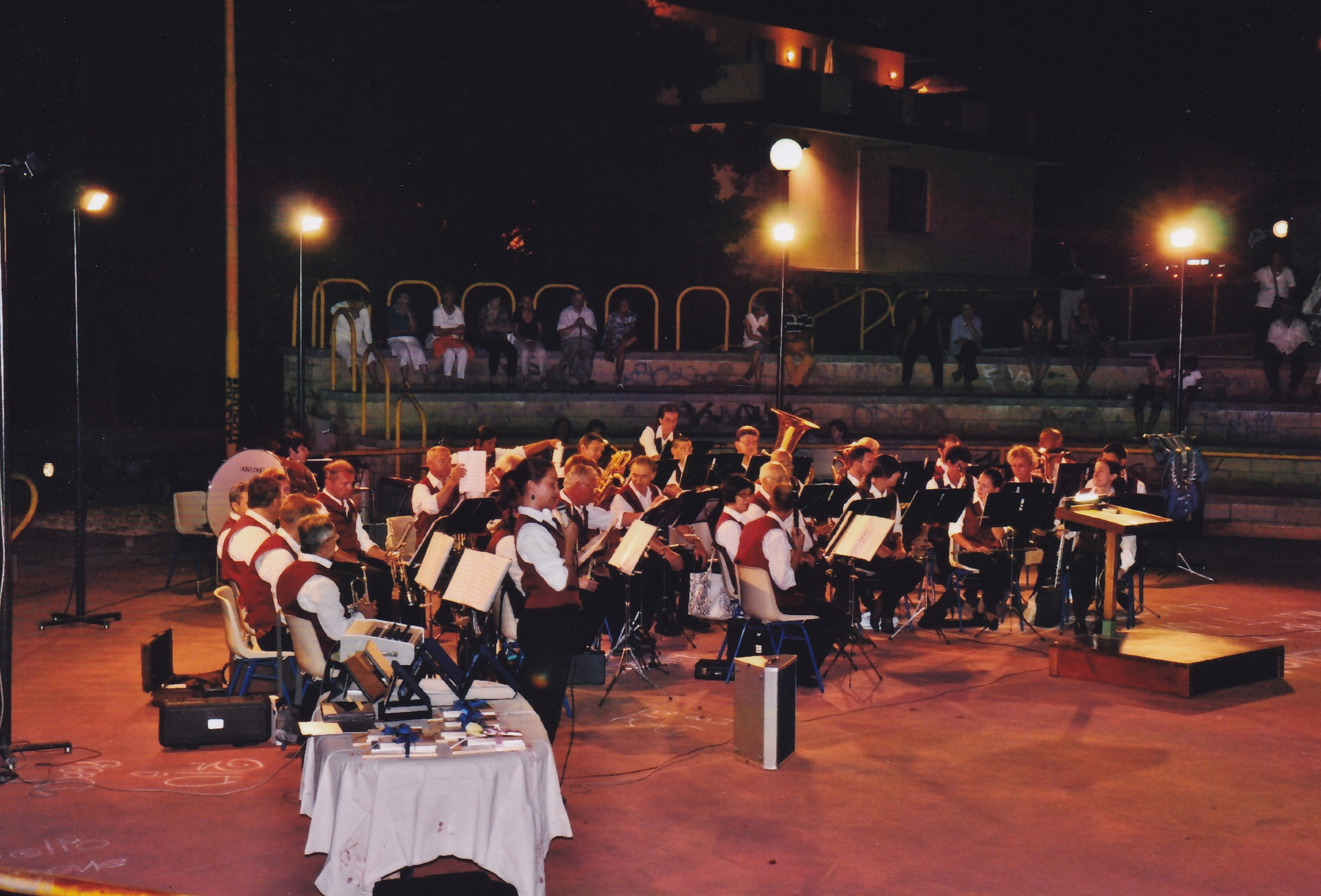 Ponte Buggianese: the band lines up before the performance
Arriving around noon at the hotel in Montecatini — where the group was spending the night — the first order of business was to find a good spot to keep the wine bottles safe from the August heat. It was during the settling-in of luggage and instruments that a bitter discovery was made: the president’s trombone was missing, clearly left behind (the trombone, not the president) in Turriaco. A flurry of phone calls to the Tuscan colleagues ensured that the Filarmonica would still be able to perform with a full brass section.
Fed, rested, and after a quick look around town, everyone was ready to head to Ponte for the dinner and the outdoor concert. Predictably, the first things unloaded from the bus — before any instruments — were the precious wine bottles. The white one was immediately confiscated by the local bandmaster, officially to prevent temptation, though rumor has it that it subsequently vanished without a trace. Mindful of the Bodensdorf Effect, however, everyone at dinner behaved impeccably, and toasting and celebrating were saved for after the performance.
 The other stars of the evening
As is customary, the Ponte Buggianese band returned the visit the following year during the Festa in Piazza, where they were welcomed by the Filarmonica along with the bands from Pieris, Doberdò del Lago, and Monfalcone. The guests took it upon themselves to explain the word finocchiona to their Bisiachi colleagues. The lesson was absorbed so thoroughly that, a few dozen minutes later, not a trace of the cured meat remained. Every once in a while, someone wonders whether it might be time to pay them another visit.
During those same years, at Maestro Zaccaria’s urging, the Filarmonica began laying the groundwork for projects that would take its artistic work to an entirely different level.
The first opportunity came with the bicentennial of Giuseppe Verdi’s birth. Countless events were organized across Italy to mark the occasion, supported by a law that declared 2013 the Anno Verdiano and allocated substantial funds for promoting Verdi’s work, restoring sites associated with him, and sponsoring commemorative performances. Not a cent of those funds made it to Turriaco, but the Filarmonica did its part anyway with SempreVerdi all’Opera, a concert series centered on operatic excerpts from Verdi’s melodramas.
A band playing Verdi is nothing new — it has always been done and always will be. But SempreVerdi all’Opera put something entirely different on stage. The program combined instrumental, solo vocal, and choral pieces. The instrumental parts were provided by the Filarmonica, performing as a wind orchestra. The soloists were tenor Federico Lepre and soprano Francesca Moretti. The choral forces were drawn from five different groups: the Seghizzi choral society of Gorizia, the choir of the Aquileia Basilica, the Gialuth choral group of Roveredo in Piano (PN), the Lorenzo Perosi choir of Fiumicello (UD), and the Tourdion choir of Cavalicco di Tavagnacco (UD).
Concerts were held at multiple venues across the region: the Villa Tinin park in Feletto Umberto, the Concordia auditorium in Pordenone, the main square of Fiumicello, the municipal auditorium of Pagnacco, and the Teatro Verdi in Gorizia — the last of these as the opening ceremony of the choral competition named after Cesare Augusto Seghizzi. Audiences were large everywhere, sometimes overwhelmingly so. In Pagnacco, with around 400 seats available, things nearly got out of hand when many people couldn’t get in and had to go home disappointed.
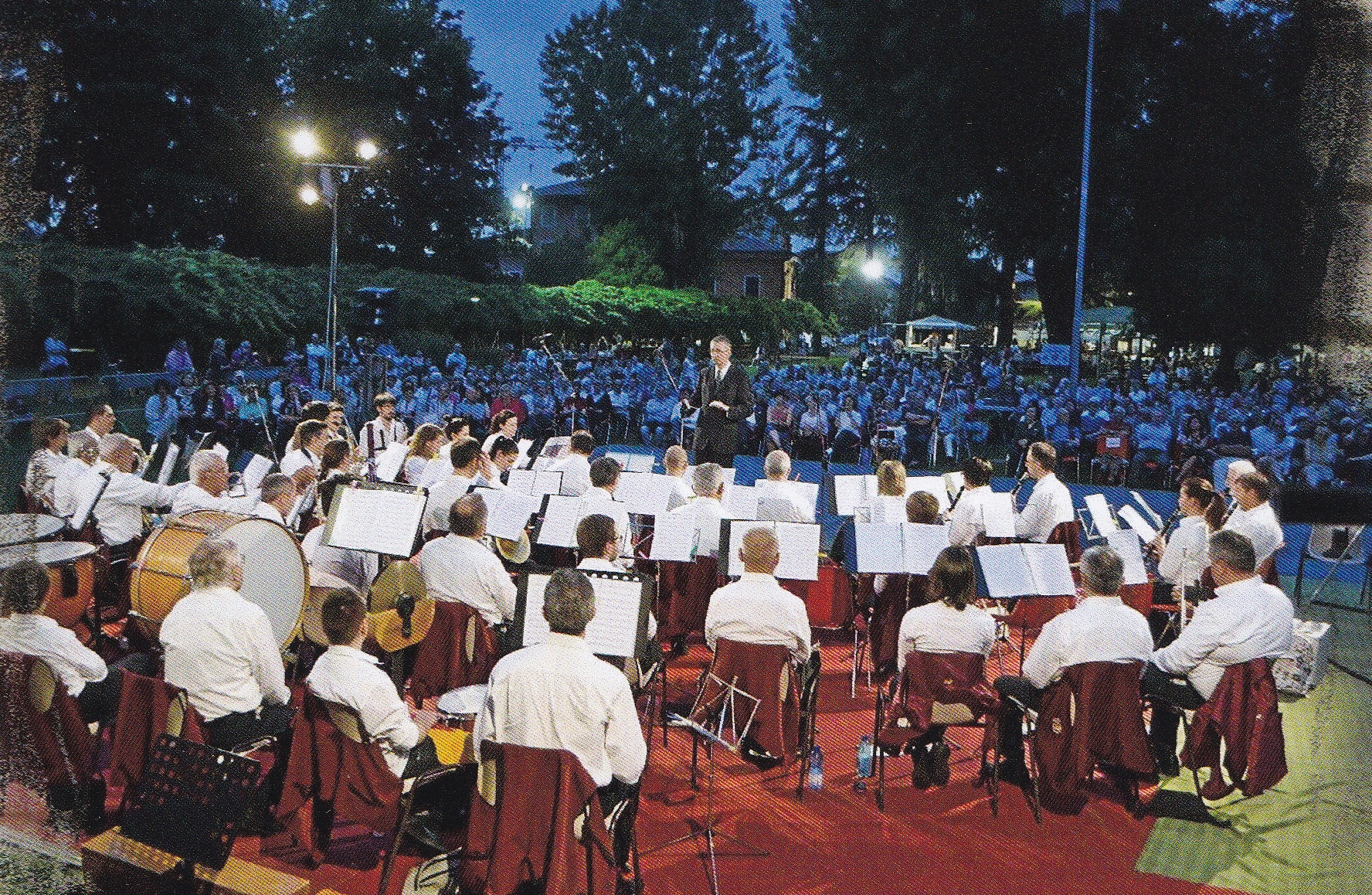 SempreVerdi all’Opera at Feletto Umberto
The program — identical for every concert — had something for everyone. It opened with the Overture from Giovanna d’Arco (a piece that gives the first flute and first clarinet plenty of room to show what they can do), moved on to two choruses from Ernani — Evviva, beviam! and Si risvegli il Leon di Castiglia — enough to warm up even the most indifferent listener. Then the soloists took the stage with Questa o quella from Rigoletto, followed by another Overture, this time from Nabucco. Two more choral pieces from Nabucco came next: Gli arredi festivi and the unavoidable Va pensiero.
The spotlight returned to the solo voice with De’ miei bollenti spiriti from La traviata, then back to the full chorus with the Anvil Chorus from Il trovatore. The concert closed in a crescendo with the Prelude from Aida and the finale of the opera’s second act: Gloria all’Egitto and the Triumphal March. In short: a superb program that had the success it deserved.
One behind-the-scenes note on logistics. Opera lovers will know that the Anvil Chorus has a distinctive feature: after a rousing introduction, the entry of the main theme on the words Chi del gitano i giorni abbella? is accompanied by the rhythmic striking of hammers on an anvil. (For some people, this is the only form of metal music they can stand.)
For a proper performance of the piece, an actual anvil was required. The problem: anvils are used by blacksmiths, and Turriaco had no blacksmiths left in 2013. Fortunately, two farmers were found who still owned one, and they were happy to lend it. Three anvils were actually located, but one was too large and too far off pitch and was immediately ruled out. So while La Scala and La Fenice perform the Anvil Chorus with one anvil, the Filarmonica performed it with two — struck (or played, take your pick) by two students from the percussion class.
Bonus question: what does a farmer do with an anvil? Answer: he uses it — or rather, used to use it — to hammer the blade of a scythe back into shape. The blade would then be sharpened with a cote, a whetstone stored in a hollowed-out ox horn. Once a common practice; today, if you want to see how it’s done, you’ll need to look it up on YouTube.
SempreVerdi was a genuine success and marked a turning point in how the Filarmonica thought about what it was doing. The experience convinced everyone that there was no need to see themselves as just a charming village band — they could venture into territory no one had thought to explore before.
Another major step in that direction came the following year, 2014. This time the push came from the friends of the Tourdion Cultural and Musical Association of Cavalicco di Tavagnacco. Founded in 1998, the choir had started with sacred and folk music before gradually moving into opera, performing — in collaboration with other choral and instrumental ensembles — productions of L’elisir d’amore, Don Pasquale, Così fan tutte, La traviata, and Madama Butterfly. The step from grand opera to operetta felt natural, and the idea emerged to build a show around a selection of arias from that genre. Maestro Zaccaria embraced the proposal with enthusiasm and the new project got underway.
Un mondo d’operetta! was staged in June 2014 — first in the Villa Tinin park at Feletto Umberto (on a Friday the 13th, as if to prove that the art world is not superstitious) and then the following Sunday in the main square of Turriaco. Under Zaccaria’s direction, the Filarmonica, the Tourdion choir, and soloists Federico Lepre (tenor and artistic director of Tourdion), Silvia Felisetti, and Federica Volpi all took part. The two sopranos alternated between performances: Felisetti appeared in Feletto Umberto, Volpi in Turriaco.
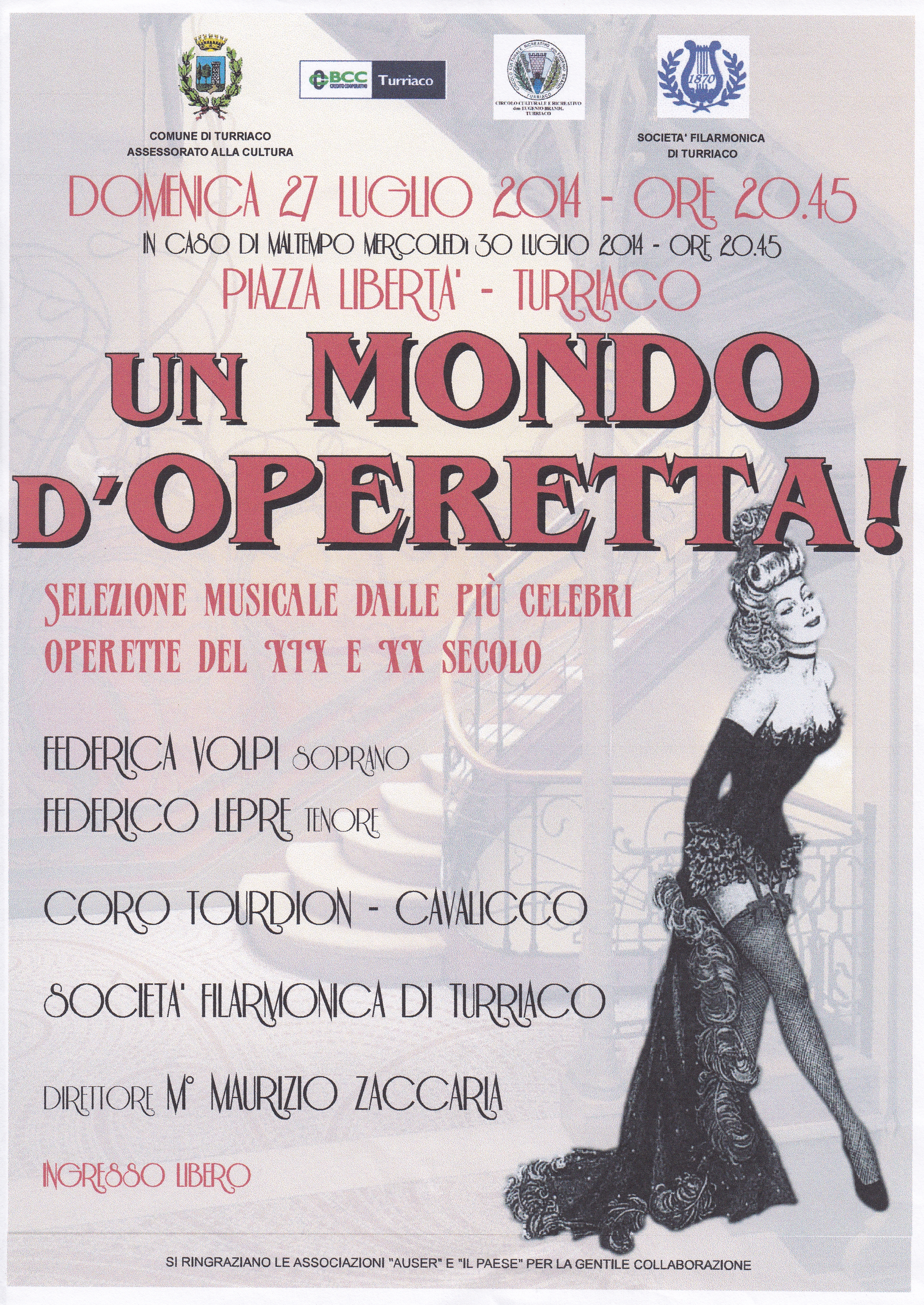 The poster for “Un mondo d’operetta”
The program was exactly what you’d expect — and more. It opened with the Overture from The Gypsy Baron by Johann Strauss the Younger, performed by band and chorus. That was followed by an anthology from Frühjahrsparade by Stolz — a work that, in Daniela Mazzuccato’s interpretation, had been a major success at the Trieste Operetta Festival two years earlier. The band performed solo for the Overture from The Mikado, that singular work born from the collaboration between Gilbert and Sullivan, and for The Gypsy Princess. Then came Dein ist mein ganzes Herz from The Land of Smiles, before a triumphant finish with Im weißen Rößl, Il paese dei campanelli, and The Merry Widow. With a program like that, success was guaranteed — and it was.
2014 was also the year marking the centennial of the outbreak of the First World War. For Italians, it is the war of 1915–18, but we shouldn’t forget that Austria had declared war on Serbia in July of the previous year. And even less remembered — especially outside this corner of Italy — is the fact that the first Italian casualties of the conflict were soldiers from Trieste, the Giulia region, and Friuli, serving in the 97th Infantry Regiment Georg Freiherr von Waldstätten, which was deployed near Lviv, in Galicia. Between August and September of 1914, the regiment lost half its strength in combat; most of the survivors ended up as Russian prisoners. And that was only the beginning of the slaughter that would continue for four more years.
It made sense, then, that commemorations in Friuli Venezia Giulia would begin earlier than in the rest of Italy. Among the events of Carso 2014 organized by the municipality of Sagrado was Suoni e parole della grande guerra (Sounds and Words of the Great War), held on Saturday, June 21, in the hamlet of S. Martino del Carso. The event was promoted by ANBIMA and featured contingents from every band in the province of Gorizia: Cormòns, Doberdò del Lago, Grado, Monfalcone, Mossa, Pieris, Ronchi dei Legionari, Turriaco, and Villesse. The Filarmonica sent about a dozen of its members.
The evening began with a parade that led participants past a plaque bearing the verses Giuseppe Ungaretti had dedicated to the village:
Of these houses nothing is left but a few scraps of wall. Of so many who were close to me not even that much is left. But in my heart no cross is missing. It is my heart the most ravaged land.
Arriving at the Piazza della Fontana, the concert began, conducted by Maestro Zaccaria. The program — military songs, folk songs, and period pieces — was interspersed with readings of wartime texts and poetry.
A similar event took place at the Villa Tinin park in Feletto Umberto on June 12 of the following year, 2015. This time the title was Musiche dai due fronti: Il nemico è come noi (Music from Both Sides: The Enemy Is Like Us). The format was the same as Suoni e parole — music and texts to tell the story of the Italian-Austrian war — but this time the perspective was dual, taking in both sides of the conflict to arrive at the realization, as the title puts it, that the enemy is like us.
The texts had been selected, read, and annotated by Professor Carlo Perucchetti of the Centro Studi Musica e Grande Guerra in Reggio Emilia. Under Maestro Zaccaria’s direction, the musical part was shared by the Filarmonica, the Tourdion choir, tenor Federico Lepre, and — in an entirely new collaboration — the Simon Gregorčič vocal octet from Kobarid (Caporetto) in Slovenia. A note of local color: the performance was given an extra touch of realism by the group I grigioverdi del Carso from Ronchi dei Legionari, a historical reenactment association specializing in the Great War.
The bipartisan character of the evening is evident even from a quick glance at the program: it included both the Marcia Reale and the Austro-Hungarian anthem; the Italian Canzone del Piave was followed by the Piave marsch (composed, incidentally, by Franz Lehár — better known for quite different musical fare); and there was even an Habsburg-era Viva Trieste marsch of the most staunchly local flavor imaginable. Particularly interesting was the inclusion of pieces from the Slovenian tradition, composed or arranged by Metod Bajt, founder and artistic director of the Gregorčič octet.
Collaborative projects with the Tourdion association continued in 2017 with the staging of Invito all’opera con delitto — a witty theatrical pastiche that poked fun at the characters and clichés of the opera world, using the plot as a pretext (more or less) for performing some of the most beloved arias, duets, and choruses from the repertoire, from Rossini to Verdi, from Puccini to Mascagni. The show had already been performed the previous year in a version with piano accompaniment only. In the production staged at Udine’s Palamostre in January, the soundtrack was provided by the Turriaco band. The show was later performed in Monfalcone and Pagnacco.
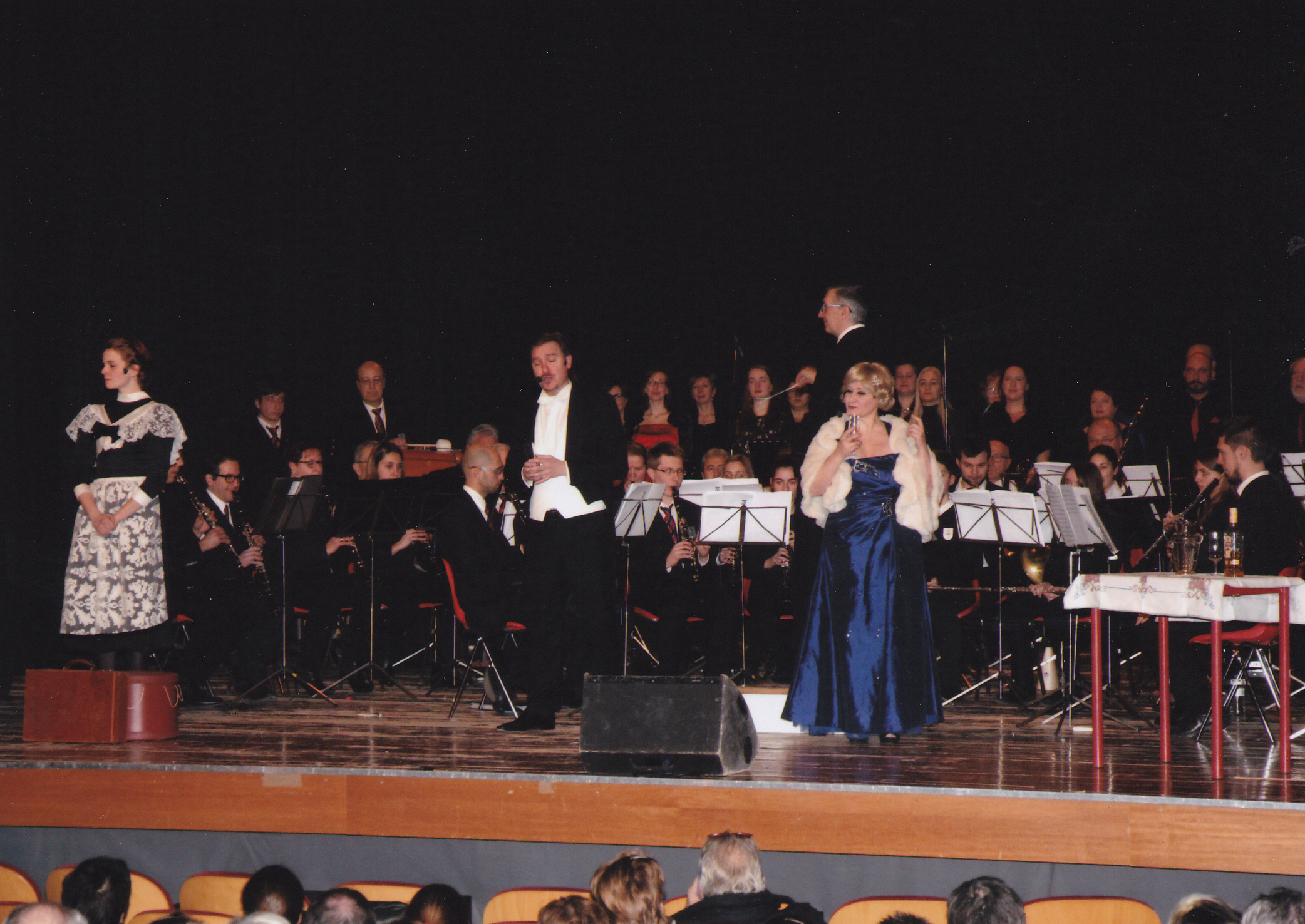 Invito all’opera con delitto
Another significant event took place in 2017. We’ll let Maestro Zaccaria speak directly:
I want to remember here the last project I carried out in 2017 with this ensemble: Toscanini on Monte Santo and in Cormòns, commemorating the centennial of the concerts Arturo Toscanini conducted on Monte Santo, directing a Military Band close to the front lines during the Eleventh Battle of the Isonzo, in August 1917. It was a particularly moving experience to perform inside the Basilica of Monte Santo — today in Slovenian territory — with a program closely tied to that place and to the events that unfolded there in those years. Once again, thanks to the collaboration with Professor Carlo Perucchetti, we were able to bring to life a project rooted in the history of our region.
2018 saw three major events. First, a change of conductor. Maurizio Zaccaria steps down and is replaced by Fulvio Dose, who had earned his clarinet diploma at the Tartini Conservatory in Trieste and gone on to specialize in conducting and scoring for wind ensemble. Dose and the Filarmonica clicked immediately. Both agreed that there was no point in settling back into the usual comfortable routine — a strong signal had to be sent from the start, by doing something Turriaco had never seen: staging a full opera.
The choice fell on La traviata — the most performed opera of all time — in a reduction and orchestration by Lorenzo Pisceddu. In just over an hour, the most celebrated arias of Verdi’s opera were performed in concert form. In addition to the three protagonists — Violetta, Alfredo, and Germont — a narrator was included to link the different pieces and guide the audience through the unfolding story.
Between July 15 and August 5, the opera was performed in Feletto Umberto, Talmassons, and Turriaco. The soloists were soprano Giulia Della Peruta, tenor Federico Lepre, and baritone Cüneyt Ünsal. The chorus was provided by the Tourdion Association; the narrator’s voice was that of Paolo Fagiolo. Maestro Dose conducted both the Filarmonica and the full ensemble.
The third major event of 2018 was the Filarmonica’s visit to the band of Venaria Reale, a town in the Turin area that is home to the famous royal palace of the same name and its magnificent formal gardens. The gardens are truly one of a kind among historic European estates. As recently as the turn of the millennium, they had fallen into such disrepair that it was difficult to make out their original layout. Fully rebuilt and restored to their three-tiered structure, the gardens reopened to the public in 2007, and offer a breathtaking panorama framed by the woodlands of the Mandria Park and the arc of the Alps.
 The band at the Venaria royal palace (tourist mode)
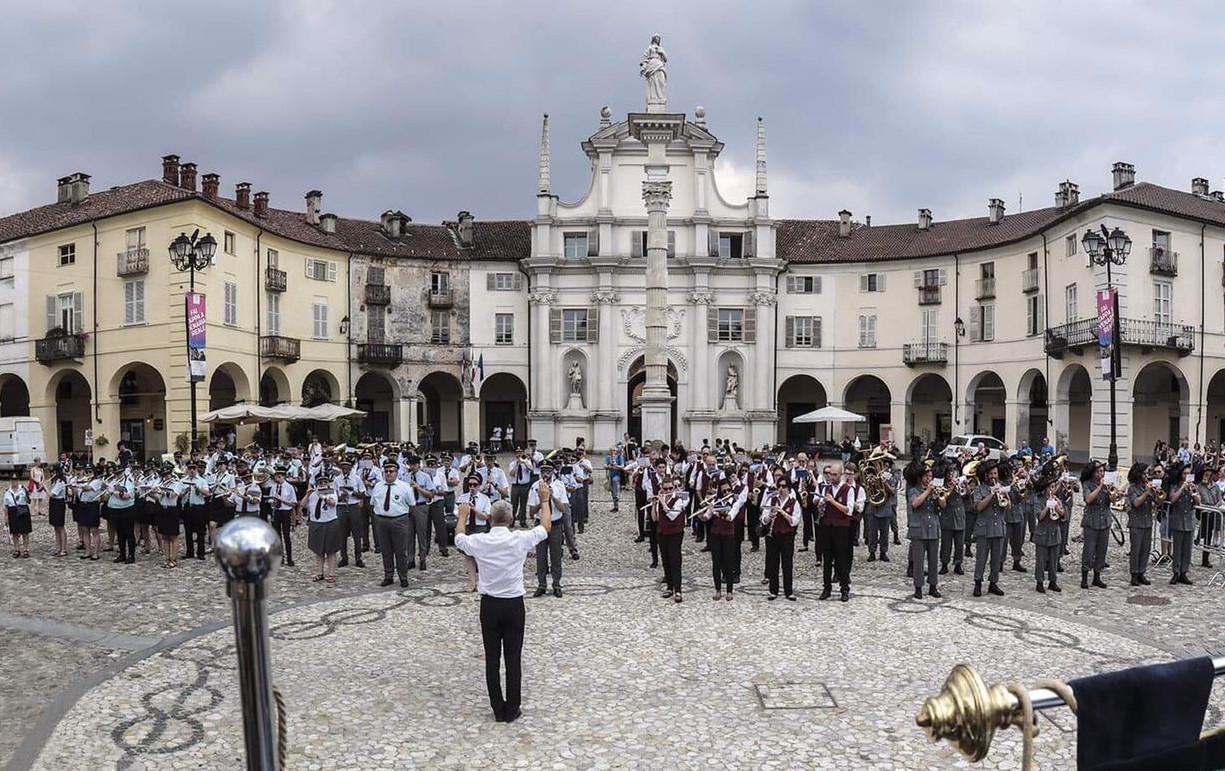 The band at the Venaria royal palace (final performance)
The band hadn’t made a major away trip in some time, and the journey to Piedmont was a very welcome change of scene — made even more enjoyable by the warm and generous hospitality they received. The program followed the familiar pattern of so many trips before: concert on Saturday evening, parade on Sunday, and so long until next time. That next time, for the usual reasons, has not yet come to pass — but the plan to make it happen remains very much alive.
In 2019 came another memorable event: a reprise of La traviata. In the theater world, the big deal is usually the opening night. Revivals are, by definition, revivals — and they often take place in somewhat less glamorous circumstances. This time, things went in exactly the opposite direction, and the atmosphere surrounding this performance of Verdi’s masterpiece was absolutely unique.
For one thing, the show was staged in the inner courtyard of Villa Sbruglio-Prandi in Cassegliano. The building is a neoclassical structure that took shape in the mid-nineteenth century through the transformation of an old farmhouse into a country villa — first the residence of the Sbruglio counts, then of the Prandi de Ulmhort counts.
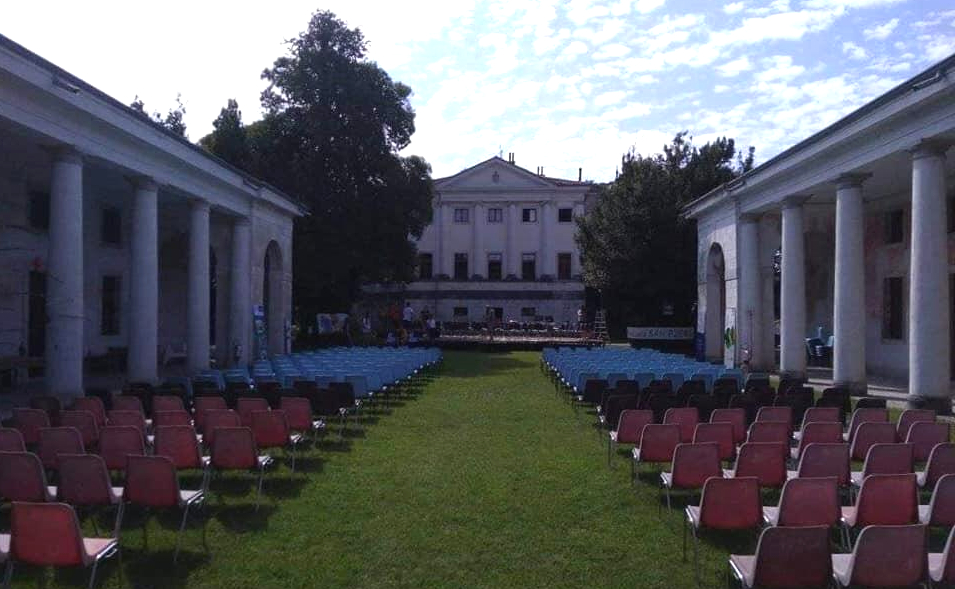 The inner courtyard of Villa Sbruglio-Prandi
Ivan Portelli writes about it on the website of the municipality of S. Pier d’Isonzo:
On April 29, 1938, the villa was unfortunately largely destroyed by a catastrophic fire, which left only a few sections of the walls standing. […] the villa “was a jewel of architectural art. Its Doric portico, with its grand staircase, gave it a unique grandeur. The reception hall, the drawing rooms upholstered in damasks and silks, the Empire-style furniture, its great and precious library, the celebrated chandeliers, paintings, and other furnishings made it a magnificent residence.”
Thanks to the sensitivity of the current owners, a long and meticulous restoration has since brought the distinguished building partly back to life. The splendid courtyard, enhanced by the colonnades of the two side wings, now regularly hosts musical and cultural events.
It is undoubtedly one of the most beautiful spaces in the Monfalcone area.
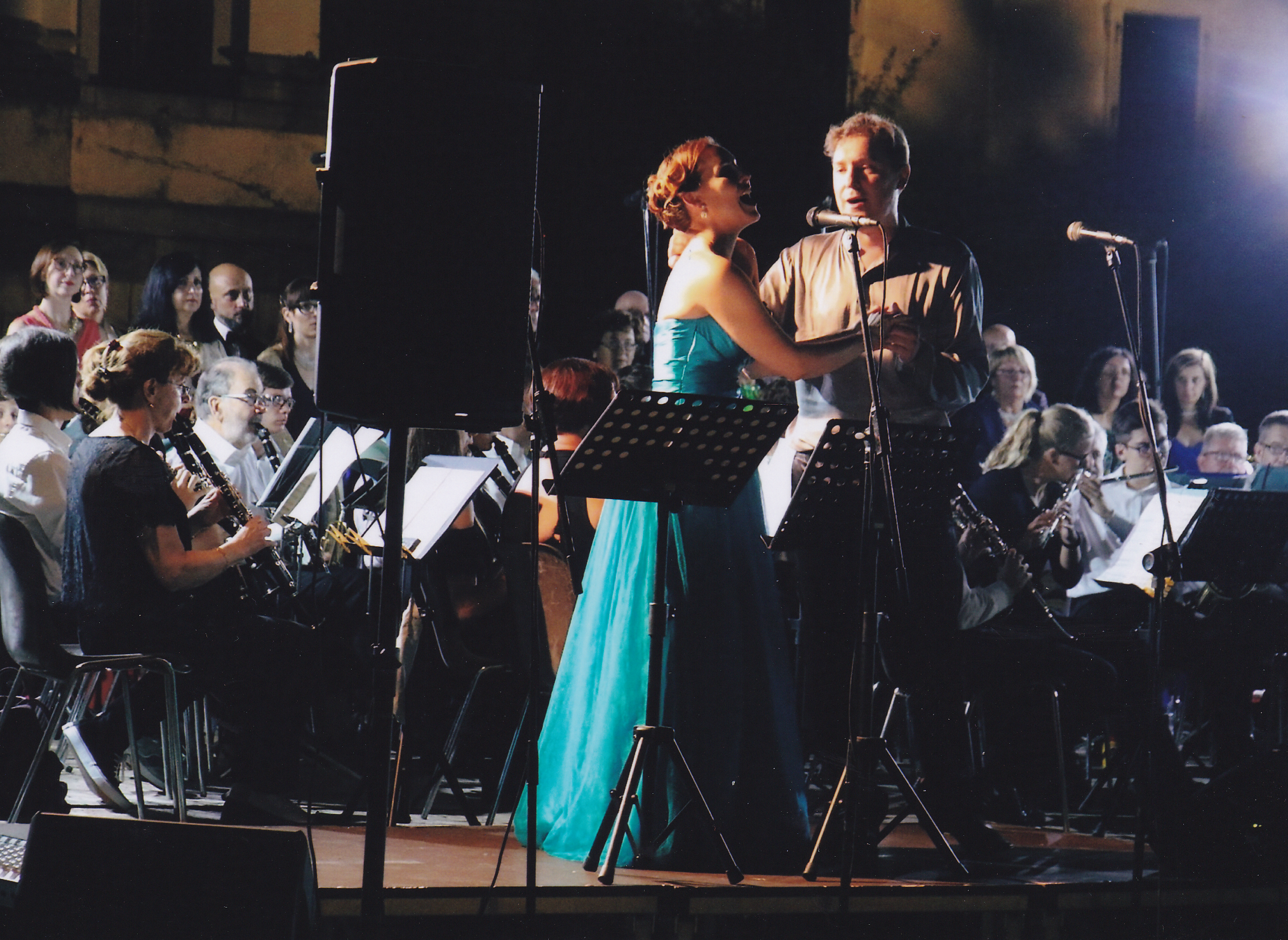 The Filarmonica accompanying Violetta and Alfredo
That evening, singers, chorus, and band all gave their best, under the impeccable direction of Maestro Dose, before a passionate audience that applauded generously. Comments from the musicians and conductors in attendance were extremely positive, with more than a few particularly struck by the rhythmic precision and tonal balance of the performance.
The year ended with the Christmas Concert, held away from home at the Teatro Comunale of Gradisca, since renovation work on the Turriaco gymnasium had made it impossible to find a local venue. Despite the inconvenience of the commute and the unusual date — a Friday instead of the customary Sunday before Christmas — attendance was unaffected. The Filarmonica performed its scheduled program, introduced the band’s new members, extended warm holiday wishes to all, and set the stage for the upcoming celebrations of the Filarmonica’s 150th anniversary.
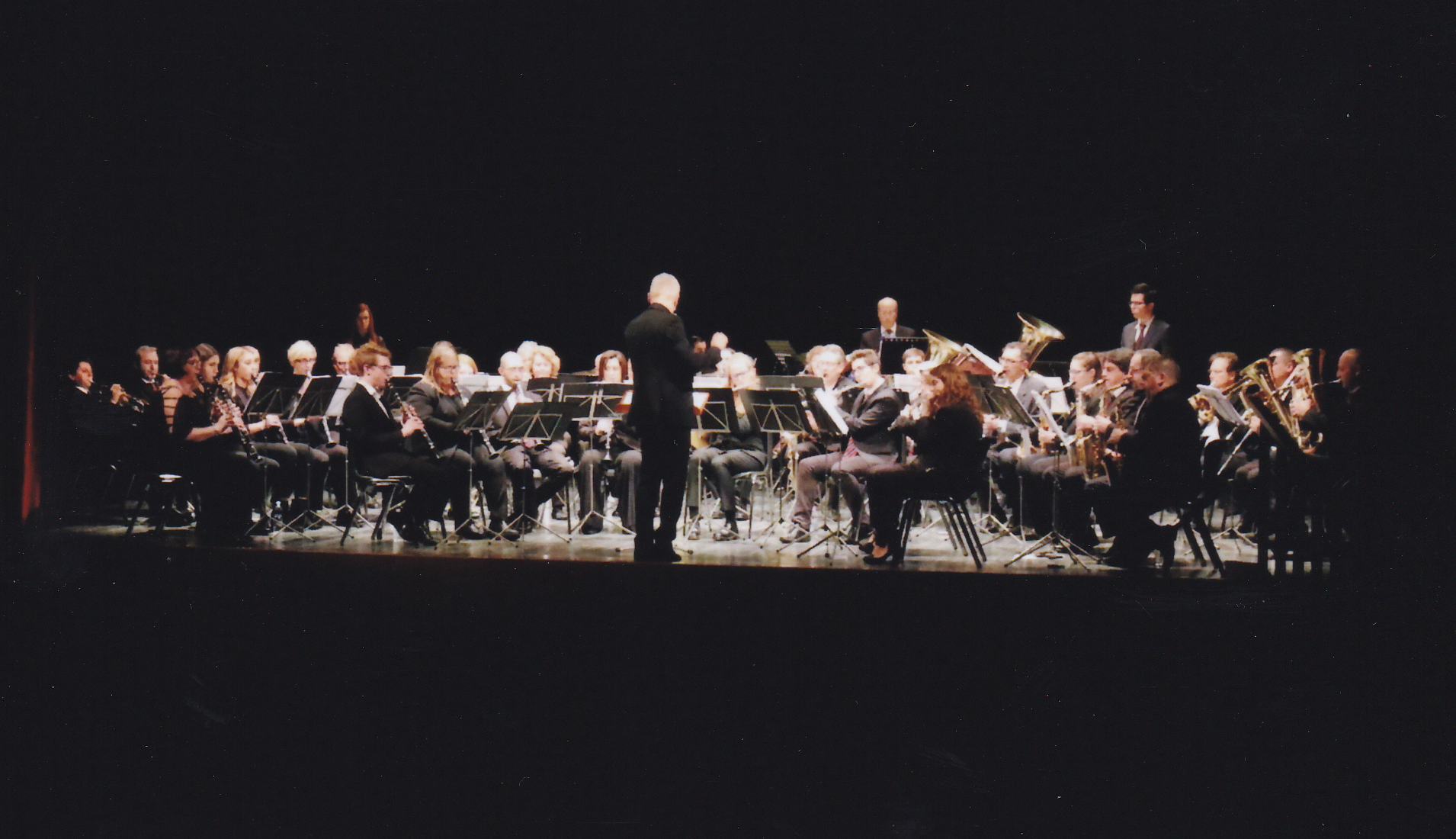 The last Christmas Concert (2019) before Covid
How things turned out from there we’ve already described in the Preface.
The stories told in books all have an ending, and the one we have recounted in these pages — spanning more than 150 years — is now drawing to a close. We were reluctant, however, to leave it without a fitting conclusion, and before publishing we decided to wait for some sign that the dreadful period we have all just lived through was beginning to move towards its end.
Touching wood, it does indeed seem that things are heading in that direction. The vaccines have arrived, and a great many people — enough to form, thankfully, a very substantial majority — have taken up the invitation to be vaccinated, even if the reasons that led them to do so may have been the most varied. Life is returning, little by little, to something resembling normality. Schools have reopened, people have gone back to their workplaces, it is possible to travel without excessive difficulty, and restaurants and other public venues have resumed operating at full capacity.
Even if everything seems to be tending back towards regularity and routine, nobody believes things will truly be as they were before. We too, in our small way, have noticed that much has changed. The pandemic has left its mark, and we are still trying to take stock of the situation and understand where we stand.
Some people are no longer among us. Others, though struck down by Covid, managed to pull through without excessive harm. Regardless of their state of health, still others decided to step back — temporarily or for good, we shall see — from their commitment to the band. The gaps are visible, even if the solid core has held: the Filarmonica has undoubtedly withstood the shock and can now count the pandemic among the hardships it has managed to overcome.
There are also more than a few positive signs. First of all, rehearsals have resumed on a regular basis — a vitally important development that allows us to reconnect, compare notes and share a very significant part of what band life is all about. Before long we shall be back rehearsing in our natural home, with heartfelt thanks to the friends who hosted us during this period. There have been a few small outings, the first rounds of applause have been earned, and plans are beginning to take shape, in the hope that they will not have to be forcibly abandoned.
The School of Music has also started up again, and new enrolments have been more than satisfactory in number. As was foreseeable and natural, there has been an influx of new members: if some have left, others have joined, the cycle has started up again and continuity is assured. Interestingly, those joining are not only students of the School and members of the Youth Band, but also adults who played elsewhere or who have picked up their instrument again after years — even decades — of inactivity.
There is also a notable number of adult enrolments in the music school itself: people who have not played for years, people who did play but wish to learn a new instrument, or people who have never played at all and would like to find out what it feels like.
This drawing closer to music (and ultimately to the Society) on the part of mature individuals is perhaps the most unexpected development of all, and one we shall need to reflect on in the near future in order to understand it, channel it, and encourage it. Perhaps it is a side effect of the pandemic: after being forced to interact only at a distance, to do things virtually, to see others through a computer screen, there has been an explosion of appetite for reality, for participation, for human interaction — and making music together is one of the finest ways to meet and fulfil that need.
This experience has certainly changed us and helped us grow. Perhaps it has also taught us something, and even if the price paid is, from every point of view, excessive, what has been gained in return is far from negligible.
In short: if the stories told in books all have an ending, the stories lived out in the daily fabric of real life go on — even if the protagonists change from time to time. And the story of our Filarmonica is no exception. The pandemic has passed, life goes on, and if until now all our attention had been devoted to the first 150 years of its history, from here on all our interest is focused on what comes … and counting.
As we send this work to press, the wish we extend to those who have read and followed us is to meet again in ten, twenty or more years’ time to tell more stories about the banda de Turiàc.